MULLALLY
Ó Maolalaidh is the original Gaelic form of the surname Mullally, a patronymic that means “descendant of Maolalaidh.” The personal name Maolalaidh is a compound of maol – denoting a bald or tonsured person, often used for monks or chieftains – and flaith, meaning “prince” or “ruler.” Consequently, the surname can be interpreted as “descendant of the bald ruler” or “descendant of the tonsured prince.”
The name was first recorded in Latinised forms such as O’Mullally, and later in the spellings Mullally and the shortened Lally. These variations were carried by emigrants to France, where the name was sometimes presented simply as Lally. The adoption of the anglicised form was common throughout the British Isles as English became the dominant language of administration and record‑keeping.
The Mullally clan originated in the pre‑10th century Old Gaelic world, belonging to the larger kinship group of the Ui Maine who held considerable sway in ancient Connacht. After the arrival of the Anglo‑Normans in 1170, the Mullallys found themselves in conflict with the de Burgo (Burke) families. As a result, many relocated northwards to the area that would become County Galway.
From the 13th to the early 17th century, members of the family rose to prominent ecclesiastical offices. Two individuals with the surname served as Archbishops of Tuam, while others held bishoprics in Clonfert and Elphin between 1211 and 1611. The earliest recorded instance of the name in documentary evidence dates to a Teag O’Mullally, Archbishop of Tuam, whose appointment is noted in medieval Irish records in 1211, during the reign of King John of England.
The name was also associated with the legendary Wild Geese, the Irish soldiers who entered foreign service after the 1691 Battle of Limerick. A notable figure was Thomas Arthur O’Mullally (1702–1766), known as Count Lally de Tolendal, who had a distinguished career in the French Army and was celebrated for his valor and patriotism.
In the 19th century, the Mullallys were part of the transatlantic diaspora. One emigrant, Watt Mullally, left Dublin aboard the “Perseverance” on 18 May 1846 to seek a new life in New York, a journey undertaken by many in response to the Great Famine.
The family coat of arms, granted by a heraldic authority, consists of a silver shield featuring three red eagles displayed. Each eagle holds a sprig of laurel in its beak, set against a background of three silver crescents. The symbolism reflects the martial prowess and moral virtues traditionally associated with the clan.
The surname is most commonly found in County Galway today, reflecting its historical roots in the western corner of Ireland. Variants such as Mally, Malay, Mallally, Malally, Mulally, and Moolally have appeared in English records, while the anglicised version Mulally and its shortened form Mullaly occur across the United Kingdom, the United States, Canada, and Australia.
Although the Mullally name has spread worldwide through migration, genealogical studies show a concentration of bearers still in Ireland, particularly in the counties of Galway and Tipperary. Records indicate that the family maintained a lineage of landholders and clergy, and members of the name have achieved notoriety in modern times in fields such as entertainment, sport, and public service.
In sum, the Mullally surname carries a rich heritage rooted in Gaelic tradition, ecclesiastical prominence, military distinction, and the enduring impact of emigration. Its evolution from Ó Maolalaidh to the contemporary spelling reflects the dynamic interplay between language, history, and identity that characterises Irish surnames.
Typical given names associated with the Mullally surname
Male
- Adam
- Anthony
- Christopher
- James
- John
- Mark
- Michael
- Patrick
- Paul
- Peter
- Philip
- Thomas
Female
- Antoinette
- Claire
- Elizabeth
- Emma
- Jacqueline
- Joanne
- Julie
- Margaret
- Maria
- Mary
- Michelle
- Nora
- Susan
Similar and related surnames
Related and similar names are generated algorithmically based on the spelling, and may not necessarily share an etymology.
How to communicate the surname Mullally in...
Braille
⠍⠥⠇⠇⠁⠇⠇⠽
Morse
--..-.-...-...-.-...-..-.--
Semaphore
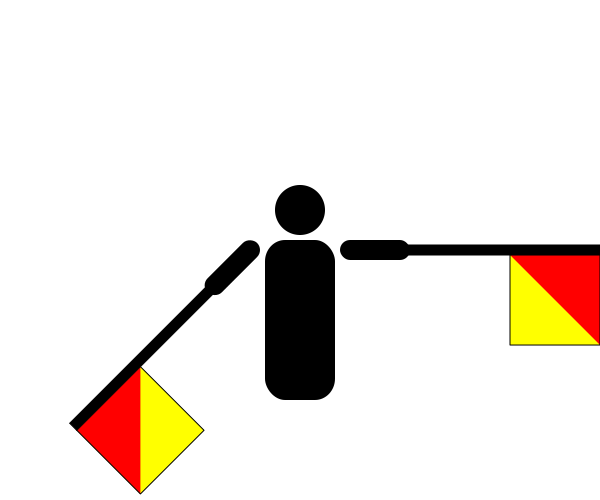


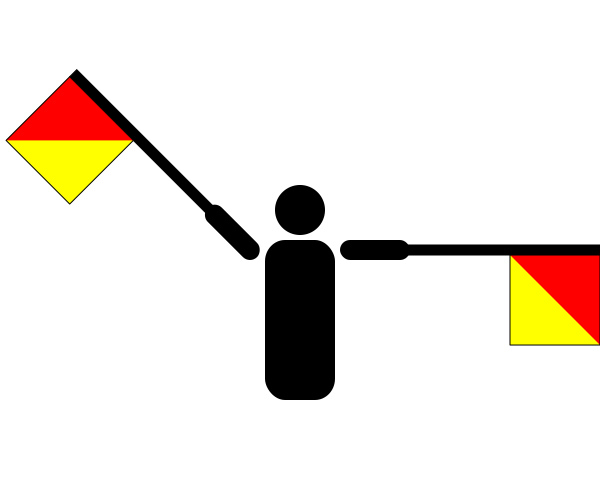
There are approximately 530 people named Mullally in the UK. That makes it one of Britain's least common surnames. Only around eight in a million people in Britain are named Mullally.
Origin: Celtic
Region of origin: British Isles
Country of origin: Ireland
Religion of origin: Christian
Language of origin: Gaelic

Famous people named Mullally
- Megan Mullally - American actress
- Sarah Mullally - Bishop of London
- Alan Mullally - Cricket player of England.
Names and descriptions courtesy of Wikipedia, and may contain errors. This is not intended to be an exhaustive list of every famous person with this name.