MUGHAL
Recorded variant spellings include Mug Hal
The surname Mughal is a term of considerable historical depth, presented in contemporary usage through at least two distinct lineages that reflect different cultural origins.
One lineage is Persian in provenance. In Persian the word Mughal denotes a Mongol and has been applied to a family name throughout the Iranian‑speaking world. This derivation is directly linked to the great Islamic dynasty that ruled the Indian subcontinent from the mid‑sixteenth century until the nineteenth century. The Mughals themselves were of Central Asian descent, tracing ancestral roots back to the great empire founded by Genghis Khan. As a result, many individuals of Indian and Pakistani ancestry who can trace their lineage to the former empire bear the name Mughal to signify that historical connection.
Within the context of the empire the surname conveys a sense of imperial heritage. The Mughal rulers were known for their synthesis of Persian administrative practices, Indian cultural traditions and the legacy of their nomadic ancestry. Therefore, the name carries with it an implicit reference to a blend of Persian, Central Asian and South Asian historical strands.
A separate and unrelated English branch of the surname exists in the British Isles. In this context the name Mughal (as well as its variants Mogg, Mugg and others) originates from a diminutive of the female given name Margaret, which historically signifies a pearl. Over centuries, the name produced a wide array of nicknames and patronymic forms such as Moggle (“little Mogg”), Muggall, Muggull, Muggle and surname derivatives like Maghull and Maghall. These forms can be traced to documented individuals in medieval and early modern England.
Early documentary evidence records the name as far back as the twelfth century. For example, Henry Mogge is listed in the Pipe Rolls of Leicester in 1195, during the reign of King Richard I. Subsequent entries include Thomas Mogg, a landowner of Tickenham recorded in 1282; Robert Mugg, who married Elin Corze at St Nicholas Acons in London on 16 January 1563; and Ales Muggle, noted at St Mary Aldermary on 13 April 1567. Further references appear in the registers of Greater London, with entries such as William Muggull at St Stephens on Coleman Street (6 September 1541) and John Maghull at St Martins in the Field, Westminster (7 April 1654).
In both traditions the surname has survived largely unchanged, each carrying distinct linguistic and cultural significance. In India and Pakistan it is predominantly associated with a historic imperial heritage, whereas in England it denotes a lineage rooted in medieval personal nomenclature. The convergence of these distinct origins makes the surname Mughal a fascinating study of how names can travel, transform and persist across continents and epochs.
Typical given names associated with the Mughal surname
Male
- Abdul
- Asif
- Imran
- Mohamed
- Mohammad
- Mohammed
- Muhammad
- Nadeem
- Osman
- Saleem
- Shahid
- Tariq
Female
- Farah
- Farzana
- Nadia
- Saima
- Saira
- Shahida
- Shamim
- Shazia
- Tahira
- Yasmin
Similar and related surnames
Related and similar names are generated algorithmically based on the spelling, and may not necessarily share an etymology.
How to communicate the surname Mughal in...
Braille
⠍⠥⠛⠓⠁⠇
Morse
--..---......-.-..
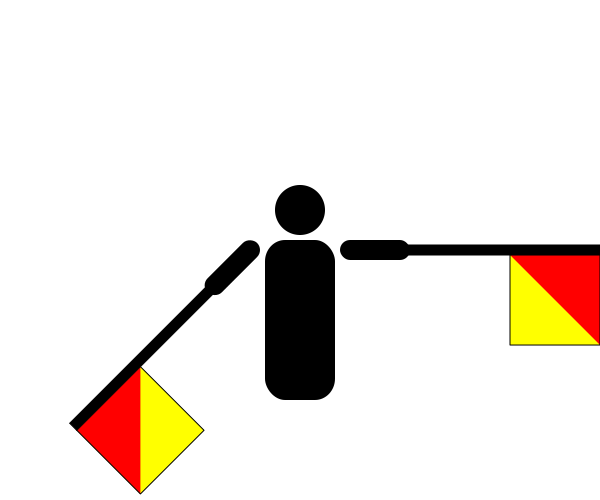
Semaphore


There are approximately 3,593 people named Mughal in the UK. That makes it roughly the 2,559th most common surname in Britain. Around 55 in a million people in Britain are named Mughal.
