MUGFORD
Origin: The surname Mugford is of English origin. It is a locational surname deriving from a place name that is no longer recorded on contemporary maps of the British Isles. The etymology is rooted in Old English, with “mucga” meaning a marsh or an area for keeping pigs, and “ford,” a shallow place in a body of water through which one can cross on foot. The combination therefore denotes a marshy place with a ford, or simply the ford where a person named Mucga crossed.
Historically, the name has been recorded in several spellings, including Mockford, Mogford, Mufford, and Mugford. Earliest documentary evidence appears in the mid‑thteenth century, with individuals such as Cryston Muforde, a christening witness at St Martins Ludgate in 1552, and William Mugford, christened at Hartland, Devonshire, in 1562. A notable medieval mention is that of Simon de Mugford in a deed dated 1260, indicating the surname’s use in the thirteenth century.
The surname is predominantly associated with the South West of England, especially the counties of Devon and Cornwall. Its persistence in these counties is linked to a long family presence in the region, exemplified by Sir John Mugford, a landowner and magistrate who was knighted by James I in 1603. The name’s frequency peaked during the mid‑nineteenth century and has since declined, rendering it relatively rare today. The current prevalence of the name is largely limited to England, with sporadic occurrences in North America, Canada, Australia, and Germany.
Variants across the British Isles and beyond include Muggford, Muggeford, Muggerford, Mugferd, Mugfurth, and Mofford in England; Minchford, Maundford, and Pincfurt in Scotland; Muggerdorf and Mugerfurt in Germany; and Mouflard in France. It is also common for the surname to appear as a secondary element in double‑barrelled names such as Mugford‑Brown, Mugford‑Smith, and Mugford‑Jones.
Because the surname originates from a now‑lost medieval settlement, its geographical reference has been identified as a possible site in Devonshire, though the exact location remains unconfirmed. The disappearance of such places is attributed to factors including the enclosure of common lands for sheep pasturage, drainage of lowlands, and the impact of plagues such as the Black Death of 1348.
In conclusion, the surname Mugford exemplifies a classic English locational name that preserves a linguistic and geographical legacy from pre‑Anglo‑Saxon times. Its rare modern distribution and rich historical record continue to be of interest to genealogical researchers and scholars of onomastics alike.
Typical given names associated with the Mugford surname
Male
- Andrew
- Dafydd
- David
- Gareth
- John
- Mark
- Michael
- Paul
- Peter
- Richard
- Simon
- Stephen
Female
- Amanda
- Caroline
- Claire
- Elizabeth
- Emily
- Hannah
- Joyce
- Karen
- Linda
- Mary
- Nicola
- Sarah
- Sharon
Similar and related surnames
Related and similar names are generated algorithmically based on the spelling, and may not necessarily share an etymology.
How to communicate the surname Mugford in...
Braille
⠍⠥⠛⠋⠕⠗⠙
Morse
--..---...-.---.-.-..
Semaphore
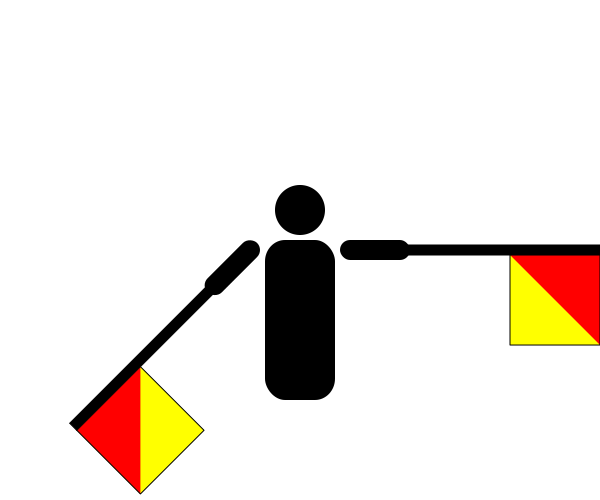


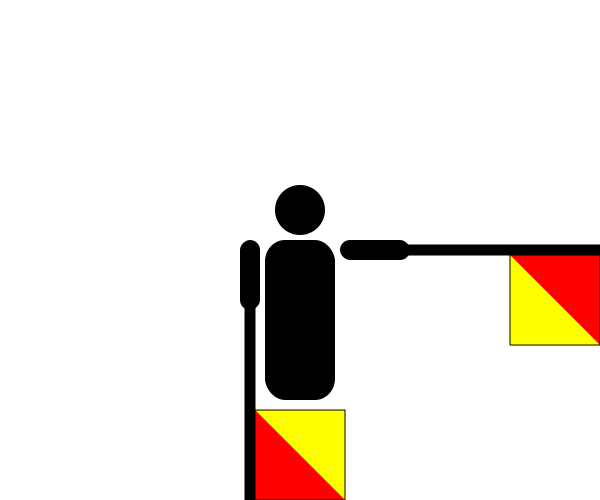
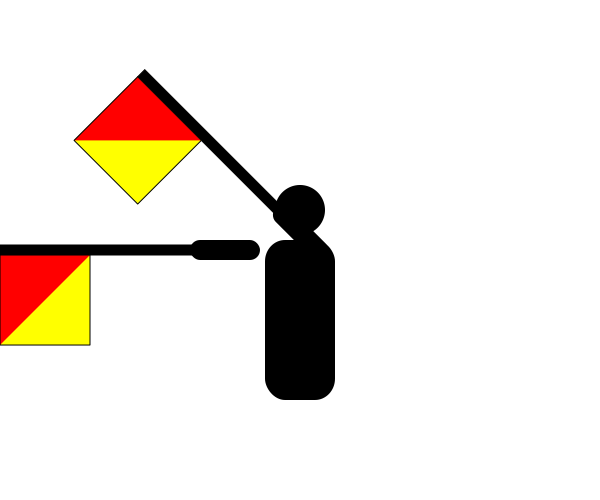
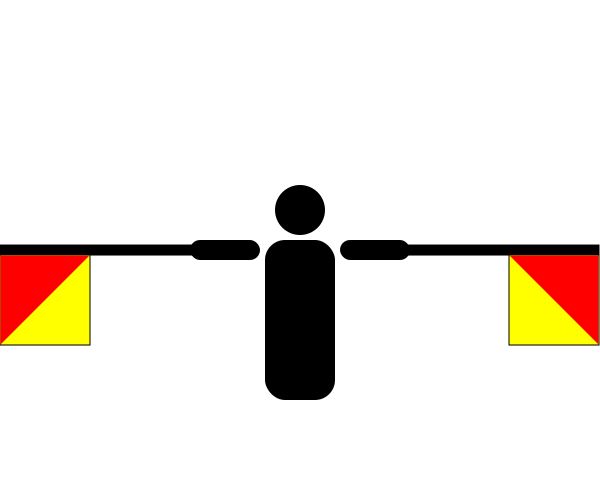

There are approximately 632 people named Mugford in the UK. That makes it one of Britain's least common surnames. Only around ten in a million people in Britain are named Mugford.
Surname type: Location or geographical feature
Origin: English
Region of origin: British Isles
Country of origin: England
Religion of origin: Christian
Language of origin: English
