MUCK
Muck is a surname of German origin, first documented in the early thirteenth century. The name derives from the Middle High German word mucke, which translates as ‘midge’, ‘mosquito’ or, more figuratively, ‘fly’. The use of the word as a byname reflects a descriptive quality attributed to a person rather than a geographical location.
The surname is classically understood as a nickname. It was applied to individuals who were notably small in stature or, alternatively, to those who displayed a restless or energetic manner, resembling the quick movements of a fly. The appellation therefore recognises either a physical attribute or a personality trait of the original bearer.
Another hypothesis concerns a possible locational origin. The name might have been taken by a person who originated from a place called Mucke or a similarly named locality near Ingelheim in Germany. In the absence of detailed toponymic evidence, this theory remains subordinate to the nickname explanation but provides an alternative avenue for onomastic study.
Early attestations of the name appear in parish registers and civil documents. Examples include the christening of Peter, son of Caspar Mucke, on 21 February 1564 at Altenburg in the Free State of Saxony; the marriage of Margretha Muck and Hans Donner on 5 September 1580 in Manubach, Rhineland; the christening of Christoph, son of Jakob and Hetwigis Mucke, on 3 April 1590 at St. Joannis in Breslau, Silesia; and the christening of Samwell Mucks on 9 May 1630 at St. Katherine by the Tower in London.
Armigerous families bearing the surname have been granted a coat of arms. The escutcheon is quartered; in the first and fourth quarters the field is silver and bears a black fly positioned en pal; in the second and third quarters the field is gold and displays a green tree on a terrace. The inclusion of the fly motif reinforces the symbolic link between the name and the insect described in its earliest form.
Variant spellings of the name are numerous and reflect dialectal differences and orthographic evolution. Common modern variants include Mueck, Mucke, Mucks, Muckegg, Mucke, Mück, Muick, and the anglicised forms Muckel and Muckler. The earliest recorded spelling, Haneman Mugke, dates from 1301 and is preserved in early medieval German records from the reign of Albert I, Holy Roman Emperor (1298–1308).
Geographically, the surname has a strong presence in Germany and Austria, where it remains relatively uncommon but historically established. It is also observed in other German-speaking territories such as the Czech Republic, Luxembourg, and Switzerland. Furthermore, diaspora demographics show the name in North America – both the United States and Canada – where many carriers emigrated during the nineteenth and early twentieth centuries, as well as in Brazil, Australia, and New Zealand. Sporadic occurrences in Asian countries including China and India are recorded, reflecting either migration or adoption by local families.
Despite its limited prevalence, the surname Muck exhibits a durable lineage that spans several centuries and continents. Its continuity is evident in historical documents, heraldic registrations, and modern civil records. The name’s endurance is a testament to the persistence of Germanic surnames even as bearers traverse social, geographical, and cultural boundaries.
Similar and related surnames
Related and similar names are generated algorithmically based on the spelling, and may not necessarily share an etymology.
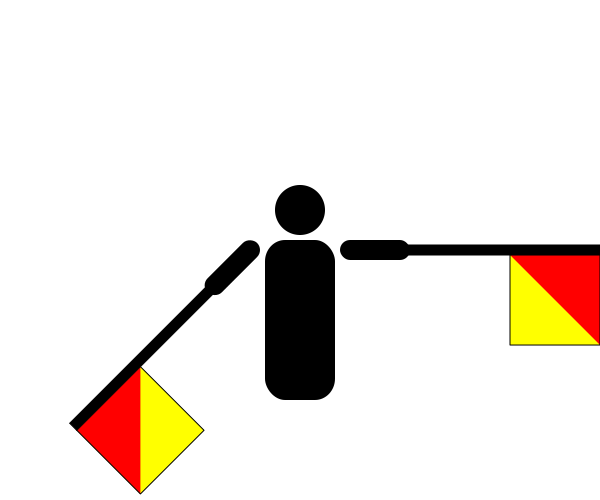
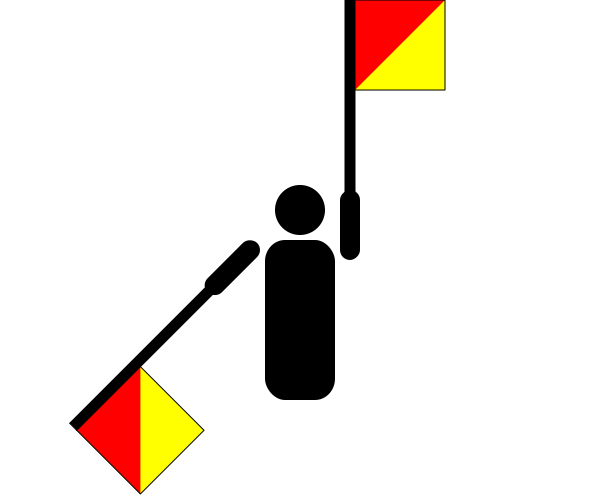
How to communicate the surname Muck in...
Braille
⠍⠥⠉⠅
Morse
--..--.-.-.-
Semaphore


Sorry, we don't have any statistics on this name. That's probably because it's very uncommon in Britain.
