MOUSLEY
Mousley is a surname of English origin, first recorded in the Domesday Book of 1086 and later in the Pipe Rolls of 1195. The name is locational, deriving from several English villages of the same spelling or similar forms, such as Moseley, Mosley, Mowsley, or Mowsly, found in the counties of Lancashire, Staffordshire, Worcestershire and Leicestershire.
In its earliest linguistic construction the surname appears to incorporate Old English elements: mus, meaning “mouse”, and leah, meaning “woodland” or “clearing”. Consequently, the original place-name would describe a clearing or woodland frequented by mice, and those who inhabited or owned such land acquired the designation Mousley as a surname. An alternative Old English derivation involves the pre‑7th century personal name Mul combined with eg, “island”, giving the meaning “Mul’s island”. Both interpretations are supported by medieval place‑name records.
The range of recorded spellings – Moseley, Mosely, Mosley, Mousley and Mowsly – reflects the fluid orthography of the Middle Ages. Historical documents include Ernold de Moseley, lord of the manor of Moseley in Lancashire during King John’s reign (1199‑1216), and later figures such as Sir Nicholas Mosley of Houghend (Lancashire), who served as Lord Mayor of London in 1422, and a descendant Sir Nicholas Mosley of the Derbyshire branch, who held the same civic office in 1599, at the close of Elizabeth I’s reign.
The name was carried beyond Britain by early emigrants, notably Joseph Moseley, who left London aboard the Bonaventure in January 1634 bound for the Virginia colony. In the centuries that followed the surname spread to North America, Australia, New Zealand and Canada, although it remains most prevalent in the English Midlands and the north‑west of England, particularly in Cheshire, Lancashire, Derbyshire, Nottinghamshire, Staffordshire, Shropshire, Herefordshire, Warwickshire and Gloucestershire. In the United States it is comparatively uncommon, but recorded most often in the central and southeastern regions since the late 19th century.
Aside from its toponymic roots, the surname has occasionally been linked to an occupational origin. The Middle English word moosely is believed to mean “of a mouse” or “remindful of mice”, which could refer to individuals who bred or kept animals associated with mice. Nonetheless, the dominant explanation for the name remains its geographical derivation rather than an occupational one.
Some contemporary scholarship notes a possible French connection, citing the town of Moulins (formerly spelled Moline) and the French word moulin for “mill”. However, the preponderance of documentary evidence supports an English origin, and any French association is considered tentative and not widely accepted among onomastic specialists.
Variations in spelling—including Mousely, Mowsly, Mowseley, Moussly, Moselle and Mossly—have emerged over the past eight centuries. These are typically viewed as regional orthographic differences rather than distinct family names. Today, Mousley continues to exist throughout the United Kingdom, with hundreds of bearers in each of the counties mentioned above, and a modest diaspora in former colonies.
Typical given names associated with the Mousley surname
Male
- Andrew
- Anthony
- Christopher
- Daniel
- David
- James
- John
- Michael
- Paul
- Peter
- Philip
- Richard
Female
- Claire
- Daphne
- Diane
- Dorothy
- Elizabeth
- Margaret
- Mary
- Nicola
- Pamela
- Patricia
- Sara
- Sarah
- Susan
Similar and related surnames
Related and similar names are generated algorithmically based on the spelling, and may not necessarily share an etymology.
How to communicate the surname Mousley in...
Braille
⠍⠕⠥⠎⠇⠑⠽
Morse
-----..-....-...-.--
Semaphore
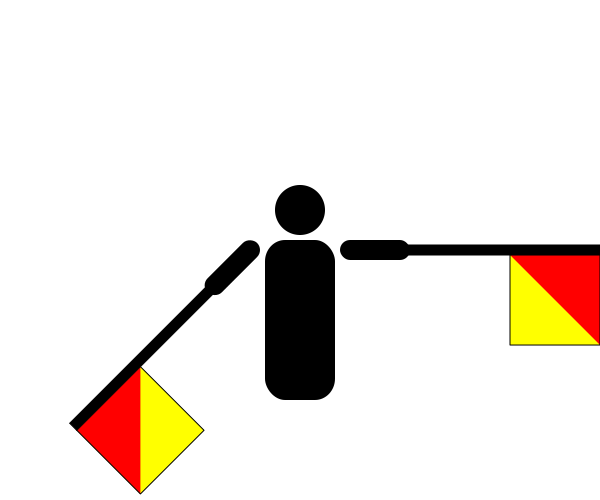
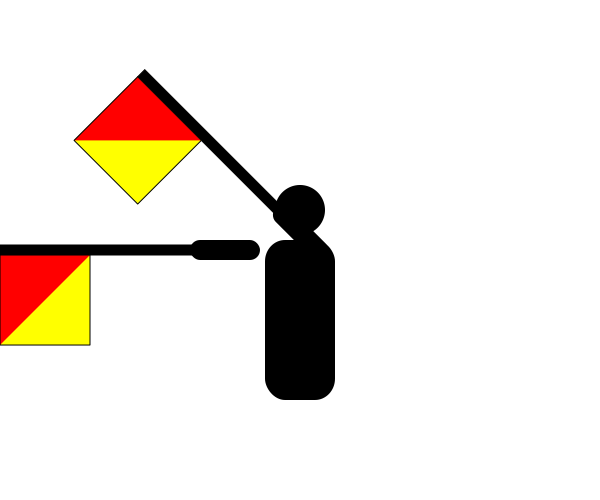


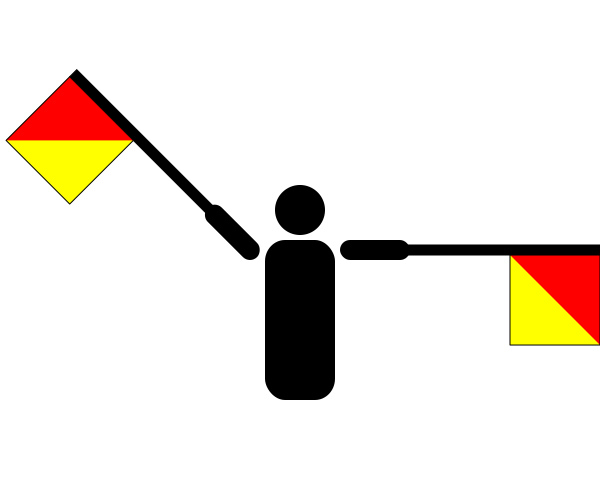
There are approximately 956 people named Mousley in the UK. That makes it roughly the 7,622nd most common surname in Britain. Around 15 in a million people in Britain are named Mousley.
Surname type: Location or geographical feature
Origin: English
Region of origin: British Isles
Country of origin: England
Religion of origin: Christian
Language of origin: English
