MORTIMER
The surname Mortimer originates in both English and Norman‑French traditions, the latter having a decisive impact upon the British Isles. The name is first recorded in the late eleventh century, when it appears in the Domesday Book of 1086 under the Latinised form de mortemer, an indication that it had already taken root in the landholding class of the newly established Norman regime.
The etymology of Mortimer is derived from the Old French personal name Mortemer, a compound of mort meaning “dead” and mer meaning “sea”. Scholars infer that the original bearer of the name may have been associated with a particular locality of the same designation in Normandy, possibly one characterised by a low‑lying, swampy landscape, in which case the literal translation “dead sea” or “still water” would be apt. The name is therefore likely to have begun as a toponymic nickname for a resident of that area before being adopted as a hereditary family name.
Roger de Mortemer, one of William the Conqueror’s commanders, is the earliest documented Anglo‑Norman holder of the name. Upon the successful subjugation of England in 1066, Roger was rewarded with extensive estates, largely within the Welsh Marches, and he subsequently established a long‑lasting noble line that would play a significant part in the history of medieval England. His descendant, Roger de Mortimer, 1st Earl of March, exerted a decisive influence in the overthrow of King Edward II in 1327 and is perhaps best remembered for his rebellion and subsequent reconciliation with the Crown.
The early medieval record contains a number of spellings that demonstrate the fluidity of orthography before the arrival of standardised spelling. Variants such as Mortimore, Mortimor, Mottmor and Mortamar are found in contemporary documents, including the Hundred Rolls of 1273 where Ralph de Mortimer of Lincoln and Hugh de Mortuomari (a Latinised form) are listed. Other medieval sources, like the Derings Roll, record that Sir Hugh de Mortimer of Richmond Castle bore a heraldic badge described as gules, two bars vair, at both the battle of Falkirk in 1298 and the siege of Carlaverock in 1300.
Despite its origins in the aristocratic strata, the surname has not remained exclusive to the nobility. Over the centuries, a wider array of individuals bearing the name – including tradespeople and entrepreneurs – has become integrated into British society. Today the name persists across the United Kingdom, ranking within the top five hundred in England and even higher, within the top two hundred, in Wales. The Office of National Statistics records the surname in the general register, indicating it remains in widespread use in contemporary Britain.
In addition to British usage, the historical migration of families bearing the name has spread the surname across the English‑speaking world. Records in the United States, Australia, Canada and New Zealand show a continued presence of individuals with the surname Mortimer. While some bear the lineage of the ancient baronial houses, others descend from less prominent branches or from unrelated families that adopted the name during later periods, taking advantage of its recognisable Norman heritage.
The array of spelling variants – such as Mottemer, Mortimour, Mottimore, Mortamara and Mortimor – reflects the historical linguistic practices of the Middle Ages, when orthographic standards were still developing. Changes in spelling could serve a variety of purposes, including a desire to reflect noble status, to adapt to local pronunciation, or in some cases to obviate persecution following the Norman Conquest. The persistence of the name in its many forms demonstrates its adaptability as well as the lasting influence of Norman France upon the cultural and linguistic landscape of the British Isles.
Overall, the surname Mortimer provides a window into the complex interweaving of Norman conquest, medieval feudalism and contemporary societal structures. Its name, derived from a literal description of a geographical feature in Normandy, has travelled across centuries and continents to become a familiar element of modern English surnames.
Typical given names associated with the Mortimer surname
Male
- Andrew
- Christopher
- David
- James
- John
- Michael
- Paul
- Richard
- Robert
- Stephen
Female
- Christine
- Elizabeth
- Helen
- Julie
- Karen
- Linda
- Margaret
- Mary
- Nicola
- Patricia
- Rachel
- Sarah
- Susan
Similar and related surnames
Related and similar names are generated algorithmically based on the spelling, and may not necessarily share an etymology.
How to communicate the surname Mortimer in...
Braille
⠍⠕⠗⠞⠊⠍⠑⠗
Morse
-----.-.-..--..-.
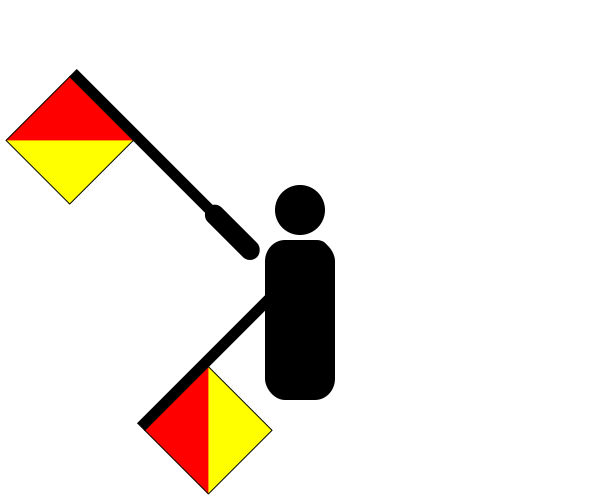
Semaphore
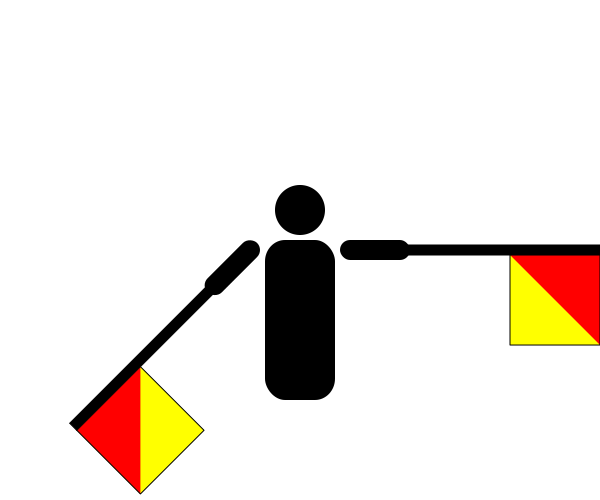
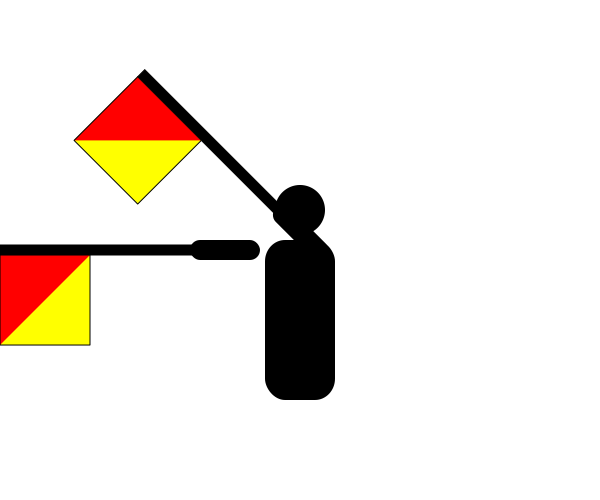
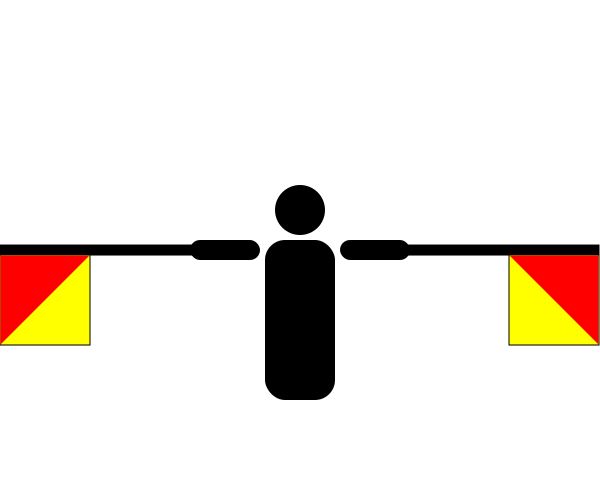
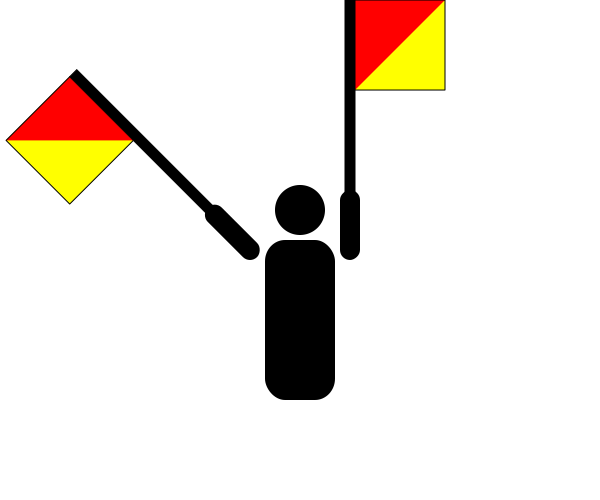

There are approximately 11,919 people named Mortimer in the UK. That makes it the 764th most common surname in Britain. Around 183 in a million people in Britain are named Mortimer.
Origin: English
Region of origin: British Isles
Country of origin: England
Religion of origin: Christian
Language of origin: English

Famous people named Mortimer
- Emily Mortimer - Actress and screenwriter
- Bob Mortimer - Comedian and actor
- John Mortimer - Barrister, dramatist, screenwriter and author (1923 to 2009)
- Tony Mortimer - Singer-songwriter, musician, record producer
- Anne Mortimer - Countess (1390 to 1411)
- Roger Mortimer, 1st Earl of March - Nobleman and rebel (1287 to 1330)
- Caroline Mortimer - Actress
- Johnnie Mortimer - Television scriptwriter (1931 to 1992)
- Penelope Mortimer - Journalist, biographer and novelist (1918 to 1999)
- Dennis Mortimer - Football player and manager
- Edmund Mortimer - Rebel with Welsh leader Owain Glyndŵr (1376 to 1)
- Edward Mortimer - Journalist
- Harry Mortimer - Composer (1902 to 1992)
- Paul Mortimer - Football player
- Gary Mortimer - Hot Air Balloon Pilot and Editor of sUAS News
- John Hamilton Mortimer - Artist (1740 to 1779)
- Clifford H. Mortimer - Ecologist (1911 to 2010)
- Jim Mortimer - Politician (1921 to 2013)
- Johnny Mortimer - Football player (1923 to 2013)
- Harry Mortimer - Cricketer (1872 to 1953)
Names and descriptions courtesy of Wikipedia, and may contain errors. This is not intended to be an exhaustive list of every famous person with this name.