MONK
Monk is a surname of English origin, found predominantly in the British Isles. The name is classified as a status name, reflecting an association with a religious community rather than a particular occupation or location.
The etymology of Monk traces back to the Old English word munuc, which itself derives from the Latin monachus. Both terms mean “monk” and refer to an individual who lives in a monastery as a member of a religious order.
In the early medieval period the name was typically used as an occupational or descriptive label. It was given either to a servant or tenant of a monastery—someone who worked within the institution but was not a monk—or to a person who was nicknamed for his monk‑like demeanor, modesty or ascetic practices. In some instances it was applied to actors who portrayed monks in medieval mystery plays.
Early documentary evidence records the surname in various spellings. One of the earliest known uses is Aylric Munec in the Anglo‑Saxon Wills register dated around 1045, during the reign of Edward the Confessor (1042–1066). Later entries include Peter le Monek in the writs of Parliament (1296–1300) and Johannes Mounke in the Poll Tax records for Yorkshire (1379). In the 20th century the spelling was varied further, with forms such as Monck, Monick, Munck and Munk.
The surname also appears in Irish records, where it has been anglicised as Minogue and Monaghan. In contemporary usage, variants such as Monks and Monksman exist, though the single‑word Monk remains the most common form.
Distribution data show that Monk is most frequently found in England and Wales, ranking as the 1,336th most common surname in the United Kingdom. It is also present in Scotland, Ireland, Canada, Australia and New Zealand, though it is comparatively rare in the United States, where it ranks around 4,007th in frequency.
Prominent individuals who bore the surname include James Henry Monk (1789–1856), who served as Bishop of Gloucester and Bristol from 1850, and William Henry Monk (1823–1889), noted composer and professor of music at King’s College, London. These figures illustrate the surname’s association with religious and artistic endeavours.
In summary, the surname Monk originated in the Anglo‑Saxon period as a descriptor for those connected, directly or indirectly, to monastic life. Its continued use across centuries and across English‑speaking countries underscores its enduring historical significance.
Typical given names associated with the Monk surname
Male
- Andrew
- Anthony
- Christopher
- David
- John
- Michael
- Paul
- Peter
- Richard
- Robert
- Stephen
Female
- Claire
- Elizabeth
- Helen
- Linda
- Margaret
- Mary
- Patricia
- Rebecca
- Sarah
- Susan
- Victoria
Similar and related surnames
Related and similar names are generated algorithmically based on the spelling, and may not necessarily share an etymology.
How to communicate the surname Monk in...
Braille
⠍⠕⠝⠅
Morse
------.-.-
Semaphore
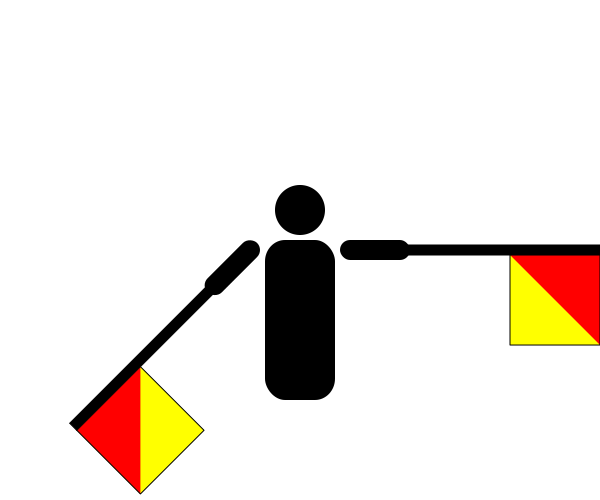
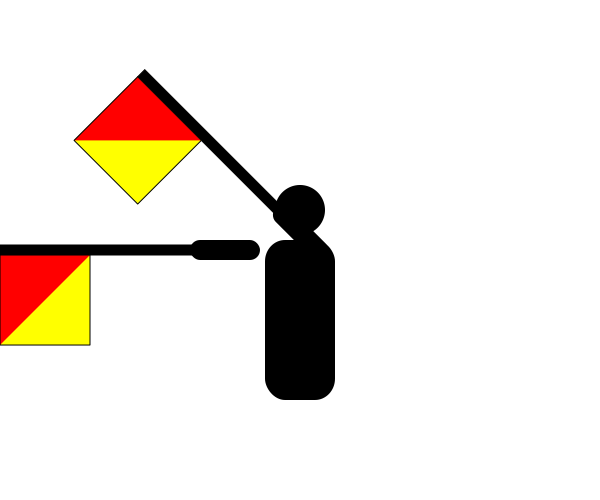
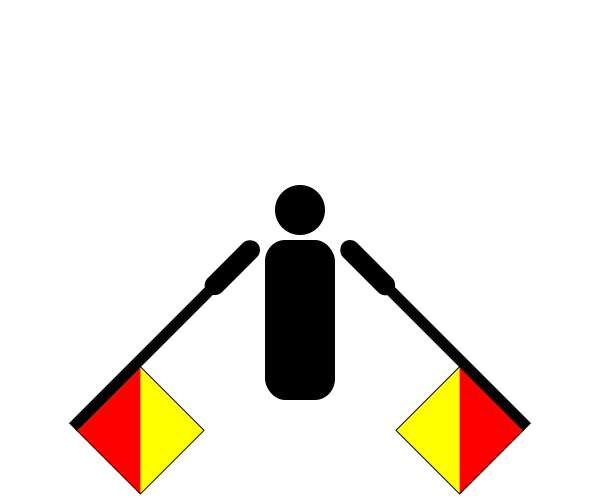
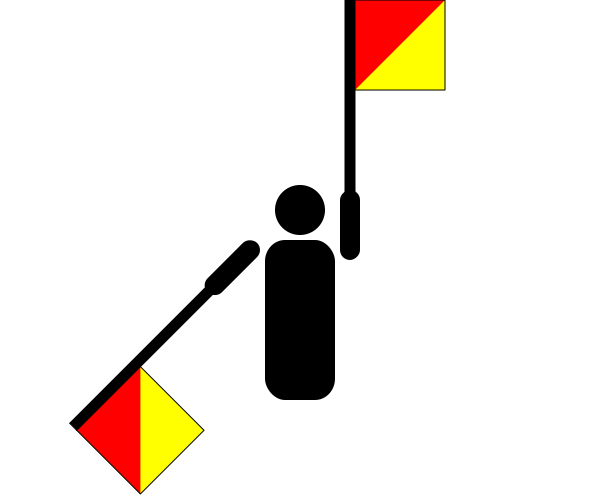
There are approximately 10,647 people named Monk in the UK. That makes it the 865th most common surname in Britain. Around 163 in a million people in Britain are named Monk.
Surname type: Status name
Origin: English
Region of origin: British Isles
Country of origin: England
Religion of origin: Christian
Language of origin: English

Famous people named Monk
- Garry Monk - Football player
- Sophie Monk - Australian actor and singer
- Ray Monk - Philosopher
- William Henry Monk - Organist, church musician, and music editor (1823 to 1889)
- Frank Monk - Football player (1886 to 1962)
- Thomas Monk - Rower (1904 to 1979)
- Arron Monk - Darts player
- Colin Monk - Darts player
- Chris Monk - Sprinter
Names and descriptions courtesy of Wikipedia, and may contain errors. This is not intended to be an exhaustive list of every famous person with this name.