MONIER
Monier is a surname of French origin, historically associated with several occupational and habitational meanings. The most common derivation traces the name to the French word monier, meaning mason or builder. Consequently the name was frequently adopted by individuals engaged in masonry or bricklaying, and it persisted as a classic occupational surname through the centuries.
Another plausible root of the name appears in the French word moine, which translates as monk. In some cases, Monier was employed as a nickname for a person who displayed a monk‑like appearance or demeanour, or for someone who worked within a monastic setting. This religious connotation is found primarily in regions of southeastern France, particularly the Rhône Valley, where the surname remains relatively common.
The name has been recorded in a variety of forms, including Le Monnier, Lemonnier, Le Mounier, Le Munyer, Monier, Monniere, and Monerie. It entered English records in the 17th century, largely through Huguenot refugees who fled France following the revocation of the Edict of Nantes in 1685. Early English paperwork cites individuals such as Frances Le Mounier, who married Charles Delanny at St Mary Magdalene in London on 31 May 1699, and Marthe, daughter of Jacques and Judith Lemonnier, who was recorded at the French Huguenot church of St Jean in Spitalfields on 19 October 1715.
In addition to the mason‑based meaning, some early English sources attach the name Monier to the occupation of money changer or banker. This interpretation is supported by the presence of numerous Huguenots in England who had professional expertise in banking, textiles, steelmaking, and precious metals. Their migration is regarded as an important factor in the development of Britain’s financial and industrial prowess.
Statistical records show that in France Monier ranks as the 91st most common surname, with its highest concentration in the Rhône Valley. In Switzerland, court documents dating from the 1500s record the name, particularly in the mountainous canton of Valais near the Italian border. In the United States the surname remains uncommon; census data identify fewer than 200 bearers of the name, with records dating back only to the early 1700s.
Beyond Europe, Monier has also been found in Australia, Algeria, South Africa, New Zealand, Canada and other Commonwealth countries. In most of these regions, individuals bearing the name appear to have migrated from France or Switzerland during the 1700s or early 1800s, often as part of Huguenot or later Protestant movements.
Multiple variations of the surname exist across languages and regions, reflecting the migrations of its bearers and the linguistic adaptations of each country. Among English‑speaking contexts the name has appeared as Mounoir, Muenier, Muenir, Muenoir, Monaher, Monnoir, Moneyre, and Moneyre. In French and French‑influenced contexts common forms include Monier, Moineau, and Desmoines. Italian variants such as Manieri and Monari have also been documented, while Spanish forms include Moneda and Montesino.
In summary, the Monier surname illustrates a convergence of occupational, religious, and geographical factors. Whether derived from the craft of masonry, the habit of monastic life, or the function of money handling, it has been carried by a diverse array of individuals across several continents for more than three centuries.
Similar and related surnames
Related and similar names are generated algorithmically based on the spelling, and may not necessarily share an etymology.
How to communicate the surname Monier in...
Braille
⠍⠕⠝⠊⠑⠗
Morse
------.....-.
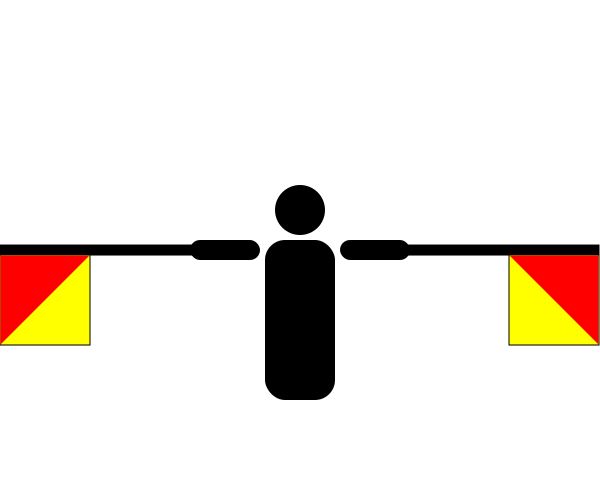
Semaphore
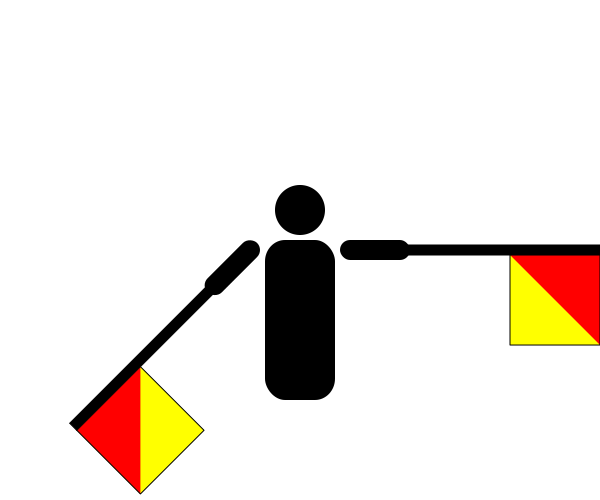
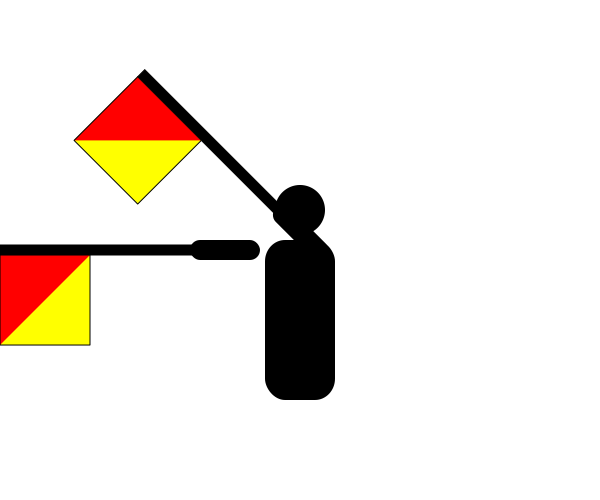
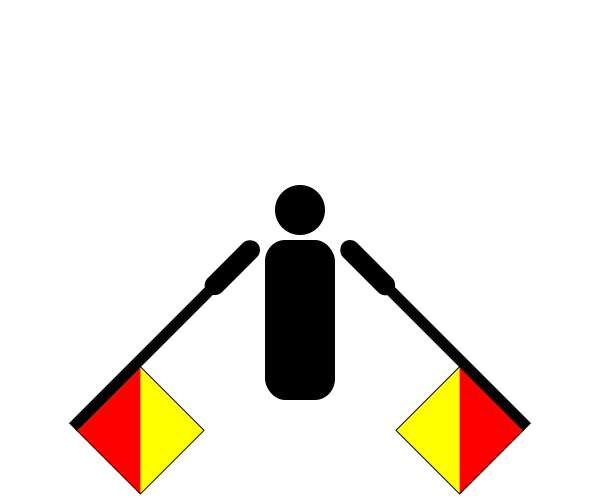
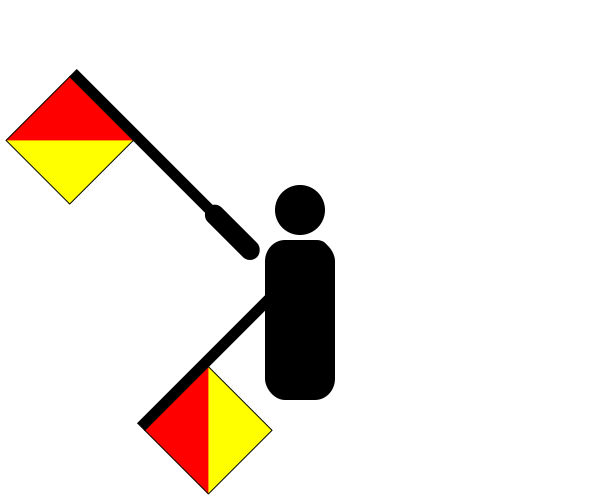

Sorry, we don't have any statistics on this name. That's probably because it's very uncommon in Britain.