MILLWARD
Millward is an English surname of Anglo‑Saxon origin that can be traced back to the late thirteenth century. It is recorded in the localities of Worcestershire and Shropshire, and its early attestations appear in the Hundred Rolls of Huntingdonshire during the reign of King Edward I.
Its etymology derives from the Old English words mylen, meaning “mill”, and weard, meaning “guardian” or “keeper”. Consequently, the surname originally signified a person who served as the guard of a mill, a role of great importance within medieval communities where the mill was central to the local economy.
Throughout the Middle Ages the spelling of Millward varied extensively. Alternate forms recorded include Milward, Millard, Millyard, Mellard, Mylward, and Mylleward, reflecting regional dialects and the lack of standardised spelling at the time. The earliest extant instance bearing a variant of the name is that of John le Milleward in 1279, as noted in the Hundred Rolls. Subsequent early records comprise Cecilia le Mulvard in the register of Early London Personal Names in 1286 and Richard Meleward in the Subsidy Tax Rolls of Sussex in 1296.
The surname’s occupational nature is further evidenced by early church entries. For example, William Milward married Elizabeth Peters on 28 April 1572 at St. Lawrence Poutney, and Richard Millward welcomed Margerie Heames into his household on 24 March 1600 at St. Martin Orgar, both within the city of London. In the early eighteenth century, Edward Milward (1712‑1757) distinguished himself as a physician and authored a treatise on gangrene, demonstrating that holders of the name regarded beyond the mill itself.
In addition to its English origins, the spelling of Millward has occasionally been altered to accommodate other linguistic contexts. Variants such as Miller, Millman and Milliner share a common occupational root, while the German surname Müller is occasionally noted as an international analogue.
In the contemporary era, the surname remains relatively common in the regions where it first appeared, especially Worcestershire and Shropshire. It can also be found in the larger English‑speaking world, including the United States, Canada and Australia, a reflection of the dispersion of English emigrants during the colonial period. Nonetheless, its frequency abroad is comparatively lower than within England.
In sum, Millward offers a clear example of an occupational surname that has survived through persistent use, regional variation and the gradual stabilisation of spelling in modern times.
Typical given names associated with the Millward surname
Male
- Andrew
- Anthony
- Christopher
- David
- John
- Mark
- Michael
- Paul
- Robert
- Stephen
Female
- Deborah
- Elizabeth
- Emma
- Helen
- Jane
- Karen
- Lisa
- Margaret
- Mary
- Patricia
- Sarah
- Susan
Similar and related surnames
Related and similar names are generated algorithmically based on the spelling, and may not necessarily share an etymology.
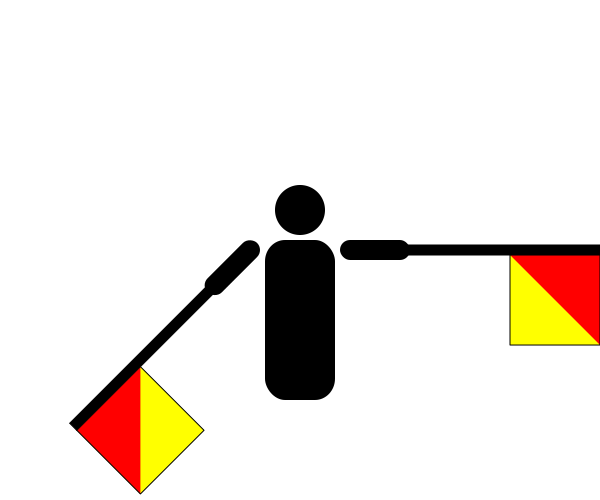
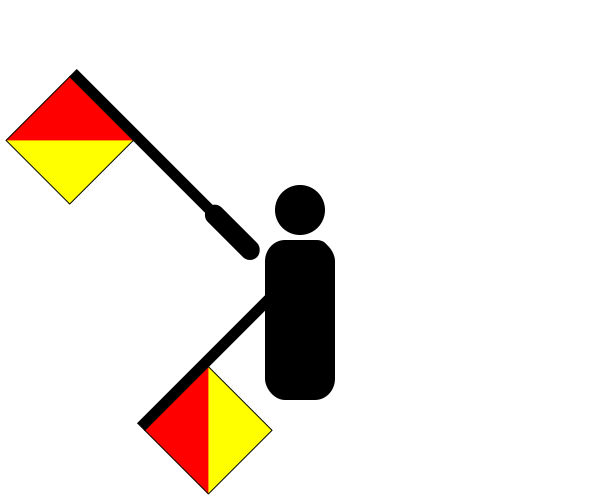
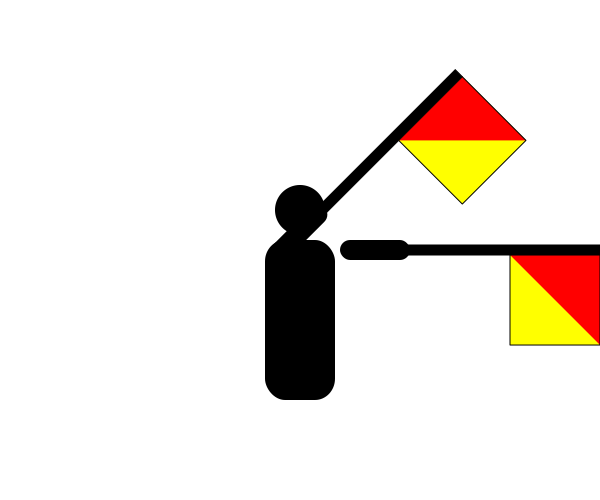
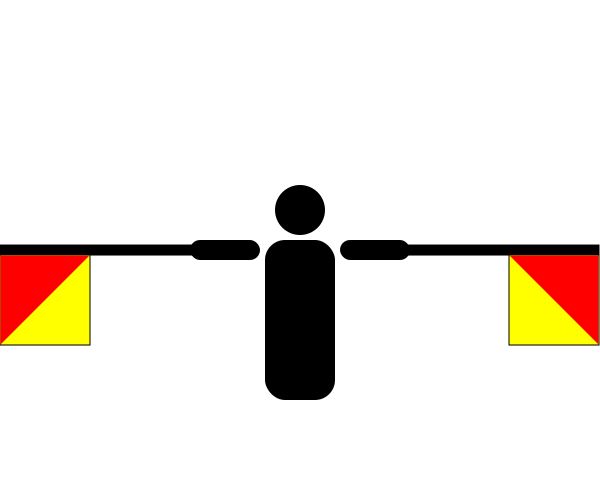
How to communicate the surname Millward in...
Braille
⠍⠊⠇⠇⠺⠁⠗⠙
Morse
--...-...-...--.-.-.-..
Semaphore



Did you know?
According to a survey carried out by Democracy Club, politicians and candidates with the surname Millward are most likely to say that their favourite biscuit is a Chocolate Hobnob.
There are approximately 9,078 people named Millward in the UK. That makes it roughly the 1,039th most common surname in Britain. Around 139 in a million people in Britain are named Millward.
Surname type: Occupational name
Origin: English
Region of origin: British Isles
Country of origin: England
Religion of origin: Christian
Language of origin: English

Famous people named Millward
- Perry Millward - Actor
- Roger Millward - Rugby league football player and coach (1947 to 2016)
- Doug Millward - Football player (1931 to 2000)
- Andrew Millward - Welsh rugby union player
Names and descriptions courtesy of Wikipedia, and may contain errors. This is not intended to be an exhaustive list of every famous person with this name.