MILLIGAN
Milligan is a surname of Celtic heritage, prominently found within the British Isles. Its linguistic roots lie in Gaelic, with a substantial presence in Scotland and Ireland, particularly in the province of Ulster.
In Gaelic, the name originally appears as Mac Gille Fhaolain—literally, “son of the servant of Saint Fillan.” Saint Fillan was a 7th‑century Irish monk celebrated for his healing prayers. The patronymic thus conveys a sense of devotion to the saint and suggests that early bearers of the name may have had a religious vocation or close allegiance to his cult.
Another early form of the surname derives from the pre‑10th‑century Gaelic O Maolagain. The personal element Maolagan is composed of the diminutive mael, meaning “bald,” and likely served as an affectionate nickname for a monk or disciple who had shaved his head as a mark of piety. The applied prefix O linked the bearer to a wider kin group, yielding a meaning of “descendant of Maolagan.”
Over time the name has been recorded under a number of spellings, including O’Milligan, Miligan, Milliken, Milikin, Mulligan, Mullikin and Millican. In the early modern period, some forms were documented within Scotland and in Ireland, most notably in the 13th‑century accounts of the city of Dublin and the county records of Ulster. For example, a 1264 roster shows a household named Molior Omolegane, a spelling that reflects an early anglicisation of the Gaelic root.
Historical documents provide further evidence of the surname’s endurance. Entries in the Scottish register "Black's Surnames of Scotland" record individuals such as Thomas Ameligane in 1477 and Thomas Amuligane in 1485. Other notable trail‑blazers include Andrew Milligan, who in 1697 married Sarah Planere at St. Paul’s Church, Covent Garden, and Richard Alfred Milliken (1767–1815), a Cork attorney who authored the literary work The Groves of Blarney. The surname is also associated with literary history through the poetess Alice Milligan, born in Omagh and deceased in 1953, who gained renown within the Irish literary movement.
In the 20th century, the name was predominantly recorded in Ulster and, to a lesser extent, in County Sligo. Its persistence across centuries, coupled with the variety of recorded forms, attests to a robust family heritage that intertwines religious devotion, Gaelic linguistic tradition, and the migration patterns of Scotland and Ireland.
Typical given names associated with the Milligan surname
Male
- Andrew
- David
- James
- John
- Paul
- Peter
- Robert
- Stephen
- Thomas
- William
Female
- Alison
- Ann
- Anne
- Caroline
- Catherine
- Elizabeth
- Helen
- Karen
- Margaret
- Mary
- Patricia
- Sarah
- Susan
Similar and related surnames
Related and similar names are generated algorithmically based on the spelling, and may not necessarily share an etymology.
How to communicate the surname Milligan in...
Braille
⠍⠊⠇⠇⠊⠛⠁⠝
Morse
--...-...-....--..--.
Semaphore
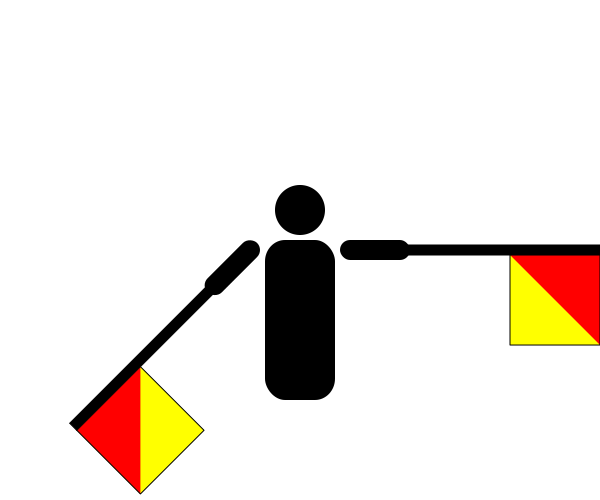
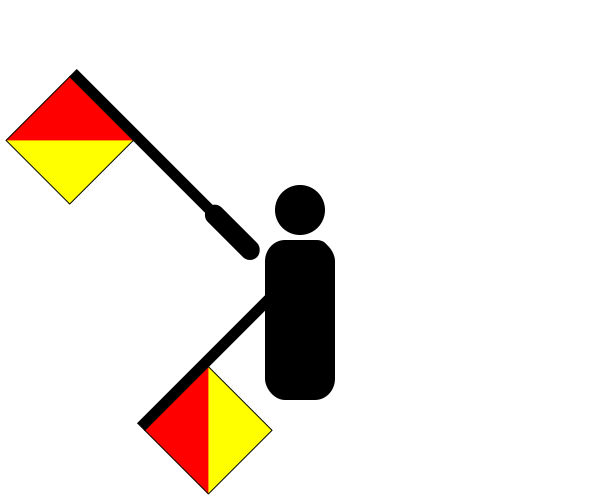


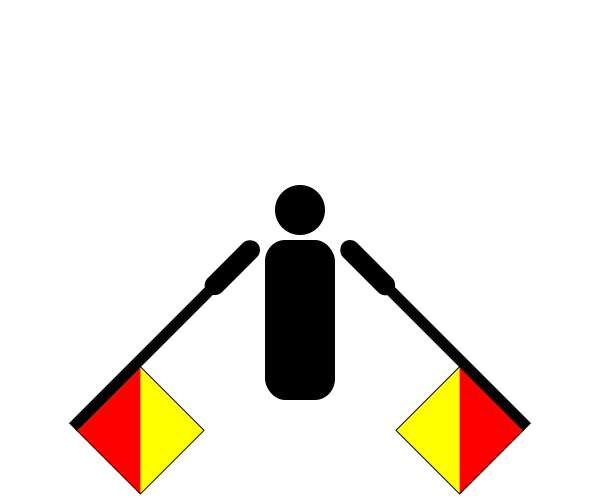
There are approximately 8,821 people named Milligan in the UK. That makes it roughly the 1,075th most common surname in Britain. Around 135 in a million people in Britain are named Milligan.
Origin: Celtic
Region of origin: British Isles
Country of origin: Scotland
Religion of origin: Christian
Language of origin: Gaelic

Famous people named Milligan
- Stephen Milligan - Politician (1948 to 1994)
- Dustin Milligan - Canadian actor
- Peter Milligan - Writer
- Jamie Milligan - Football player
- Mike Milligan - Irish football player
- William Milligan - Theologian (1821 to 1893)
- Chic Milligan - Scottish football player
- William Milligan, Lord Milligan - Scottish judge and politician (1898 to 1975)
- Henry Milligan - American boxer
- Helen Milligan - Scottish/New Zealand chess master
- Frank Milligan - Test and County cricketer (1870 to 1900)
- Rob Milligan - Rugby union player
- Tommy Milligan - Scottish boxer (1904 to 1970)
- Robert Milligan - Politician (1786 to 1862)
Names and descriptions courtesy of Wikipedia, and may contain errors. This is not intended to be an exhaustive list of every famous person with this name.