MAUS
Origin of the surname Maus can be traced to Germany. It stems from the Middle High German word mus, which translates as “mouse”. The name was traditionally adopted as a nickname for a person who displayed characteristics resembling those of a mouse, whether smallness, quickness or, by some accounts, timidity.
Another plausible derivation is an occupational surname, applied to someone who dealt with mice—either by catching them or by controlling infestations. Both explanations reflect common practices in medieval Europe for the creation of family names.
Records show the earliest known instance of the name in the city of Worms in 1257, where a man named Gerlacus Mus appears in the city charters. A further early appearance occurs in 1268 in Sangerhausen, where Godwinus Mauser is documented in the local registers.
The surname has manifested itself in a variety of forms and spelling variations. These include Maus, Mauser, Meuser, the diminutives Mausel, Meisel and Meissel, as well as the English Mouse and Mouser; Dutch and Flemish variants such as Muis and De Muys; French Mousse; and Polish Myska, Myszkor, Myszkowski; among others. These variations illustrate the spread of the name through different linguistic and cultural contexts while retaining its original semantic core.
In contemporary usage the surname remains most prevalent in Germany, reflecting its origins and the concentration of German‑speaking communities. It is also found among descendants of German emigrants in the United States, Canada and other parts of Europe, where historical migration and cultural assimilation have reshaped its distribution. The persistence of the name in these regions underscores the enduring nature of surnames that arise from simple linguistic roots.
It is noteworthy that the surname Maus has been associated with the renowned Mauser rifle—a weapon of great distinction in the first and second World Wars. This connection, while not directly tied to the personal histories of individuals bearing the name, has contributed to the wider visibility of the surname in historical and cultural records.
Although the literal meaning of the surname may appear modest, bearers of the name have made significant contributions across a range of fields over the centuries. Their achievements demonstrate how a surname of humble origin can nevertheless be linked with notable activity within society.
The continued use of Maus throughout the modern era indicates a lasting respect for the historic identity embedded in the name, suggesting that it will likely remain part of the genealogical landscape for many more generations.
Similar and related surnames
Related and similar names are generated algorithmically based on the spelling, and may not necessarily share an etymology.
How to communicate the surname Maus in...
Braille
⠍⠁⠥⠎
Morse
--.-..-...
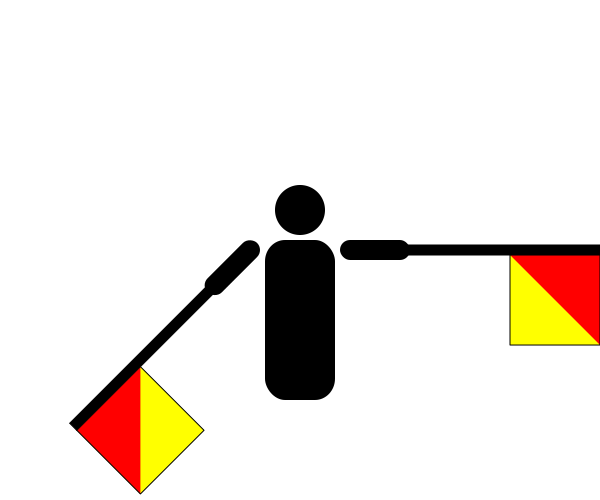
Semaphore


There are approximately 23 people named Maus in the UK. That makes it one of Britain's least common surnames. Fewer than one in a million people in Britain are named Maus.
Region of origin: Europe
Country of origin: Germany
Language of origin: German
