MASH
Mash is an English surname whose origin lies in the British Isles, particularly in England where it has been recorded since the Middle Ages. The name is historically linked with the English language and Christian religious contexts, as reflected in early parish and tax records.
The most widely accepted derivation of Mash views it as a topographic surname. It is believed to have arisen from the Old English word mæsc or maesce, both meaning a marsh, swamp or fen. Consequently, the surname originally described a person who lived near such a wetland feature. This interpretation is supported by the parallel use of the older form mersc from pre‑7th‑century Old English.
Mash is often considered a variant spelling of Marsh, a surname with the same geographic connotation. The two names were historically interchangeable in spelling, as demonstrated by medieval records such as the 1524 Suffolk Subsidy Rolls which feature an early spelling of the family name as Robert Masshe. In British orthography, the difference between the two forms was frequently driven by spelling conventions of the period rather than by distinct linguistic origins.
Occasionally, scholarly references have suggested a Hebrew connection, noting that the name Mash appears in the biblical genealogy in Genesis (chapter 10, verse 23) as part of the list of the sons of Aram. However, this reference is limited to a single text and is not generally considered a primary source for the English surname’s development.
Geographically, Mash is most common in the southern counties of England, especially in Hampshire, Wiltshire, Dorset, Somerset, Gloucestershire, Oxfordshire and Devon. It is also found more widely across the English Midlands, London and in regions where English emigrants settled, such as the United States, Canada, Australia, New Zealand, South Africa and the Caribbean.
Early records show that the surname appeared in the 13th century as an identification of individuals by their fathers’ names, following the patronymic tradition. Subsequent centuries saw the surname diversify in spelling, with variations including Mashe, Mashes and others noted in regional documents. Migration and regional dialects further contributed to these spelling differences over time.
In contemporary usage, Mash remains one of the more common surnames in England and among English‑speaking communities worldwide. Its prevalence reflects the continuity of a name that began as a simple geographic marker and has persisted through centuries of linguistic change and human mobility.
Typical given names associated with the Mash surname
Male
- Alan
- Andrew
- Christopher
- Clive
- David
- James
- John
- Julian
- Michael
- Peter
- Richard
- Robert
Female
- Camilla
- Gemma
- Helen
- Iwona
- Jean
- Joan
- Julie
- Katie
- Laura
- Lorraine
- Nicola
- Patricia
- Samantha
- Sarah
- Susan
Similar and related surnames
- Maach
- Maachi
- Maasch
- Maass
- Maasz
- Mach
- Macha
- Mache
- Machee
- Machi
- Machia
- Machie
- Macho
- Machu
- Macia
- Maese
- Maesh
- Mahesh
- Maich
- Maicha
- Maisch
- Maise
- Maish
- Maisha
- Maiss
- Maocha
- March
- Marsh
- Mas
- Masa
- Masch
- Maschi
- Maschke
- Mase
- Masha
- Mashal
- Masham
- Mashar
- Mashat
- Mashaw
- Mashel
- Mashen
- Masher
- Mashet
- Mashew
- Mashi
- Mashiah
- Mashin
- Mashis
- Masho
- Mashon
- Mashru
- Mashta
- Mashuk
- Masi
- Masih
- Mask
- Maso
- Mass
- Masse
- Masu
- Masy
- Match
- Matcha
- Mauch
- Mayse
- Maysh
- Mchee
- Meach
- Meache
- Meash
- Measho
- Mech
- Mecha
- Mechi
- Mechie
- Mecia
- Meech
- Meechie
- Meisch
- Meish
- Mesch
- Mesh
- Meshe
- Meshi
- Miach
- Miachi
- Mich
- Micha
- Michau
- Miche
- Micheau
- Michi
- Michia
- Michie
- Michou
- Miech
- Miechie
- Miesch
- Mish
- Mishio
- Mitch
- Mitche
- Mitchie
- Moch
- Mocha
- Mochi
- Mocho
- Mosh
- Mosha
- Moshe
- Moshi
- Motch
- Mouch
- Moush
- Much
- Mucha
- Muche
- Muchie
- Mucho
- Muich
- Mush
- Musha
- Mushi
- Mutch
Related and similar names are generated algorithmically based on the spelling, and may not necessarily share an etymology.
How to communicate the surname Mash in...
Braille
⠍⠁⠎⠓
Morse
--.-.......
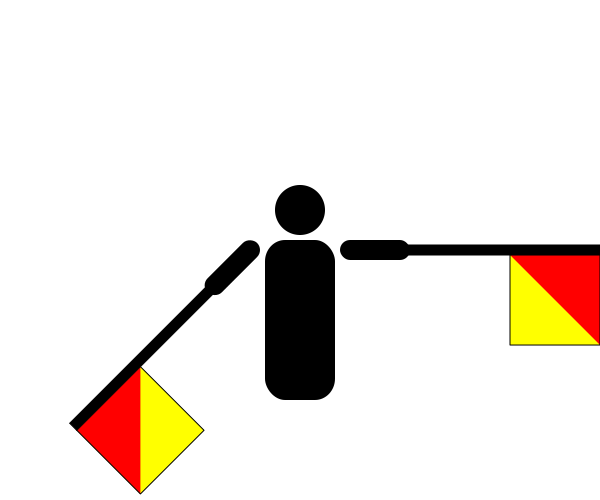
Semaphore


There are approximately 781 people named Mash in the UK. That makes it roughly the 8,945th most common surname in Britain. Around 12 in a million people in Britain are named Mash.
Origin: English
Region of origin: British Isles
Country of origin: England
Religion of origin: Christian
Language of origin: English
