MARRINER
The surname Marriner is historically recorded in the British Isles, particularly in England, and its etymology is rooted in both English and French linguistic traditions. It is regarded as an occupational name, signifying a person engaged in maritime pursuits.
Its origin can be traced to the Middle English term mar(i)ner, which itself derives from the Old French word marinier. The transition from French to English reflects the profound linguistic impact of the Norman conquest after 1066, during which many French occupational titles entered the English lexicon.
As an occupational designation, the surname originally described a mariner or sailor. However, contemporary research suggests that the term may have carried a more specialised connotation. In medieval records the name was ascribed to individuals in counties remote from seafaring activity, indicating that it could also have been applied to travelling merchants who purchased goods overseas and thus needed to travel by sea. This duality reflects the multifunctional nature of maritime occupations in the Middle Ages.
The earliest documented instance of the surname occurs in the pipe rolls of 1197, where Hugo Le Marinier is recorded in Oxfordshire during the reign of King Richard I, known as The Lionheart (1189-1199). Subsequent entries include Ace Merinier of Clerkenwell, London, in 1211; Ivo Le Mariner of Hertford in 1228; and Peter Le Marner in the 1327 subsidy rolls of Sussex. In the early modern period the name appears as Thomas Maryner, who married Anne Gylbarte at St Giles Church, Cripplegate, London, on 5 February 1595, and as William Mariner (1760-1820), whose voyages to the Tonga Islands in 1805 and subsequent captivity became the subject of a celebrated account of life among cannibals.
Variations of the surname include Mariner and Marner. The family’s heraldic achievement is striking: a blue field displaying a red fesse positioned between six silver lions rampant. Although the arms are colourful, they offer no direct insight into the original occupational meaning of the surname.
In summary, the surname Marriner embodies a rich linguistic heritage and a connection to maritime and mercantile activities in medieval England, with its etymological roots firmly planted in both English and French origins.
Typical given names associated with the Marriner surname
Male
- Andrew
- David
- John
- Kevin
- Paul
- Peter
- Richard
- Robert
- Stephen
- Thomas
Female
- Angela
- Elaine
- Elizabeth
- Helen
- Jacqueline
- Karen
- Katie
- Margaret
- Michelle
- Patricia
- Susan
- Zelda
Similar and related surnames
Related and similar names are generated algorithmically based on the spelling, and may not necessarily share an etymology.
How to communicate the surname Marriner in...
Braille
⠍⠁⠗⠗⠊⠝⠑⠗
Morse
--.-.-..-...-...-.
Semaphore
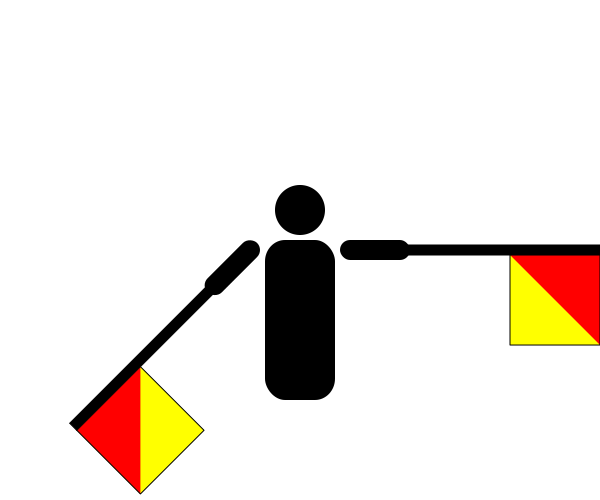

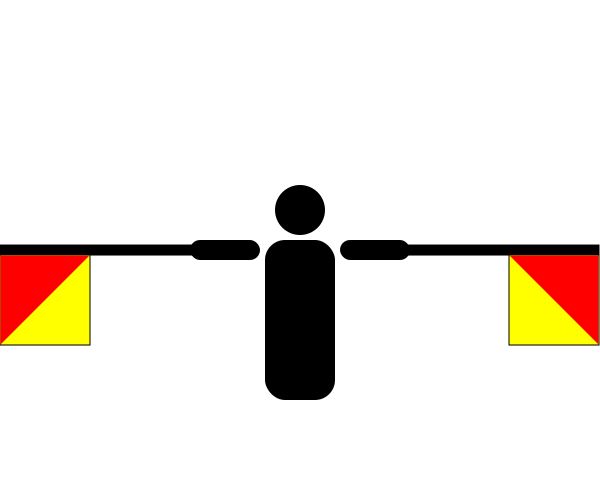
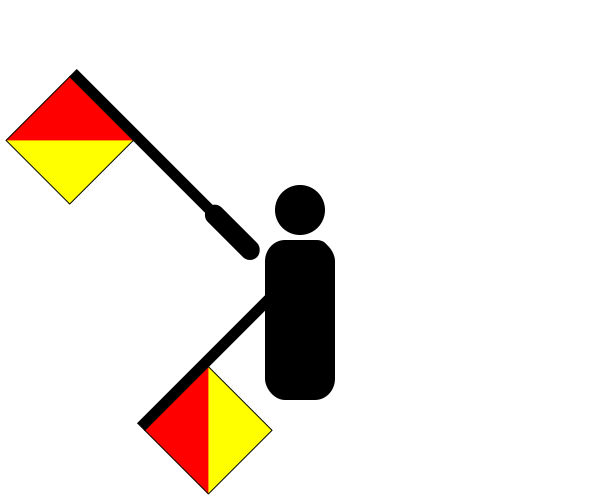
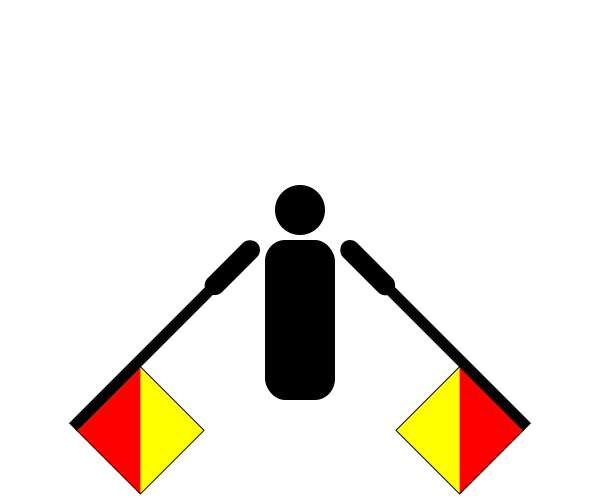

There are approximately 1,037 people named Marriner in the UK. That makes it roughly the 7,163rd most common surname in Britain. Around 16 in a million people in Britain are named Marriner.
Surname type: Occupational name
Origin: English
Region of origin: British Isles
Country of origin: England
Religion of origin: Christian
Language of origin: English

Famous people named Marriner
- Neville Marriner - Conductor and violinist (1924 to 2016)
- Andre Marriner - Football referee
- Andrew Marriner - Musician
Names and descriptions courtesy of Wikipedia, and may contain errors. This is not intended to be an exhaustive list of every famous person with this name.