MARCUM
Marcum is a surname of purely English provenance, further rooted in the Latin personal name Marcus. The Roman name Marcus was frequent in antiquity and derives from the god Mars, the deity of fertility and war, thus imbuing the name with a martial heritage that may have been reflected in the early bearers of the surname.
The transformation from Marcus to Mark and finally to Marcum is a typical example of medieval linguistic evolution. The suffix -um is uncommon in English surnames and is now regarded as a patronymic marker, meaning the name can be interpreted as “son of Mark” or “descendant of Mark.” This matches the convention observed in other surnames that employ a suffix to denote lineage.
In addition to its patronymic roots, the surname has a strong locational element. Recorded variants such as Marcham, Marcam, Marcome, Marcombe and Marsham find their origin in place-names. Marcham is a village near Abingdon in Oxfordshire, first documented as early as 835 AD, when it was known as Mercham, a farm where merce (flax or reed) was cultivated. Markham, located in Nottinghamshire and later called Markham Clinton after the family who held the manor, appears in the Domesday Book of 1086 under the name Marcham. Both sites derive their names from the idea of a “boundary marker in the valley,” a reference to a visible landmark that marked parish limits. The first known use of the surname in official records is attributed to Robert de Marcham of Nottingham, noted in the Hundred Rolls of 1273.
Variations of the name speak to the fluidity of spelling before the standardisation of English orthography. Other spellings recorded include Markham, Markum, Markam, Marcom and Markan. The breadth of these variants indicates that an early family migrating from one region to another often adapted the spelling of their name to local dialects and clerical practices. The presence of the surname and its variants across the British Isles suggests that a large number of families adopted similar names independently, especially in rural communities situated around historic village boundaries.
In modern times the surname remains predominantly found in English‑speaking regions. Concentrations are highest in the United Kingdom, with a notable presence in Northern England owing to the historic settlement in Cambridgeshire, Lincolnshire and the West Midlands. Through waves of emigration in the nineteenth and early twentieth centuries the name was carried to North America, where states such as Kentucky and Ohio host significant numbers of individuals bearing the surname. Australian records also show the name in modest numbers, correlating with British migration during the colonial era. These patterns reflect the broader trend of surnames spreading from their place of origin through migratory movements within the British diaspora.
Related surnames that share a common etymological root include Mark, Marks, Markus and Marcus, as well as the geographical surnames Markham and Marcham. While not all of these bearers descend directly from the same lineage, their names reveal the enduring influence of the personal name Mark or its Latin ancestor in the formation of family identities across centuries.
Similar and related surnames
Related and similar names are generated algorithmically based on the spelling, and may not necessarily share an etymology.
How to communicate the surname Marcum in...
Braille
⠍⠁⠗⠉⠥⠍
Morse
--.-.-.-.-...---
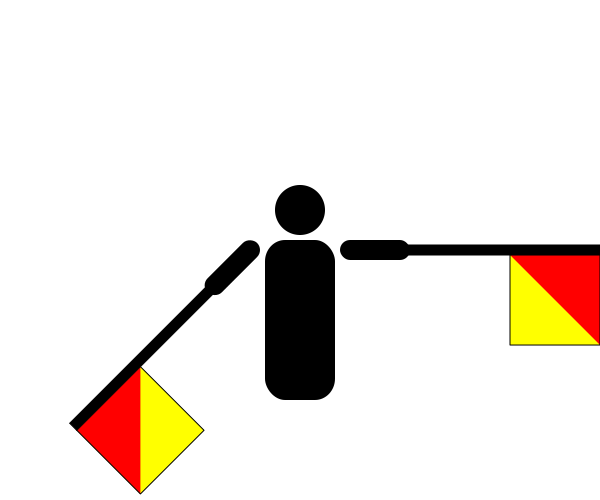
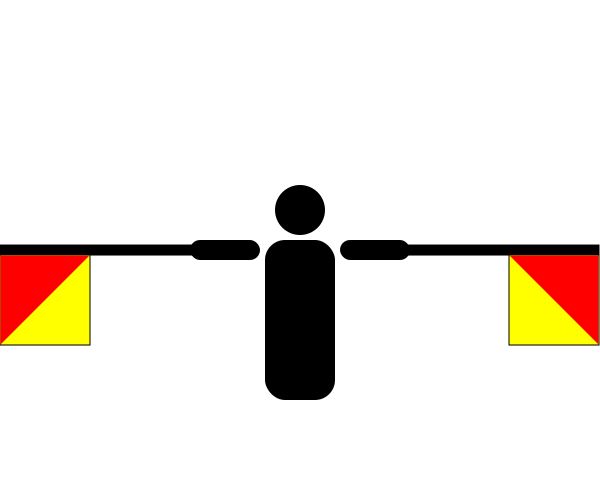
Semaphore



Sorry, we don't have any statistics on this name. That's probably because it's very uncommon in Britain.
