MANZ
Manz is a surname of Germanic origin that has evolved through a range of linguistic and cultural contexts. It is recognised as an occupational and patronymic name, initially used to describe a person of authority who managed a group of men, and subsequently adopted as a hereditary family identifier.
The earliest documented use of the name appears in the late medieval period in German‑speaking territories. It was recorded as Manze von Hornstein in the years 1298 and 1305, as Manto von Pflegelberg in a 1332 charter, and as Herman dicitus Manzellin in 1339. These entries indicate that the name was not yet a fixed family name but rather a title or descriptor linked to the occupation of managing people. The transition to a hereditary surname is evident in the 1360 record of Rudolf Mancz of Winterlingen, which suggests that the possession of the name had become inherited by subsequent generations.
The name is etymologically derived from the personal name Manzo, a diminutive of Manfred, and is patronymic in nature; it originally signified “descendant of Manzo” or “son of Manfred.” In some Italian contexts it has been linked to the Latin word manet, meaning “he remains or stays,” reflecting a sense of stability and rootedness. The variety of spellings—such as Manz, Mantze, Manze, Manntz, Mann, Mannz, Manzel, Mantzell, and the pejorative Manzler—attests to its widespread use across German, Austrian, Swiss, and Italian linguistic regions.
In addition to its Germanic roots, the surname is also found among Jewish communities, both Ashkenazic and Sephardic, where it appears in forms such as Manzi, Manzu, and Manzke. Related surnames include Manns, Manse, Manzini, Manzoni, Manzotti, and Mana. Despite these variants, the underlying etymological origins and pronunciation remain essentially consistent.
Geographic distribution shows that the surname is most prevalent in German–speaking countries. In Germany it is especially common in the state of Baden‑Wurttemberg, followed by North Rhine‑Westphalia, Bavaria, and Hesse. Austria and Switzerland also report significant numbers of bearers of the name, and it is recorded among the nobility of the region, such as Siegbert von Manz, who served as marshal of Deutz in the thirteenth century. In Italy, the name is noteworthy in the Molise and Veneto regions, where it is the most frequent surname in certain villages, reflecting a deep, local heritage.
In the United States, the 2020 Census identifies Manz as the 3,983rd most common surname, with the greatest concentration of households found in Wisconsin, Illinois, Michigan, and Ohio. The surname is present across all fifty states and the District of Columbia. In the United Kingdom, the 2011 Census records it as the 6,914th most common surname, and worldwide it is estimated to rank 1,738th in commonality, with approximately 366,558 individuals sharing the name.
The historical associations of the Manz surname with management roles, noble titles, and stable, long‑lasting family ties convey a cultural image of responsibility, loyalty, and community service. Families bearing the name are noted for their enduring presence in local societies and for roles in public service, further cementing the connotations of constancy and trustworthiness that the name embodies across its diverse contexts.
Similar and related surnames
- Man
- Mana
- Manza
- Manze
- Manzi
- Manzo
- Maan
- Magne
- Magnes
- Mahn
- Mahne
- Main
- Maine
- Maines
- Mainn
- Mains
- Mainz
- Manas
- Mancz
- Mane
- Manes
- Manez
- Maniez
- Manis
- Mann
- Manne
- Mannes
- Manns
- Manos
- Mans
- Manus
- Mayn
- Mayne
- Maynes
- Maynez
- Mayns
- Mean
- Meanes
- Means
- Meenz
- Meinz
- Menz
- Magness
- Mance
- Mand
- Mani
- Mansi
- Manzie
- Menze
- Mines
- Minnis
- Mounce
- Munns
- Munoz
Related and similar names are generated algorithmically based on the spelling, and may not necessarily share an etymology.
How to communicate the surname Manz in...
Braille
⠍⠁⠝⠵
Morse
--.--.--..
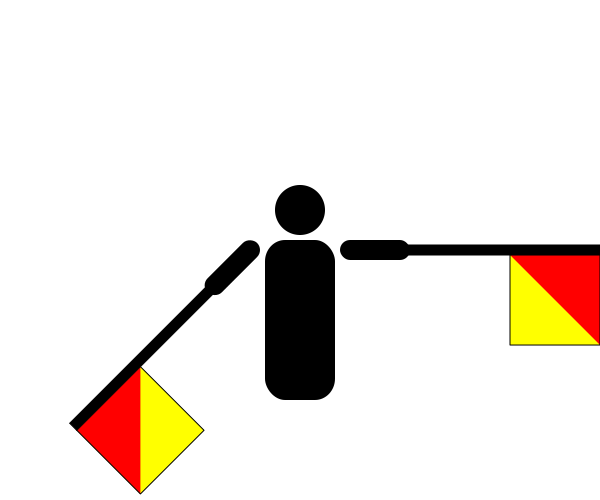
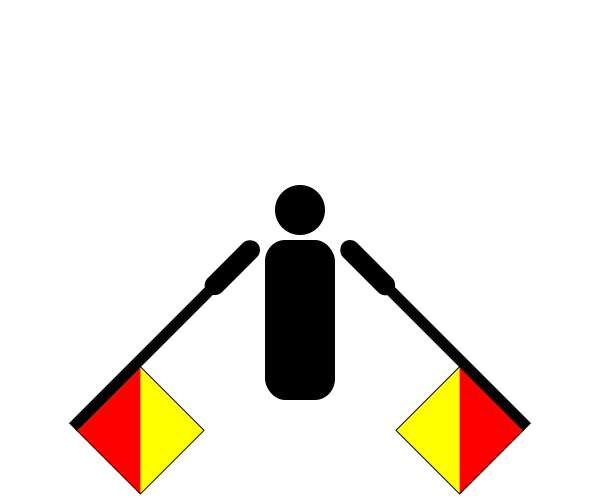
Semaphore


There are approximately 103 people named Manz in the UK. That makes it one of Britain's least common surnames. Only around two in a million people in Britain are named Manz.