MANCHESTER
Manchester is an English locational surname that denotes origin from the city of Manchester in North West England. The name is derived from the Old English term Mamceaster, which translates literally as “fortress of the Mamucium.” This links the surname to the ancient Roman fort that once dominated the landscape and later evolved into the industrial hub for which the city is now renowned.
The placename itself is recorded in early medieval sources as Mameceaster in the 923 Anglo‑Saxon Chronicles and as Mamecestre in the Domesday Book of 1086. It combines the Brittonic element mamuca, meaning “breast” and referring to the prominent hill shape of the fort, with the Old English suffix ceaster, a derivative of the Latin castra meaning “military camp” or “fort.” The resulting toponym was subsequently adopted as a family name by those who originated from the area.
Documentary evidence of the surname dates back to the early 14th century. The earliest definite record is that of John de Manchestre in 1325, noted as a Freeman of Yorkshire during the reign of King Edward I. Later entries include John Manchester appearing in the 1427 Close Rolls, and the marriage of William Manchester to Elizabeth Breathers at St. Dunstan’s, Stepney, London, on 26 January 1642. The Manchester coat of arms, granted to the family, features a red shield with three gold mitres upon a red engrailed pale and three silver bendlets enhanced on a red canton.
In contemporary times the surname remains comparatively uncommon but is still widely found throughout the United Kingdom, especially in the north‑west regions of Lancashire, Cumbria, West Yorkshire and the Midlands. It currently ranks as the 739th most common surname in England and Wales. In the United States it is the 844th most frequent surname, with a noticeable concentration of bearers residing in Pennsylvania.
Several orthographic variants of the Manchester surname exist, including Manchestor, Manchesterr, Manchster and Manchesster. These forms are generally regarded as pointing back to the same locational origin. The surname is also recorded abroad, particularly in Canada, Ireland, Australia and South Africa, where the same spelling variations appear in parish records.
Overall, the Manchester surname is firmly rooted in its English geographic provenance, reflecting both the ancient Roman heritage of the city’s fort and the linguistic evolution that transformed a place name into a hereditary family designation.
Typical given names associated with the Manchester surname
Male
- Alan
- Anthony
- David
- Graham
- Ian
- James
- John
- Paul
- Peter
- Robert
- Roy
- Stephen
Female
- Barbara
- Cara
- Elizabeth
- Emma
- Jane
- Jennifer
- Lucy
- Margaret
- Natalie
- Sarah
- Sheila
- Susan
- Tina
- Victoria
Similar and related surnames
Related and similar names are generated algorithmically based on the spelling, and may not necessarily share an etymology.
How to communicate the surname Manchester in...
Braille
⠍⠁⠝⠉⠓⠑⠎⠞⠑⠗
Morse
--.--.-.-.........-..-.
Semaphore
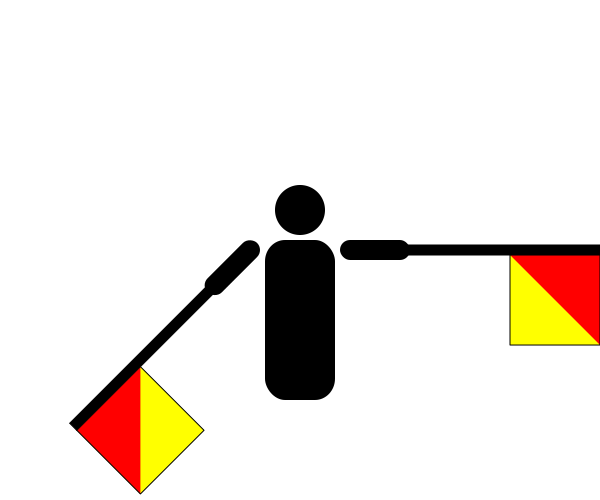

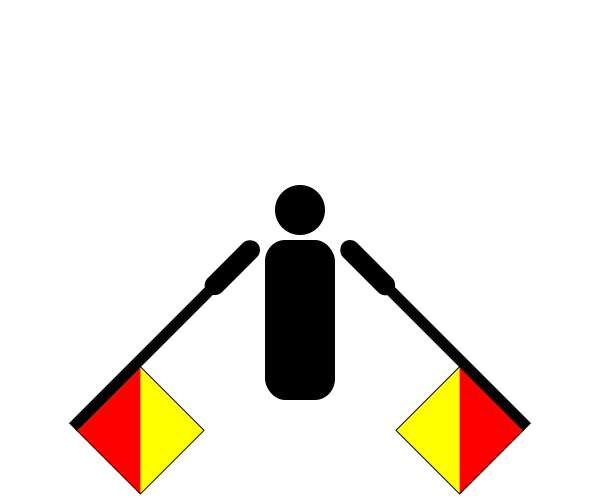


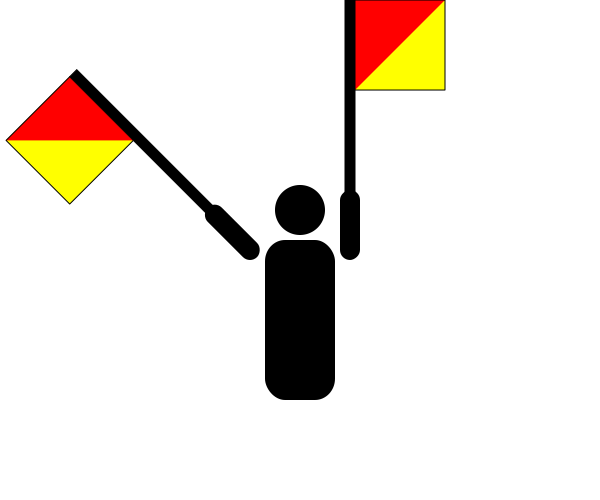
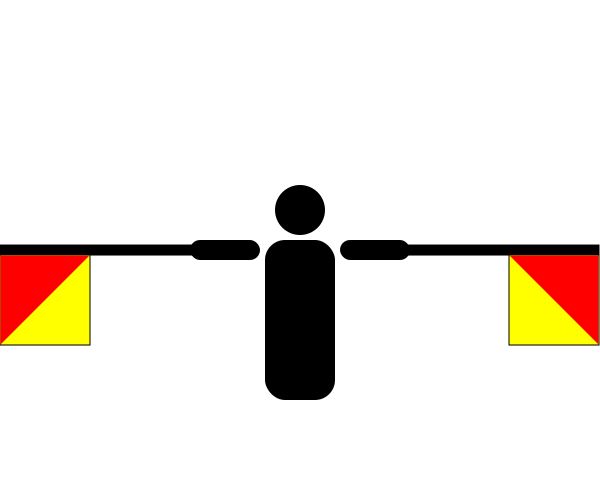
There are approximately 966 people named Manchester in the UK. That makes it roughly the 7,560th most common surname in Britain. Around 15 in a million people in Britain are named Manchester.
Surname type: Location or geographical feature
Origin: English
Region of origin: British Isles
Country of origin: England
Religion of origin: Christian
Language of origin: English

Famous people named Manchester
- John Byrom or John Byrom of Kersal or John Byrom of Manchester - Poet, inventor of a shorthand system (1692 to 1763)
Names and descriptions courtesy of Wikipedia, and may contain errors. This is not intended to be an exhaustive list of every famous person with this name.