MAGNUS
The Magnus surname possesses a history that entwines Latin and Scandinavian roots, reflecting a name that has traversed linguistic and geographic boundaries across centuries.
Originating from the Latin word magnus, which denotes great or large, the surname first appeared as an epithet in ancient Rome. Through the medieval period, this adjective transformed into a personal name, especially within Scandinavian societies where it signalled a person of considerable stature or influence.
Within Scandinavia the name evolved into the personal name Magnus, frequently bestowed upon those deemed powerful or of noble birth. In the eighteenth and early nineteenth centuries, it gained further prominence through the reigns of Scandinavian monarchs, most notably Magnus the Good, King of Norway, who died in 1047. The name subsequently spread from Norway to neighbouring Sweden, Denmark and Norway itself before arriving in England.
The Anglo-Saxon adoption of the name dates back to the period of the Norman Conquest in 1066. The earliest documented use of the surname in England concerns a Magnus de Weitecroft, mentioned in a London manuscript dating from around 1100. By the early eleventh century the name was already established as a hereditary family name. A later record, preserved in the Burton Chartulary of Staffordshire, cites Hugo Magnus in a document dated to the reign of King Henry I, circa 1114. These occurrences illustrate the gradual transition of Magnus from a personal epithet to a recognised family name.
In the modern era the surname appears across a range of countries, with significant concentrations observed in England, Sweden, Denmark, Norway, and the United States. While it remains a common first name in Scandinavia, within the English‑speaking world it functions predominantly as a family name.
Multiple orthographic variants of the surname exist. In addition to the original Magnus, spelling forms such as Manus, the patronymic Magnusson, and the Scottish iteration McManus are frequently encountered. These variants reflect linguistic adaptations in different regions while preserving the core meaning of the name.
Notable individuals carrying the surname include the mathematician Carl Gustav Magnus, known for his work in differential geometry, and the chess grandmaster Magnus Carlsen, though the latter’s surname is a separate formation. These figures underscore the surname’s endurance and its association with distinction and achievement.
Typical given names associated with the Magnus surname
Male
- Adrian
- Alan
- Brian
- Christopher
- David
- Gary
- James
- John
- Laurence
- Paul
- Peter
- Philip
- Richard
- Simon
Female
- Angela
- Clare
- Emma
- Helen
- Julie
- Lisa
- Louise
- Margaret
- Rose
- Ruth
- Sarah
- Susan
Similar and related surnames
- Magnas
- Magne
- Magnes
- Magness
- Magnew
- Magno
- Magnum
- Magnun
- Magnusen
- Magnuson
- Maines
- Maino
- Mains
- Mainu
- Mainus
- Manes
- Maneus
- Mangus
- Mannes
- Manno
- Manns
- Mannu
- Mannus
- Mano
- Manoe
- Manoo
- Manos
- Manou
- Manow
- Mans
- Mansi
- Manu
- Manuk
- Manus
- Manzi
- Manzie
- Maynes
- Mayns
- Meanes
- Means
- Menu
- Menus
- Mines
- Minnis
- Mounce
- Munns
- Munoz
Related and similar names are generated algorithmically based on the spelling, and may not necessarily share an etymology.
How to communicate the surname Magnus in...
Braille
⠍⠁⠛⠝⠥⠎
Morse
--.---.-...-...
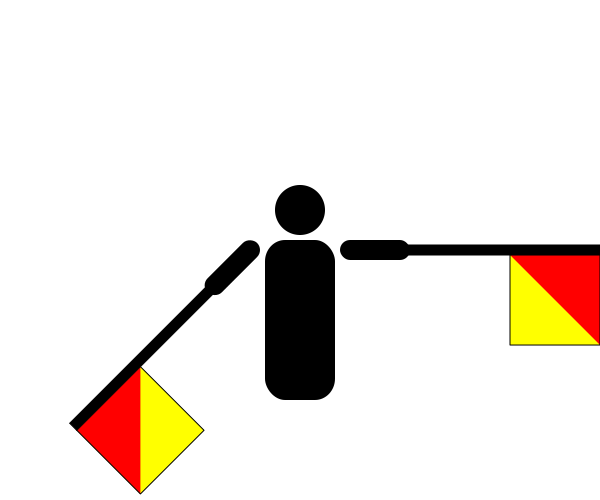
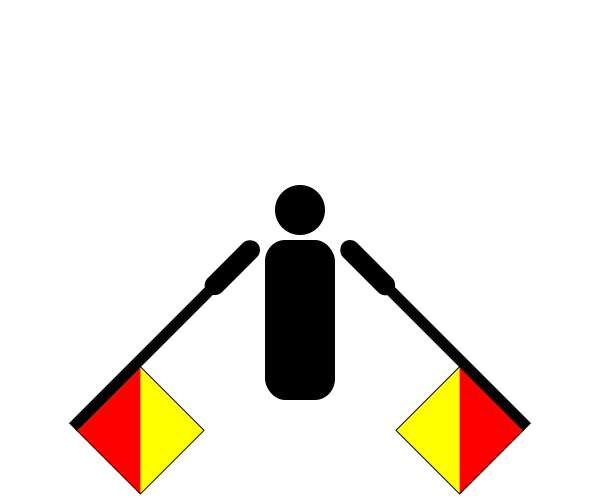
Semaphore




There are approximately 433 people named Magnus in the UK. That makes it one of Britain's least common surnames. Only around seven in a million people in Britain are named Magnus.
Surname type: From given name or forename
Origin: English
Region of origin: British Isles
Country of origin: England
Religion of origin: Christian
Language of origin: English

Famous people named Magnus
- Belinda Magnus - Actress and Ska singer
- Gnaeus Pompeius Magnus - Roman general (106 to 48)
- Nick Magnus - Musician
Names and descriptions courtesy of Wikipedia, and may contain errors. This is not intended to be an exhaustive list of every famous person with this name.