MACON
Macon is a surname of French origin, derived from the town of Mâcon in the east-central region of Bourgogne-Franche-Comté. As a locational surname it indicated that the original bearer had hailed from or possessed some association with this place, a common practice in medieval Europe for identifying individuals who migrated from their birthplace.
The etymology of Macon is twofold. It is believed to spring from the Latin word Matisco, meaning “place of abundant waters”, which alludes to the geographical features of the area surrounding the town. At the same time, the name may reflect an occupational origin, being related to the Old French word maçon, the ancestor of the English word “mason”, which denoted a skilled stone mason or bricklayer. This occupational element was introduced to England by the Norman-French after the conquest of 1066, when stone construction was gradually adopted in Britain.
As a medieval surname it was recorded under a surprising number of spellings, indicating its status as both a place-based and occupational identifier. Early documentary evidence includes the name John Macun appearing in the building accounts of King Henry I of England in 1130, and Ace le Mazun in the Pipe Rolls of Lincolnshire in 1193. The first known spelling may be that of Richard Machun, dated around 1120 in the charters of the Danelaw during the reign of King Henry I.
By the 16th century, records from parish registers show varieties such as Elizabeth Masson, christened at St. Margaret's Westminster on 21 July 1540, and Awdry Mason, who married William Elyat at the same church on 10 June 1548. The surname continued to appear under several forms: Macon, Mason, Massen, Masson, Machen, Machent, Machin, Machon, Massin, Maison and others. These variations arose from regional pronunciations and the lack of standardised spelling in early modern England and France.
Through the centuries the name spread beyond its original borders. In English-speaking countries it remains relatively uncommon but is still present, particularly in the United States where immigration and the legacy of slavery have produced a diverse set of bearers. Some African-American families carry the name Macon as a testament to the historical practice of slave owners assigning surnames to enslaved people during the era of slavery, though the exact origins in these cases are not documented beyond this general context.
In contemporary times, Macon can be found worldwide due to continuing migration and intermarriage. The name is present in France, reflecting its origin; it is also seen in countries such as the United Kingdom, Canada, Australia and the United States. Its distribution is no longer confined to any single region or nationality, although it retains a particularly strong association with French heritage.
Among the notable historical figures bearing the surname is George Mason (1725–1792), an American statesman who framed the Virginia Bill of Rights and whose ideas later influenced Thomas Jefferson in the drafting of the Declaration of Independence in 1776. His prominence demonstrates the surname’s reach into political history and its continued relevance in the modern world.
Typical given names associated with the Macon surname
Male
- Scott
Female
Similar and related surnames
Related and similar names are generated algorithmically based on the spelling, and may not necessarily share an etymology.
How to communicate the surname Macon in...
Braille
⠍⠁⠉⠕⠝
Morse
--.--.-.----.
Semaphore
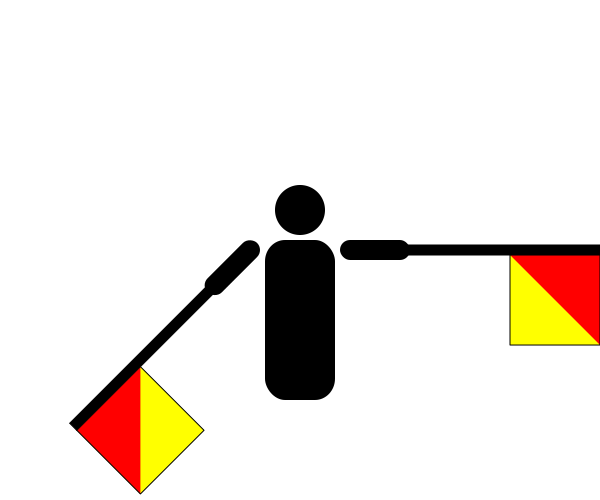


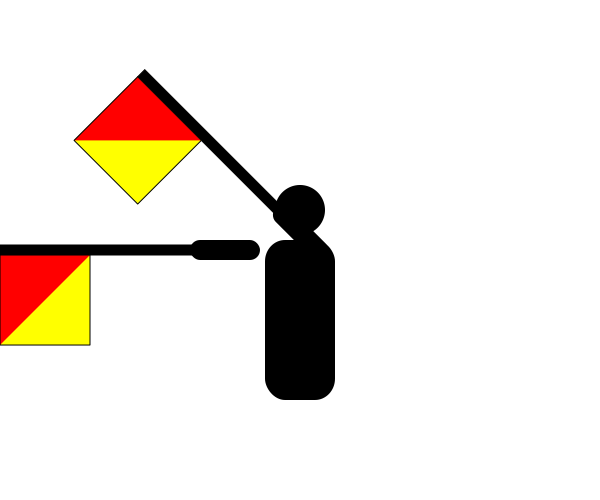
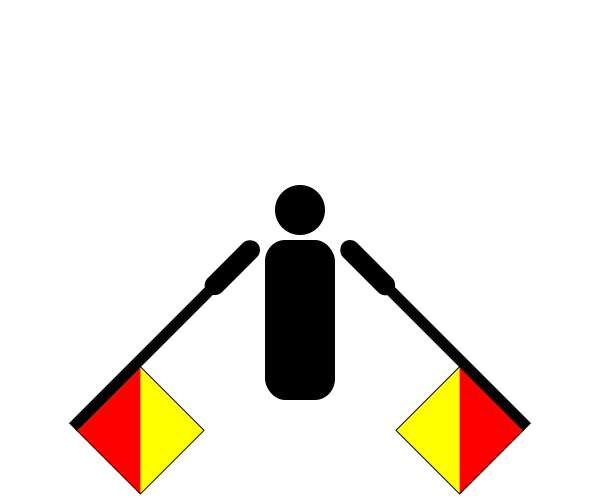
There are approximately 19 people named Macon in the UK. That makes it one of Britain's least common surnames. Fewer than one in a million people in Britain are named Macon.
Origin: Iberian
Region of origin: Europe
Country of origin: Spain
Religion of origin: Christian
Language of origin: Spanish
