LYTTON
The surname Lytton is a distinctly English habitational name, originating from a variety of villages across the British Isles which bear the same or similar place‑names. It is recorded as having arisen in the counties of Derbyshire, Dorset, Somerset, West Yorkshire and Hertfordshire, where the localities were known by spellings such as Litton, Litun and Lyttleton. The earliest documentary references appear in the Domesday Book of 1086, where one entry records the locality as Hlytton, the oldest surviving form that would eventually evolve into the modern Lytton spelling.
The etymology of the name can be traced back to Old English elements. One interpretation ties it to the word lytta, meaning ‘little’, coupled with tun, denoting a settlement or farm, thereby rendering the sense ‘small farm’ or ‘little settlement’. Another, derived from the Old English hlith ‘slope or hill’ and the same suffix ‑tun, would identify a village situated upon a hill. A third reading, suggested by the geographical context of some of the villages, interprets the name as ‘the place on a torrent’, drawing on the Old English hylide for a rapid or fast‑flowing stream. All of these meanings are consistent with the rural origins of the surname.
In the medieval period the surname appears in varying forms, reflecting contemporary spelling practices. Notable early holders include Gamel de Litton in a 1175 Yorkshire charter, Thomas de Lytton of Derbyshire mentioned in the Hundred Rolls of 1273, and Thomas Lytton of Essex noted in the 1403 Feet of Fines. The interchangeable use of Litton and Lytton during this era demonstrates that the distinction between the two was largely orthographic rather than indicative of separate lineages.
Over the centuries a range of variant spellings has been recorded. These include Lytten, Litthen, Littune, Littone and Lyttun; each variant can be traced to the way Latin script accommodated regional accents and the lack of standardised orthography. In some cases the name was further altered through phonetic transcription into other languages, producing forms such as Litten or Litton in German contexts. The spread of the surname beyond England, notably to the United States, Canada and Australia, has sometimes resulted in new combinations, as in the double‑barrelled forms Lytton‑Barnett and Lytton‑Smith, reflecting matrimonial or familial alliances.
The most celebrated bearer of the surname belongs to the Bulwer‑Lytton family, whose origins are closely tied to the Knebworth estate in Hertfordshire. Edward Bulwer‑Lytton, a Victorian novelist, playwright and politician, brought the name into the national consciousness with a prolific literary and parliamentary career. His nephew, Robert Bulwer‑Lytton, 1st Earl of Lytton, served as President of the Council and Viceroy of India, further cementing the surname’s association with contemporary British aristocracy and governance.
The literary legacy of the Bulwer‑Lytton family inspired a whimsical cultural reference in the form of the Bulwer‑Lytton Fiction Contest, an annual competition that rewards deliberately dreadful prose. The event, named after Edward himself, has gained a following among writers and readers who enjoy the tradition of crafting intentionally bad sentences, thereby ensuring that the surname continues to feature in modern literary discourse.
Today the surname Lytton remains relatively uncommon, yet it is found across the English‑speaking world. In the United Kingdom it persists chiefly in the south‑east, mirroring the historic distribution of the original place‑names, while in countries such as the United States, Canada and Australia more dispersed lines can be identified through genealogical records. The name retains its heritage through its continued association with the village of Knebworth, the historic house that once served as the family seat, and through the ongoing prominence of individuals who carry the name into fields as diverse as politics, literature and academia.
Typical given names associated with the Lytton surname
Male
- Andrew
- Anthony
- David
- Edward
- Jason
- John
- Malcolm
- Matthew
- Michael
- Paul
- Simon
- Stephen
Female
- Daphne
- Davina
- Helen
- Imogen
- Jane
- Joanne
- Josephine
- Kathleen
- Laura
- Lilian
- Rebecca
- Rosa
- Rosina
- Sharon
Similar and related surnames
Related and similar names are generated algorithmically based on the spelling, and may not necessarily share an etymology.
How to communicate the surname Lytton in...
Braille
⠇⠽⠞⠞⠕⠝
Morse
.-..-.--------.
Semaphore

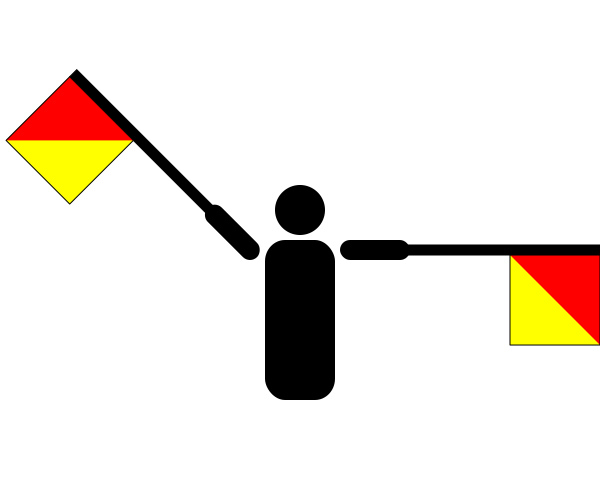
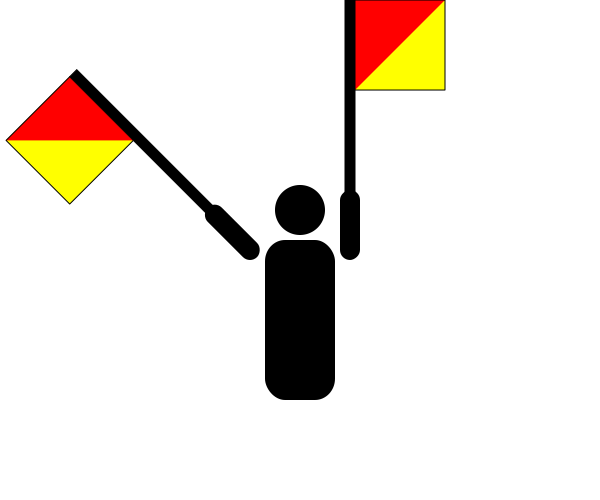
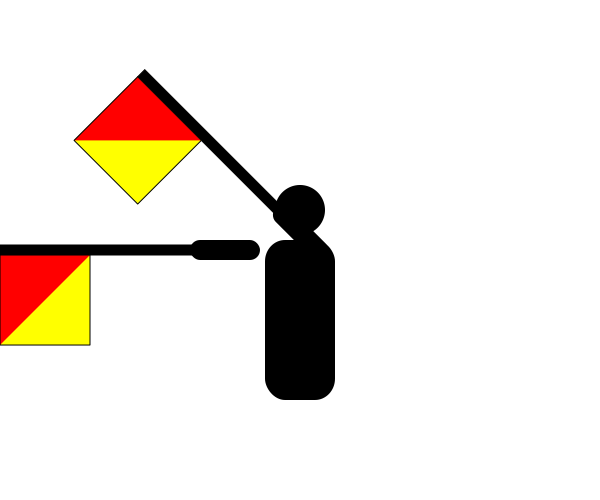
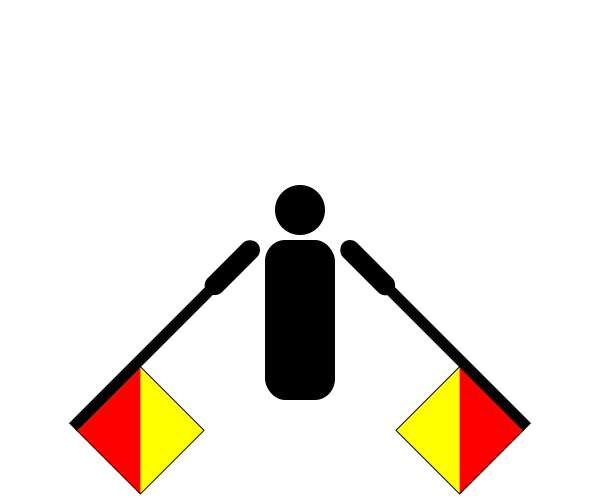
There are approximately 222 people named Lytton in the UK. That makes it one of Britain's least common surnames. Only around three in a million people in Britain are named Lytton.
Surname type: Location or geographical feature
Origin: English
Region of origin: British Isles
Country of origin: England
Religion of origin: Christian
Language of origin: English

Famous people named Lytton
- Louisa Lytton - Actress
- Judith Blunt-Lytton, 16th Baroness Wentworth - Peeress, Arabian horse breeder and tennis player (1873 to 1957)
- John Lytton, 5th Earl of Lytton - Surveyor and peer
- Noel Lytton, 4th Earl of Lytton - Writer (1900 to 1985)
- Victor Bulwer-Lytton, 2nd Earl of Lytton - Politician and colonial administrator (1876 to 1947)
- Neville Bulwer-Lytton, 3rd Earl of Lytton - Military officer, tennis player and artist (1879 to 1951)
- Henry Lytton - Actor and singer (1865 to 1936)
- Paul Lytton - Musician
Names and descriptions courtesy of Wikipedia, and may contain errors. This is not intended to be an exhaustive list of every famous person with this name.