LYSAGHT
The surname Lysaght is of Gaelic, Irish origin and is recorded in the old Irish language as “Ó Liosachta”, meaning descendant of Liosachta. The personal element Liosachta itself is derived from the word lios, a term that denoted a fort or an enclosure within the ancient Celtic landscape.
Another proposed root for the name is the pre‑10th century Gaelic phrase “Giolla Iasachta”, translated as loaned people. According to historical records, those bearing the patronymic were considered fighting men who were lent by the dominant Dalcassian sept of Ó Brien of Thomond. The prefix Mac (sons of) or Mc fell into disuse over the centuries, yet the name persisted in various forms across the islands.
Geographically, the Lysaght surname has long been associated with the western province of Connacht, particularly County Clare, as well as by the medieval strongholds of Knockmor in County Mayo and the fortified settlements of County Limerick and Cork. In the north of the country, a line of the family is recorded in County Longford, where they were noted as Lords of Ferran and Cuchulainn before the modern period.
Prominent bearers of the name include William MacLysaght, an officer in Clare’s Dragoons who fought on the side of King James I at the Battle of the Boyne in 1690. In the late eighteenth and early nineteenth centuries Edward Lysaght – nicknamed “Pleasant Ned” – published poetry in both Irish and English, becoming a celebrated figure of Dublin life during the era of Grattan’s Parliament. The most influential chronicler of Irish families, Edward MacLysaght, held the office of Chief Herald of Ireland in 1922 and produced a definitive account of the surname’s history.
The variety of spellings accompanying the Lysaght name reflects its long linguistic evolution. Common variants include MacLysaght, McLysaght, Lysaught, Lysett, Lyssett, Lisyaght, and Leysaush. Additional forms such as Lissack, Leishght, Leishman and Lishman appear in German and Scottish contexts. Anglicised derivatives such as O'Ligh, O'Laidig and Ó Laoidigh also trace back to the original Gaelic patronymic.
In the United Kingdom, the surname is most common in England, where it is concentrated in East Anglia, Kent and London, and in Scotland, where it can be found in the Border regions, Grampian and the north‑east near Inverness and Aberdeen. Across the Atlantic, the name appears in the United States, where it was adopted by emigrants of Irish descent in the nineteenth century and subsequently found in various regions of the country.
The Lysaght surname, despite its diverse spellings and wide geographical spread, retains a strong association with Irish heritage. Its etymological roots in fortification and loyalty to ruling septs evoke a sense of resilience and steadfastness that is echoed in the achievements of its notable bearers throughout history. The name continues to be used by families around the world, carrying with it a legacy of perseverance and cultural identity.
Typical given names associated with the Lysaght surname
Male
- Christopher
- John
- Jonathan
- Joseph
- Karl
- Michael
- Patrick
- Paul
- Peter
- Stephen
- Thomas
- William
Female
- Amy
- Barbara
- Emma
- Erica
- Georgina
- Helen
- Janice
- Margaret
- Mary
- Michelle
- Pauline
- Sally
- Sarah
- Victoria
Similar and related surnames
Related and similar names are generated algorithmically based on the spelling, and may not necessarily share an etymology.
How to communicate the surname Lysaght in...
Braille
⠇⠽⠎⠁⠛⠓⠞
Morse
.-..-.--....---.....-
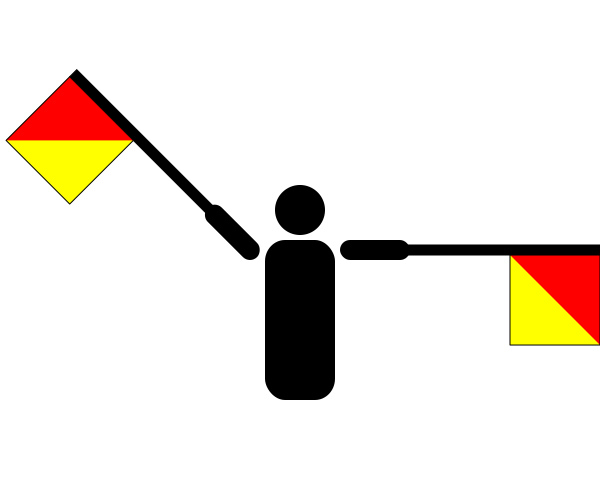
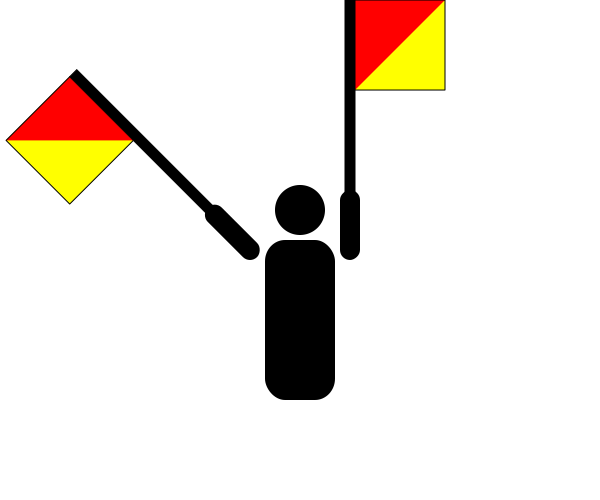
Semaphore



Did you know?
According to a survey carried out by Democracy Club, politicians and candidates with the surname Lysaght are most likely to say that their favourite biscuit is a Chocolate Hobnob.
There are approximately 445 people named Lysaght in the UK. That makes it one of Britain's least common surnames. Only around seven in a million people in Britain are named Lysaght.
Origin: Celtic
Region of origin: British Isles
Country of origin: Ireland
Religion of origin: Christian
Language of origin: Gaelic
