LUX
Lux is an old surname of Germanic origin, first recorded in the 12th century. It has been found in a number of European countries and was introduced to the English‑speaking world by early immigrants and Crusader families.
In German, the name is normally associated with the Middle High German word luchs, meaning “lynx”. The nickname was given to someone who displayed characteristics such as keen eyesight or great agility, and it later became hereditary. This derivation remains the predominant explanation for the surname in German‑speaking areas.
At the same time the Latin word lux, meaning “light”, is also cited as a source for the name. Throughout the Middle Ages the word was used for people exposed to light in a religious context, and it was sometimes applied to those who demonstrated bright or shining qualities. The dual derivation reflects the surname’s presence in both Germanic and Latin traditions.
Another strand of the surname’s history is connected to the Crusader era. In the 12th century the name appears in the register of the Knights Templars in England as Euerard Lucas; Lucas derives from the ancient Greek Loucas, the name of a man from Lucania in Italy. The popularity of St. Luke the Evangelist, noted in the same period, also helped spread the form. Early English records show Lucas de Luke in London’s Pipe Rolls of 1274, while German records contain Ulrich der Luk in 1310 and Johannes Lucker in 1422. A marriage recorded in St. Botolph’s Church, Bishopsgate, on 27 January 1571 between Christopher Lucas and Margaret Medcalfe is another example of the name in early modern England.
There are over one hundred spelling variations of Lux. In England and Scotland the surname has been spelled as Lucas, Luke, Luck and Luckett; in France the variants include Lucaus and Luca in Italy; in Germany it appears as Lucks and Lauks; Czech forms such as Luasek and Kasek are also recorded; Polish usage includes Lukasik; Ukrainian bearers might write Lukashevich; in Croatia the form is Lukovic; and there are others such as Luxenbach and Luxenfels in Germany, Luks in Russia, and Luks‑Montgomery in Ireland.
The surname is most common in Germany, Austria, Switzerland, Luxembourg and the Czech Republic, and it also has a significant presence in the United States, Canada, the United Kingdom and the Netherlands. The large number of European immigrants in the 19th and 20th centuries brought many variations of the name to North America, where approximately 8,500 American families now bear the surname Lux.
In the late 15th to 19th centuries, members of the Lux family in Germany were noted for their blacksmithing expertise, particularly in the forging of horseshoes and other metal implements. This craft, combined with the sociopolitical changes following the Reformation, positioned many Lux individuals among the landed gentry and commercial classes.
In contemporary times, Lux remains a commonly used surname and is often considered a symbol of distinction. Its bearers are recognised for the clarity and illumination that the medieval notion of lux suggests, allowing them to shed light upon various endeavours.
Typical given names associated with the Lux surname
Male
- Alan
- Anthony
- Christopher
- David
- Howard
- Jonathan
- Kelvin
- Laurence
- Neil
- Peter
- Russell
- Steven
- Wayne
Female
- Christine
- Collette
- Danielle
- Denise
- Elisabeth
- Elizabeth
- Hilary
- Margaret
- Paulene
- Ruth
- Susan
- Suzannah
- Wendy
Similar and related surnames
Related and similar names are generated algorithmically based on the spelling, and may not necessarily share an etymology.
How to communicate the surname Lux in...
Braille
⠇⠥⠭
Morse
.-....--..-
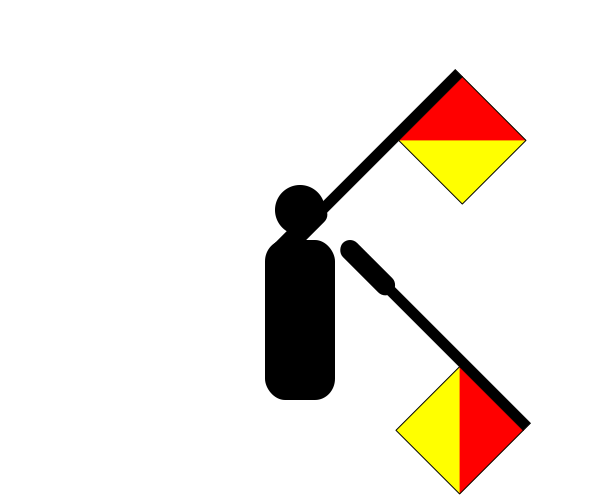
Semaphore


There are approximately 207 people named Lux in the UK. That makes it one of Britain's least common surnames. Only around three in a million people in Britain are named Lux.
Origin: English
Region of origin: British Isles
Country of origin: England
Religion of origin: Christian
Language of origin: English