LUNDIE
Lundie is a family name of distinctly Scottish provenance, situated within the broader context of the British Isles. The name is traditionally identified with the former county of Forfarshire, now the council area of Angus, and its association with the village of Lundie therein.
Historically, the surname has been linked to both Norse and Gaelic linguistic roots. The Old Norse word lundr translates as “grove” or “woodland”, while the Gaelic term lunnd denotes a “marsh” and lùnd a “little hollow or grove”. Consequently, bearers of the name were likely identified with a grove, small woodland, or a marshy hollow in or near the eponymous locality.
The earliest documented use of the name appears in the 12th century. The Pipe Rolls of Yorkshire, dated 1183, record the name as Ralph de la Lunde, a matter concerning the reign of King Henry II. Subsequent medieval references include a William Lundi, Sheriff of Fife in 1491, and a George Lundye, ministl of Dummany in 1547, illustrating the name’s persistence across several centuries.
Variations of the surname have emerged over time and across regions. These encompass spellings such as Lundy, Lunt, Lount, Lundin, Lundeen, Lunan, Lunnie, Lounie, and Lundyne. Phonetic shifts and local dialects contributed to these differences, and some forms align with similar Scandinavian surnames like Lund, Lunde, Lundquist, Lundgren, and Lundberg.
In contemporary times, the surname remains chiefly associated with Scotland, particularly the Angus region. It has also spread to other English-speaking nations through historical emigration, notably the United States, Canada, Australia, and New Zealand. However, census data indicate that Lundie is not a common surname in any of these countries, suggesting a certain niche prevalence.
Because the name derives from a tangible geographical feature, genealogical research can often trace lineage back to the village of Lundie or its surrounding countryside. Nonetheless, the multitude of spelling variants and the non-uniform adoption of surnames during medieval Britain mean that individuals bearing Lundie or its derivatives may not share a single common ancestor, although many can confirm Scottish origins.
The rarity of the name, coupled with its clear locational etymology, provides bearers with a unique opportunity to explore and claim a connection to Scotland’s historical and cultural tapestry.
Typical given names associated with the Lundie surname
Male
- Andrew
- Brian
- Christopher
- David
- Ian
- James
- John
- Joseph
- Peter
- Robert
- Thomas
- William
Female
- Amanda
- Ann
- Anne
- Catherine
- Elizabeth
- Fiona
- Hazel
- Helen
- Lisa
- Margaret
- Mary
- Sarah
- Tracy
Similar and related surnames
Related and similar names are generated algorithmically based on the spelling, and may not necessarily share an etymology.
How to communicate the surname Lundie in...
Braille
⠇⠥⠝⠙⠊⠑
Morse
.-....--.-.....
Semaphore


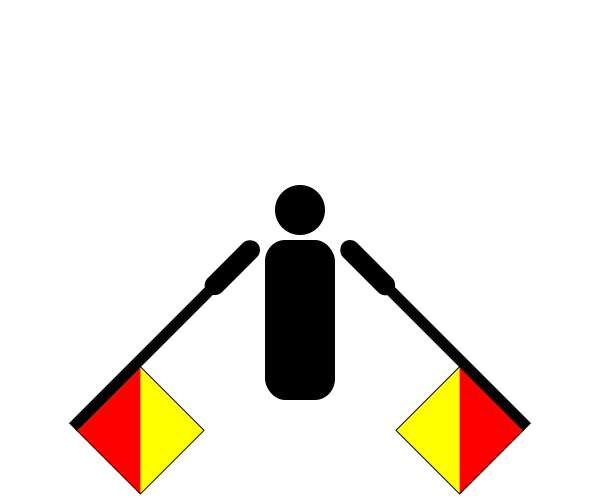

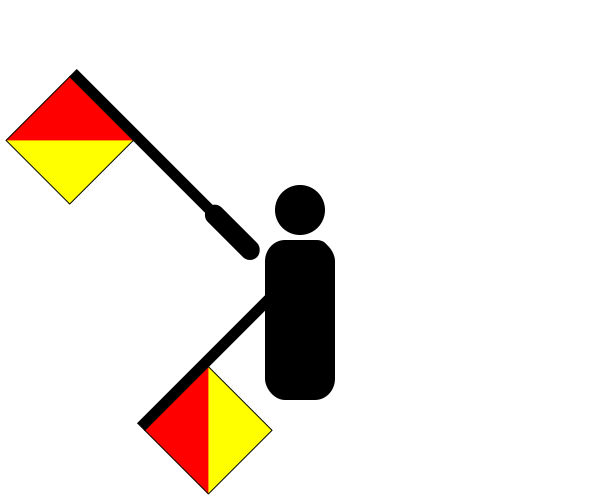

Did you know?
According to a survey carried out by Democracy Club, politicians and candidates with the surname Lundie are most likely to say that their favourite biscuit is a Dark chocolate Digestive.
There are approximately 1,014 people named Lundie in the UK. That makes it roughly the 7,303rd most common surname in Britain. Around 16 in a million people in Britain are named Lundie.
Origin: Celtic
Region of origin: British Isles
Country of origin: Scotland
Religion of origin: Christian
Language of origin: Gaelic

Famous people named Lundie
- James Lundie - Football player (1857 to 1942)
Names and descriptions courtesy of Wikipedia, and may contain errors. This is not intended to be an exhaustive list of every famous person with this name.