LUKACS
Lukacs is a surname of Hungarian origin that has evolved through a range of linguistic influences and historical contexts. The name is generally understood to derive from the Hungarian given name Lukács, the Hungarian form of Lucas, itself stemming from the Latin Lucius meaning “light” or “illumination.” Consequently, the surname can be interpreted as “son of Lukács” or “descendant of Lucas,” signalling a familial link to an ancestor bearing that given name.
Early medieval documentation shows that the surname appears in over a hundred orthographic variations, including Lucas, Luke, Luck, and Luckett in England and Scotland; Lucas and Lucaud in France; Luca in Italy; Lucks and Lauks in Germany; Luasek and Kasek in Czech lands; Lukasik in Poland; Lukashevich in Ukraine; Lukovic in Croatia; and multiple other forms elsewhere. These variations attest to the widespread use of the name across Europe during the Middle Ages.
One early record of the name, dated 1153, appears in the register of the Knights Templars of England, a pioneer order within the Crusading movement. The association of the name with participants in the Crusades—particularly those who returned home after the 11th‑ and 12th‑century expeditions to the Holy Land—highlights a potential link between the surname and the broader crusader diaspora. Other early documentation includes a 1274 entry for Lucas de Luke in the Pipe Rolls of London, as well as German records of Ulrich der Luk in 1310 and Johannes Lucker in 1422.
Beyond its medieval usage, Lukacs may also reflect occupational origins. Traditional Hungarian interpretations suggest derivation from lakatos, the word for blacksmith, indicating that bearers of the surname might have been smiths by trade. An alternative theory proposes a link to the Hungarian term lukac, meaning locksmith, implying a specialised role in lock‑making. Both crafts carried significant importance in society, conferring a sense of technical skill and resilience that the name conveys to this day.
In the late nineteenth century, Lukacs was among the most common surnames in Hungary, with more than thirty‑five thousand individuals bearing the name in 1913. Notable figures include the athlete Györgyi Lukacs and the physician Dénes Lukács. The name has retained a strong presence in contemporary Hungary and in neighbouring countries such as Croatia, where it remains common. In the United States, Lukacs is an established surname, with over one thousand recorded bearers in the 1990 Census and more than ten thousand according to later estimates; the majority trace their ancestry directly to Hungary.
The surname manifests a wide array of spelling variants that reflect regional linguistic practices. In Hungary the spelling is most frequently seen as Lukács or Lukácsházy, whereas in Croatia it often appears as Lukačević. Slovak renderings include Lukáč; shortened forms such as Lukác or Lucák are also common. German, Polish, and Austrian records may list the surname as Lukacz or Lukec. French influences produce the variants Lucien and Lucie, while Belarusian variants include Lukaszewski. These variations demonstrate the surname’s adaptability across linguistic boundaries while preserving its core etymological roots.
Today the surname Lukacs remains a testament to a multifaceted heritage that intertwines patronymic lineage, occupational identity, and historical migration. Whether signifying a connection to the light of Lucius, the craft of smithing or lock‑making, or the legacy of crusading veterans, the name carries a rich narrative that spans centuries and continents.
Typical given names associated with the Lukacs surname
Male
- Andras
- David
- Frank
- Gabor
- Istvan
- Miklos
- Nicholas
- Peter
- Tamas
- Zoltan
Female
- Andrea
- Anna
- Christina
- Connie
- Elizabeth
- Erika
- Ilona
- Lisa
- Maria
- Samantha
Similar and related surnames
Related and similar names are generated algorithmically based on the spelling, and may not necessarily share an etymology.
How to communicate the surname Lukacs in...
Braille
⠇⠥⠅⠁⠉⠎
Morse
.-....--.-.--.-....
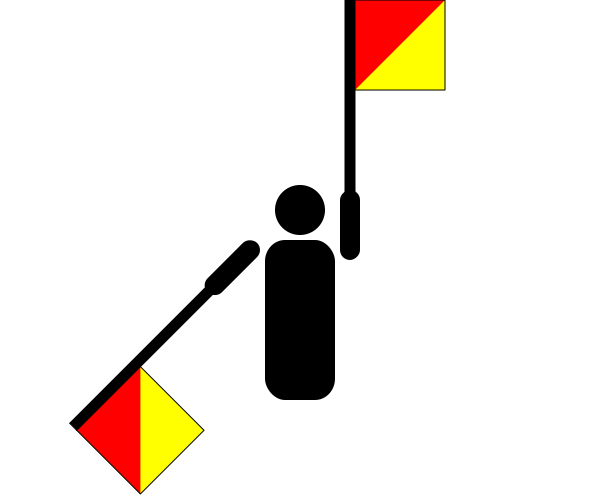
Semaphore




There are approximately 159 people named Lukacs in the UK. That makes it one of Britain's least common surnames. Only around two in a million people in Britain are named Lukacs.
