LUDWIG
Ludwig is a surname of Germanic origin, the concatenation of the elements hlud, denoting “loud” or “famous”, and wig, meaning “battle” or “warrior”. Consequently, the name conveys the sense of a “famous warrior” and is traditionally interpreted as indicating descent from an individual bearing the given name Ludwig.
In the early medieval period the personal name Ludwig was popular among royalty and nobility. It is recorded in Latin chronicles as Ludovicus or Chlodovechus, the latter giving rise to the Old French forms Clovis, Cluoi and Louie. Notable early bearers include Louis the Pious, son of Charlemagne, who lived in the late seventh and early eighth centuries, and Louis IX of France, whose canonisation as a saint further reinforced the name’s prestige.
The surname itself first appears in the early thirteenth century. The earliest known instance is that of Robert Lowis, found in the Pipe Rolls of Lancashire in 1202, during the reign of King John (1199–1216). Subsequent documentary evidence includes a witness named William Lewys in the 1267 Fines Court Rolls of Suffolk, and the entry of Lowis le Briton in the Red Book of the Exchequer for Essex in 1166.
Throughout Europe the name has been recorded in more than fifty variant spellings, ranging from Lewis, Lois, Loisi, Ludovici, Lotze, Lohde to Ludwikiewicz. In Wales the English rendition Lewis is often an adaptation of the Welsh name Llywelyn. One Welsh archdeacon, Llewelyn ap‑Madoc, known as Lewis Rede, served in Brecon in 1437.
In English‑speaking contexts the surname is frequently Anglicised as Lewis or Louis, and it has also appeared as Lowe or Loewice in more recent centuries. Rounded off by prefixes such as von or van it may indicate a line of noble standing, resulting in forms like Von Ludwig or Van Ludwig. Scandinavian variations including Ludvigsen or Ludvigson translate literally as “son of Ludwig”.
The surname remains particularly common in Germany, Austria and Switzerland, where it is listed among standard surnames. In the United Kingdom it is comparatively rare but can be found, especially in areas with German immigration, such as parts of Kent and Sussex. In the United States the name tends to cluster in Pennsylvania and other states that hosted significant German settlement during the nineteenth and early twentieth centuries.
Among the most celebrated individuals bearing the name are the German composer and pianist Ludwig van Beethoven (1770–1827) and the American explorer Meriwether Lewis (1774–1807) who, together with William Clark, led the famous expedition from St. Louis to the Pacific Ocean in 1804–1806.
Because the original meaning of the name refers to a notable warrior, it is sometimes assumed that those who carry the surname Ludwig have ancestor(s) of martial repute. However, the etymology of a surname is not always a precise record of a family’s history, and the contemporary bearers of Ludwig may have diverse origins and professions.
Typical given names associated with the Ludwig surname
Male
- Arno
- Christopher
- Daniel
- Frank
- Heinrich
- John
- Joseph
- Klaus
- Mark
- Michael
- Paul
- Philip
- Stefan
Female
- Alison
- Anna
- Birgit
- Catherine
- Clare
- Goldie
- Hannah
- Monica
- Natalie
- Patricia
- Petra
- Sandra
- Sarah
- Sophie
- Sylvia
Similar and related surnames
Related and similar names are generated algorithmically based on the spelling, and may not necessarily share an etymology.
How to communicate the surname Ludwig in...
Braille
⠇⠥⠙⠺⠊⠛
Morse
.-....--...--..--.
Semaphore


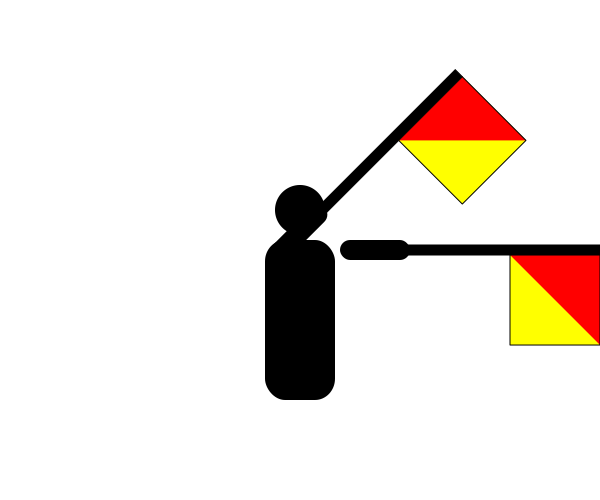
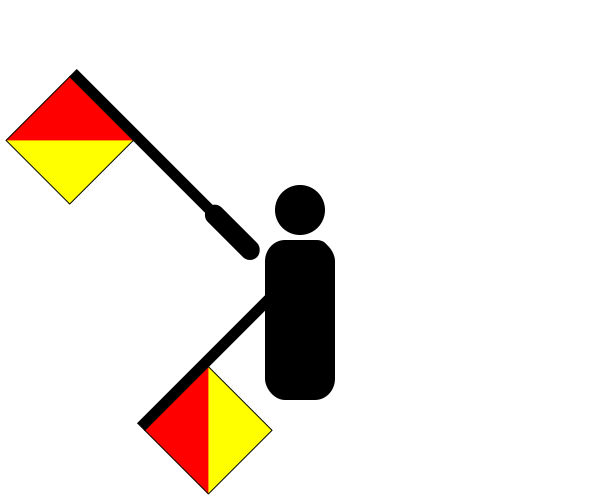

There are approximately 383 people named Ludwig in the UK. That makes it one of Britain's least common surnames. Only around six in a million people in Britain are named Ludwig.
Region of origin: Europe
Country of origin: Poland
Language of origin: Polish

Famous people named Ludwig
- Alexander Ludwig - Canadian actor, singer and model
Names and descriptions courtesy of Wikipedia, and may contain errors. This is not intended to be an exhaustive list of every famous person with this name.