LOYNES
The Loynes surname is of English origin, arising within the region of the British Isles and predominantly identified with the country of England. The language of its original derivation is English and its bearers historically adhered to the Christian faith.
In its earliest form the name is understood to be a patronymic construction derived from the Old English word lind, which can mean either a lime tree or a shield. The appended suffix -es denotes a genitive, specifically “son of”. Consequently the original bearer was either the son of an individual named Lind or was associated with a lime tree or a shield, as was customary in early medieval naming practices.
A further etymology places the surname as a derivative of the Middle English personal name Loyne or Lowne, itself stemming from the pre‑7th‑Century Anglo‑Saxon compound Leofhun. This compound combines leof, meaning dear or beloved, and hun, meaning bear cub. Such compounds were typical of pre‑7th‑Century Anglo‑Saxon and Old Norse personal names, often featuring elements associated with the gods of fire, water and war, or with disparate symbolic components.
Records from the fifteenth and sixteenth centuries attest to the surname’s usage across Norfolk and surrounding counties. For instance, on 28 May 1556 Hew, son of John Lowne, was christened at Marsham, Norfolk; on 20 February 1596 the infant Elizabeth Lownes was christened at St. Bride's, Fleet Street, London. The final s in these occurrences indicates a genitive form, a reduced variant of the patronymic “son of”. By the eighteenth and nineteenth centuries cognates such as Lownes, Lowndes, Loynes, Loines, Loins and Loyns were in common use to denote the same lineage.
Examples of matrimonial and baptismal events further illustrate the name’s geographical and social penetration. Rose Loynes and Thomas Church were married on 11 May 1655 at St. Giles', Norwich, Norfolk, whereas Ann, daughter of John and Ann Loynes, was christened on 4 November 1849 at Fylingdales, Yorkshire.
The heraldic emblem associated with the Loynes family was granted to the line during the reign of Queen Elizabeth I. The shield is quartered, with the first and fourth sections gold and the second and third black, each of the first and fourth featuring a red cinquefoil. The crest is depicted as a hydra proper, royal blue and crimson with golden feet. Such a coat of arms underscores the historical prestige of the surname.
The earliest documented instance of the name is recorded as that of Jone Loynes, who entered into matrimony with Francis Goodwin on 12 February 1585 at Hemblington, Yorkshire. This event occurred within the monarchic period of Queen Elizabeth I (1558‑1603), a reign often referred to as the era of “Good Queen Bess”. This initial spelling provides a concrete anchor for the genealogical history of the Loynes surname.
Typical given names associated with the Loynes surname
Male
- Andrew
- Bernard
- Christopher
- David
- Ian
- John
- Matthew
- Paul
- Peter
- Richard
- Robert
- Simon
Female
- Catherine
- Christine
- Emma
- Helen
- Julie
- Katherine
- Linda
- Margaret
- Mary
- Nicola
- Rebecca
- Sally
- Yvonne
Similar and related surnames
- Lonis
- Lones
- Loye
- Loynd
- Lohnes
- Loines
- Loyne
- Loyn
- Loins
- Loyndes
- Loyes
- Loynds
- Loyens
- Lyones
- Lainas
- Laines
- Lainez
- Lains
- Lanas
- Lance
- Lancee
- Lanci
- Lanes
- Lanese
- Langnes
- Laniesse
- Lanis
- Lanius
- Lannas
- Lannes
- Lanness
- Lanos
- Lans
- Lanse
- Lanuza
- Lanz
- Lanza
- Lanzi
- Lanzo
- Launce
- Launius
- Launois
- Lawnes
- Lawns
- Laynes
- Leanes
- Leaness
- Leans
- Leanse
- Leanza
- Lehneis
- Lehnis
- Leines
- Leins
- Leinz
- Lence
- Lenci
- Lenes
- Leness
- Lenis
- Lenius
- Lennes
- Lennis
- Lenoci
- Lens
- Lense
- Lenus
- Lenz
- Lenza
- Lenzi
- Lenzie
- Leonas
- Leonce
- Leoncio
- Leones
- Leonis
- Leons
- Leunis
- Lewns
- Leynes
- Leyness
- Leyns
- Lianos
- Liens
- Lignos
- Linas
- Lince
- Lines
- Liness
- Linis
- Linnes
- Linns
- Linos
- Lins
- Linsao
- Linse
- Linus
- Linz
- Linza
- Linzee
- Linzie
- Liones
- Lionis
- Lions
- Llanes
- Llaneza
- Llanos
- Llinas
- Loanes
- Loans
- Loehnis
- Loens
- Lohneis
- Loin
- Loinaz
- Lonas
- Lonoce
- Lons
- Loones
- Loons
- Lounas
- Lounes
- Lounici
- Lounis
- Lownes
- Lowness
- Lowns
- Loydes
- Loyns
- Luens
- Lunes
- Lunness
- Lunnis
- Lunniss
- Lygnos
- Lynas
- Lynass
- Lynce
- Lynes
- Lyness
- Lynis
- Lynnes
- Lynns
- Lynos
- Lyns
- Lynus
Related and similar names are generated algorithmically based on the spelling, and may not necessarily share an etymology.
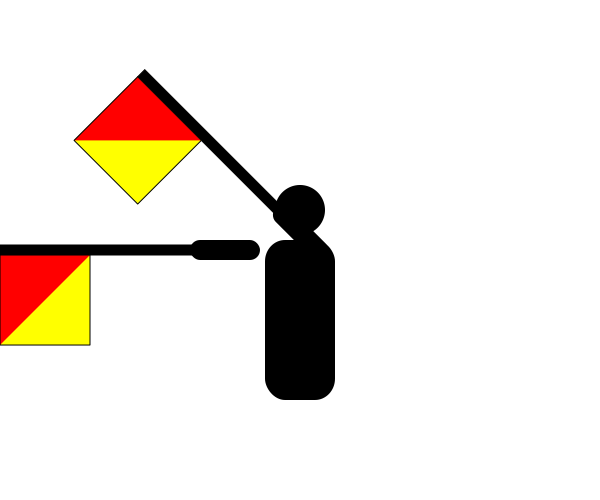
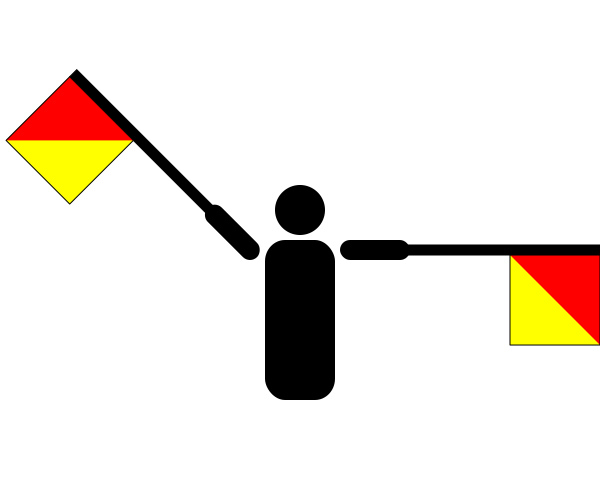
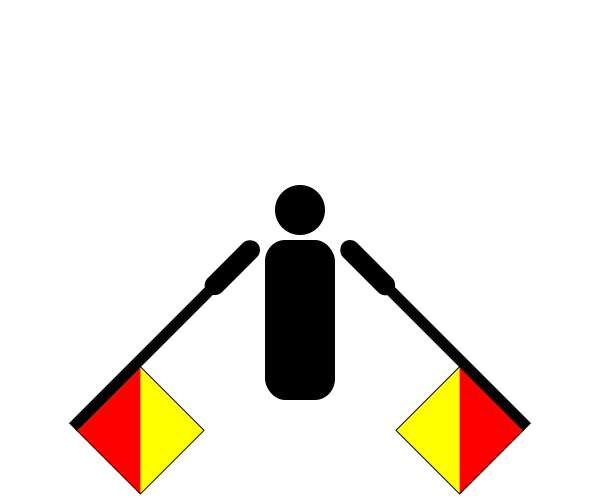
How to communicate the surname Loynes in...
Braille
⠇⠕⠽⠝⠑⠎
Morse
.-..----.---.....
Semaphore



There are approximately 704 people named Loynes in the UK. That makes it roughly the 9,668th most common surname in Britain. Around 11 in a million people in Britain are named Loynes.
Origin: English
Region of origin: British Isles
Country of origin: England
Religion of origin: Christian
Language of origin: English