LOVITT
Lovitt is a surname that originates from the English-speaking regions of the British Isles, with a particular concentration in England.
The name is traced back to the Old English word lufu, meaning “love,” coupled with the diminutive suffix -ett, which denotes “little” or “son of.” Consequently, the earliest sense of the surname is that of “little love” or a patronymic reference to a person who was affectionate or beloved.
Alternative derivations recognise English and Scottish roots. One hypothesis is that it derived as a nickname from the Anglo‑Norman French word louvet – a diminutive of loup meaning “wolf” – thereby denoting a “wolfcub” or “young wolf.” A second hypothesis is as a locational surname linked to the place of Lovat near Beauly in Inverness, Scotland; this name itself is derived from the Gaelic components lobh (“rot”) and ait (“place”).
The earliest extant record of the family is the name Geoffrey Luvet dated approximately 1125 in the Chartulary of Staffordshire during the reign of King Henry I (1100‑1135). Subsequent documentation includes a 1273 subsidy roll entry for Thomas Lovet in Northamptonshire and a 1379 poll‑tax record of Willelmus Louott in Yorkshire. Parish registers from Staffordshire contain notable entries such as the christening of Elianor Lovett (daughter of John Lovett) on 29 August 1517 at Trentham, and the marriage of Agnes Lovatt to Richard Lovatt on 18 November 1582, also at Trentham.
The surname appears in many spelling variants that reflect regional pronunciation and transcription over the centuries. Common forms include Lovett, Loveitt, Lovit, and Lovat, alongside less frequent variants such as Lovet, Lovett, and Lovat.
In contemporary times the name remains relatively uncommon. According to the genealogical database Forebears, there are approximately 2,118 individuals worldwide bearing the name Lovitt. It is most frequently found in the United States, with a high density in Australia. The name’s distribution reflects its historical spread through British colonisation.
Beyond its etymology, Lovitt conveys a sense of endearment or affection, a quality that may have contributed to its initial use as a nickname for a charming or amicable person. In some medieval contexts it was also associated with the personal name Lefwyth, meaning “dear pledge.” Though certain occupational or professional links remain unclear, the name’s affectionate origin is consistently present across its various historical forms.
Typified by its linguistic heritage and its documented presence in parish records spanning from the twelfth to the fifteenth century, the surname Lovitt stands as a concise linguistic testament to affection, lineage, and geographic identity within English and Scottish cultural histories.
Typical given names associated with the Lovitt surname
Male
- Andrew
- David
- Geoffrey
- Jason
- John
- Jonathan
- Keith
- Leslie
- Matthew
- Michael
- Neil
- Robert
- William
Female
- Alison
- Amanda
- Gillian
- Helen
- Joan
- Josephine
- Julie
- Mary
- Pavlina
- Sarah
- Susan
- Suzanne
- Unhan
- Valerie
Similar and related surnames
Related and similar names are generated algorithmically based on the spelling, and may not necessarily share an etymology.
How to communicate the surname Lovitt in...
Braille
⠇⠕⠧⠊⠞⠞
Morse
.-..---...-..--
Semaphore

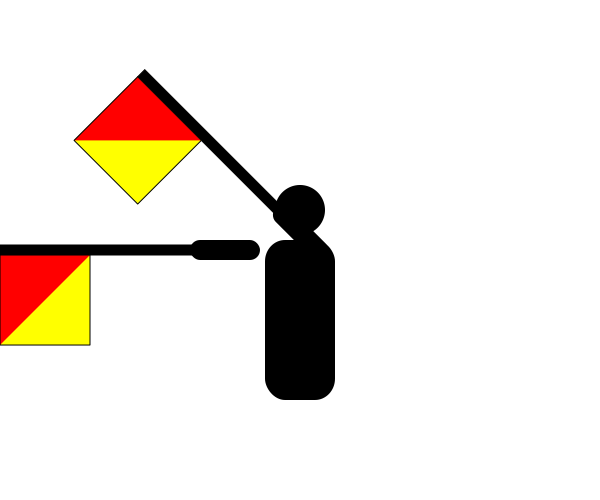
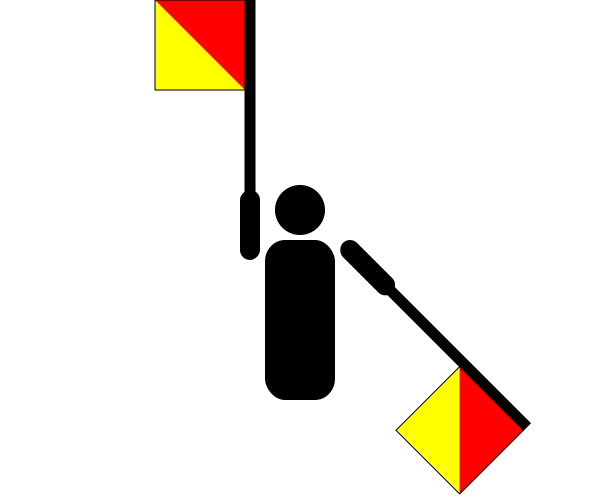
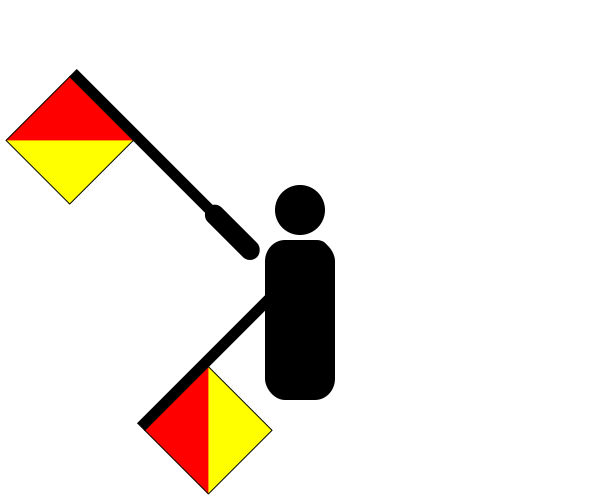
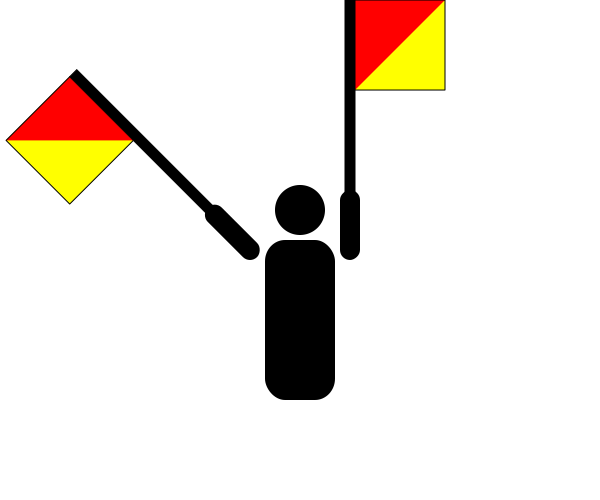
There are approximately 221 people named Lovitt in the UK. That makes it one of Britain's least common surnames. Only around three in a million people in Britain are named Lovitt.
Origin: English
Region of origin: British Isles
Country of origin: England
Religion of origin: Christian
Language of origin: English
