LOVELACE
Lovelace is a surname of English origin, signifying an attachment to a lost place name. The designation traditionally indicates that the earliest bearer hailed from a locality called Lovelace, an Anglo–Saxon settlement that has not survived into the modern era.
The name derives from Old English lof “praise” and lac “play, sport”, together suggesting a person who is praised for engaging in sport or playful activities. An alternative older interpretation, derived from lufu “love” and leas “clearing”, has been proposed to mean “free from love”; however, contemporary scholarship regards this explanation as uncertain, and the more widely accepted meaning relates to praise and sport.
The earliest surviving record of the family name is that of Edith Luvelece, who appeared as a witness in the Somerset Assize Court at Taunton in 1243. Subsequent medieval documents contain varied spellings such as William Luvelas in the rolls of St Gregory's Abbey, Kent; Albricus Loveles in the 1275 Hundred Rolls of Leicestershire; John Lovelace in the 1367 charters of Kent; and Robert Lufeless in the 1445 Calverley rolls of Yorkshire. These documents demonstrate the name’s appearance across several English counties – Somerset, Kent and Yorkshire – and show both male and female bearers.
Prominent individuals bearing the surname include the 17th‑century poet Richard Lovelace, known as the “Cavaliers Poet”, the 19th‑century mathematician Ada Lovelace, noted for her pioneering work on Charles Babbage’s Analytical Engine, and Francis Lovelace, who served as Governor of New York in 1675. The original coat of arms, granted in 1599, consists of a red field, a black chief indented, and a silver knight’s spur.
In contemporary times the surname remains comparatively uncommon. It is found in the United Kingdom and has spread to the United States, where it is occasionally encountered in southern states such as Arkansas, Alabama and Mississippi. Variants of the name that have appeared over time include Loveless, Lowless, Lowles and Lovelass, reflecting regional pronunciation and transcription practices.
While genealogical research can trace some lineages back to the medieval records, the lack of a continuous place associated with the name means that descent from the original locational holder may not be determinable for all modern bearers. Nonetheless, the surname Lovelace carries a historical legacy that links its holders to notable figures in English literature, mathematics and governance.
Typical given names associated with the Lovelace surname
Male
- Christopher
- David
- Dean
- Desmond
- James
- John
- Mark
- Michael
- Nicholas
- Peter
- Richard
- Robert
Female
- Ann
- Caroline
- Elizabeth
- Jean
- Linda
- Louise
- Nina
- Paulette
- Rebecca
- Sandra
- Sarah
- Susan
- Suzanna
Similar and related surnames
Related and similar names are generated algorithmically based on the spelling, and may not necessarily share an etymology.
How to communicate the surname Lovelace in...
Braille
⠇⠕⠧⠑⠇⠁⠉⠑
Morse
.-..---...-..-...--.-..
Semaphore

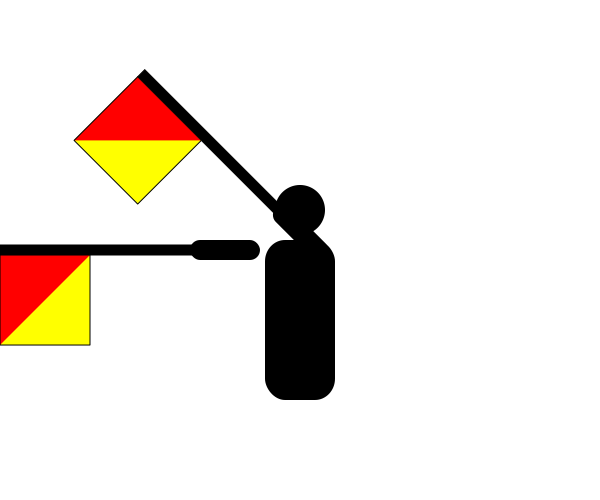
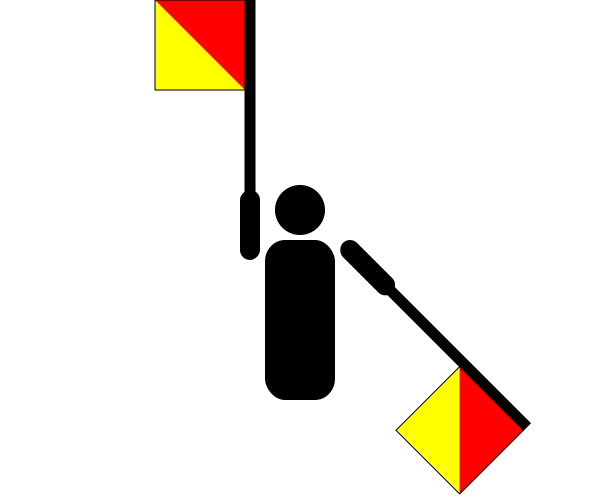


There are approximately 513 people named Lovelace in the UK. That makes it one of Britain's least common surnames. Only around eight in a million people in Britain are named Lovelace.
Surname type: Location or geographical feature
Origin: English
Region of origin: British Isles
Country of origin: England
Religion of origin: Christian
Language of origin: English

Famous people named Lovelace
- Linda Lovelace - American pornographic actress and anti-porn activist (1949 to 2002)
- Richard Lovelace - Writer and poet (1617 to 1658)
- Claud Lovelace - Physicist working on string theory (1934 to 2012)
Names and descriptions courtesy of Wikipedia, and may contain errors. This is not intended to be an exhaustive list of every famous person with this name.