LORENTZ
Origins
The surname Lorentz is of Germanic origin and ultimately descends from the Latin personal name Laurentius, which means “man of Laurentum,” a city on the Italian coast that was renowned in antiquity as the “city of laurels.” The laurel was a symbol of victory and honour in Roman culture, so the name carried connotations of triumph and status.
Early Records
Only a single instance of the name appears in the Domesday Book of England, compiled in 1086. By the following century the name had spread widely across England, appearing in all social strata. A further early example is Magister Laurentius, a cleric whose record dates from about 1150 in the Episcopal Records of Glasgow, Scotland, during the reign of King David I (1124–1153). Other early notations include Johan Lauri of Ulm in 1376 and Lucas Laurenci of Mahren in 1447.
Geographical Spread and Variants
The name evolved into numerous spelling varieties as it migrated across linguistic boundaries. In England and Scotland it gave rise to surnames such as Lawrence, Laurence, Lawrance, Laurie and Lowrie. French forms include Laurant and Laurents; Spanish usage favours Lorenzo; Italian spelling is often Lorenzi or Laurenti; Czech forms incorporate Vavrik; Norwegian adaptations include Lorentzen or Lorentz. Variants that employ patronymic suffixes are Lorenson and Lorensen, indicating “son of Lorenz”. In Eastern Europe the name appears as Lavrentyev, Lavrentiev or Lavrentev.
The surname remains particularly common in Germany, especially in the Rhineland, and is also found in Norway, reflecting historical emigration patterns from those regions.
Etymological Meaning
Through its Latin root, Laurentius, the surname carries the meaning “man from Laurentum.” The associated symbol of the laurel conveys an image of honour and victory, attributes that may have contributed to the name’s popularity among Christians after the martyrdom of St. Lawrence of Rome in 258 AD.
Notable Bearers
One of the most celebrated individuals bearing the surname was the Dutch physicist Hendrik Lorentz, who received the Nobel Prize for Physics in 1902 for his pioneering work on electrodynamics. Although his renown helped to popularise the name in scientific circles, the surname’s prevalence is primarily a result of its long-standing European distribution rather than any single family’s prominence.
Contemporary Presence
Today, Lorentz is not among the most common German surnames, but it remains relatively well-represented across Germany and in the broader diaspora. Its many orthographic variations are found worldwide, demonstrating the surname’s historical adaptability to differing languages and cultures.
Similar and related surnames
Related and similar names are generated algorithmically based on the spelling, and may not necessarily share an etymology.
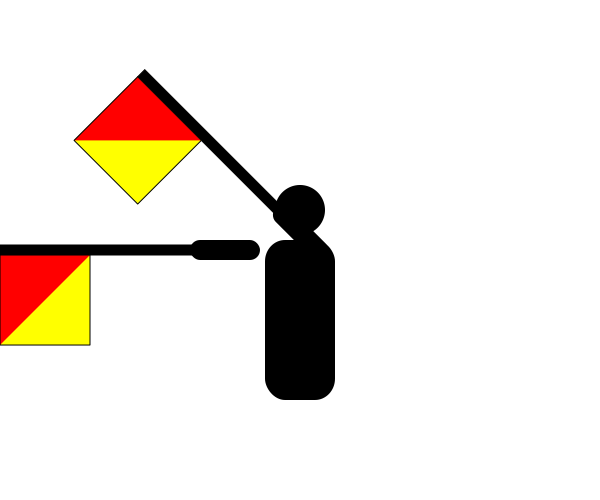
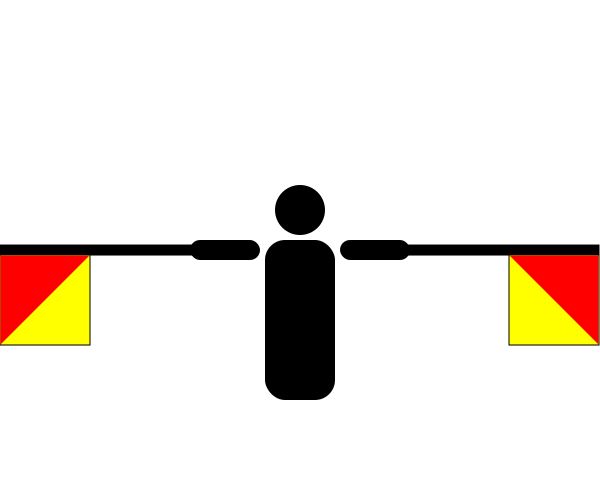
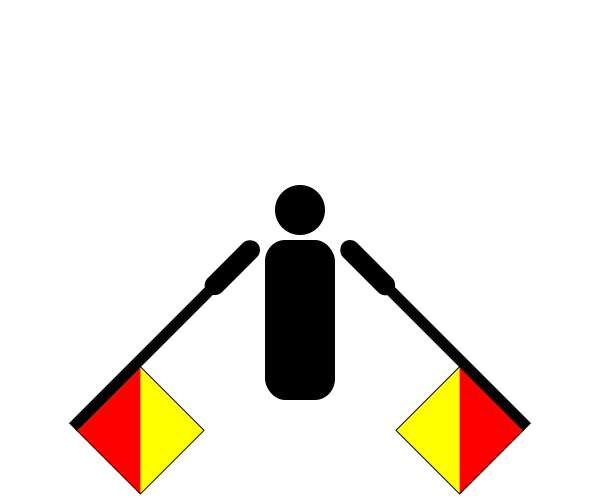
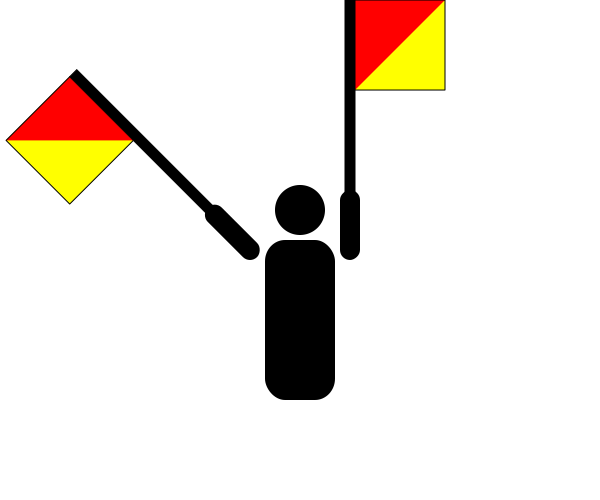
How to communicate the surname Lorentz in...
Braille
⠇⠕⠗⠑⠝⠞⠵
Morse
.-..---.-..-.---..
Semaphore



Sorry, we don't have any statistics on this name. That's probably because it's very uncommon in Britain.
