LOCKNER
Lockner is a surname of German origin, though its presence in Britain stems from several distinct roots. In the Germanic language, the name is connected to the Old High German word lock or Loch, referring to a lock or a vaulted chamber, and the suffix ‑ner, a patronymic element meaning servant or attendant. Consequently, the meaning of the surname can be interpreted as servant of the lock or attendant of the castle, indicating an occupational or locational origin in a fortified place.
Records of the name in German-speaking areas date from the thirteenth century. In 1273 the Hundred Rolls of Oxfordshire mention a Geoffrey de Leweknore, a precursor of the name that would evolve into Lockner in English documents. The German form Löckner has historically been associated with locksmithing, a trade that was highly valued during the Middle Ages when the security of homes and businesses depended on the expertise of skilled craftsmen. Today, variations such as Lockner, Lockner, Lückner and Löckener can still be found in Germany, particularly within the eastern and southeastern states of Hessen, Thuringen, Brandenburg and Saxony an der Saale, as well as in Switzerland and Austria.
Separately, an Anglo‑Saxon variety of the surname appears in the southeastern counties of England. It is a late form of the locational surname Lackner or Leakner, itself rare and derived from the place known as Lewknor near Watlington in Oxfordshire. The place name has been recorded as Leofecanoran in a 994 Saxon Diplomatic Codex, as Levec(h)anole in the Domesday Book of 1086, and as Leovechenora by about 1160. The name is believed to stem from the Old English personal name Leofeca, itself a diminutive of Leofa meaning beloved, with the suffix ora, meaning bank or slope; when combined, it yields the sense Leofeca's slope.
Within this Anglo‑Saxon tradition, the surname has appeared in Church Registers under a variety of spellings, including Leackener (1564, Kent), John Lacknar (1614, Surrey), and Richard Lockner (1623, Sussex). A record of a marriage between Ruth Lockney and Joseph Taylor is dated 31 July 1763 in Thames Ditton, Surrey, while a christening in Alnwick, Northumberland, lists James Wilson, son of James Lockney, on 25 December 1809. These entries show how the surname was used as a means of identifying individuals who had departed their birthplace to settle elsewhere, and how regional dialects and varying literacy levels produced the wide range of variants that persist.
Moreover, the name has been observed to have spread beyond Europe, carrying with it the heritage of a once-critical trade to countries such as the United States, Canada, Australia, New Zealand, South Africa, Argentina and Brazil. Despite the decline of traditional locksmithing due to modern security systems, the surname Lockner remains a testament to German cultural heritage and the history of skilled trades in medieval society.
Similar and related surnames
Related and similar names are generated algorithmically based on the spelling, and may not necessarily share an etymology.
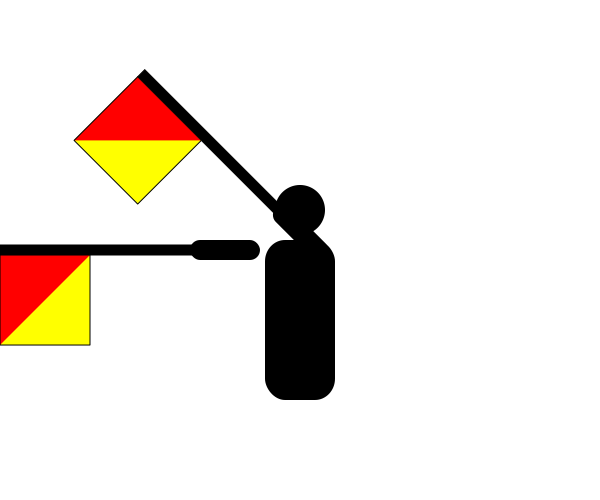
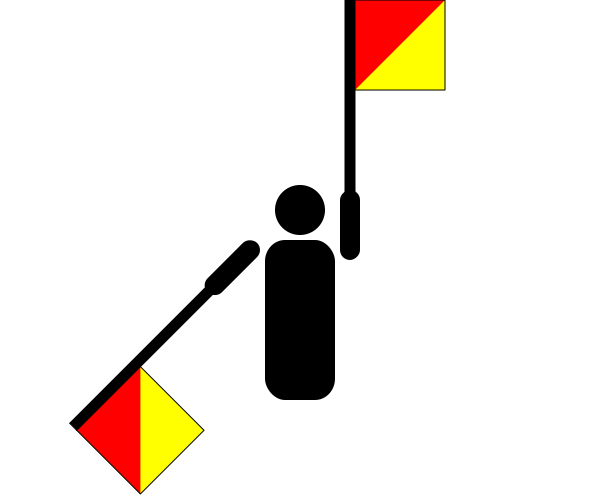
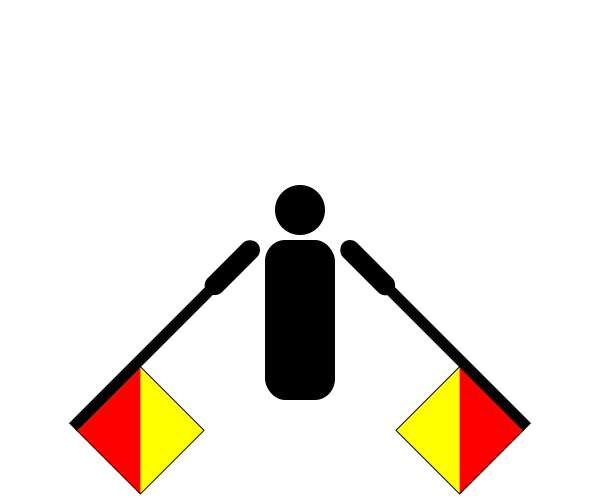
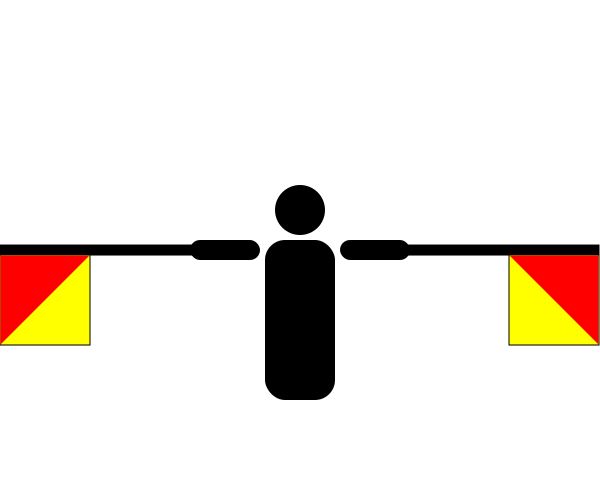
How to communicate the surname Lockner in...
Braille
⠇⠕⠉⠅⠝⠑⠗
Morse
.-..----.-.-.--...-.
Semaphore



Sorry, we don't have any statistics on this name. That's probably because it's very uncommon in Britain.
