LOBER
Lober is a surname of German origin. It is derived from the Middle High German word "lober", meaning "praise" or "praiser". The name is regarded as an occupational surname or nickname given to people who were known for praising or complimenting others. Praise was often part of the duties of court jesters or other entertainers, and the label later became hereditary and was passed down through successive generations.
Alternative etymological explanations describe Lober as a medieval variant of Lebert, a name cognate with the English surname "leppard". This word is in turn derived from Old German, Old French "lepard" and ultimately from Late Latin "leopardus" (a compound of leo "lion" and pardus "panther"). This lineage suggests that the surname may have originally served as a nickname for a stealthy man or for a person who lived in a house distinguished by the sign of a leopard. In England the surname is rare but has been documented in the mid‑16th century; for example, Charles Lober married Margaret Fernne on 12 June 1558 at Ardingley in Sussex. Further early records include the marriage of Paul Loeber to Katharina Weiner in 1560 at Weimar, Sachsen‑Weimar, Eisenach; the christening of Margaret Lober, daughter of Hans and Anna, on 17 May 1567 at Schwaben, Lindau Bodensee, Bayern; and the christening of Jacque Lober, son of Olivier and Anne, in 1654 at Cone-sur-l'Escant, Nord in France.
A coat of arms requested for a Lober family in Germany is described as a shield divided per pale, black and silver. The first half bears a gold lion crowned in the same metal; the second half contains three diagonal red bars. The earliest recorded spelling is that of Adam Loeber, dated 1530, whose marriage to Maria Seidel took place at Zwickan, Planew, Sachsen, Germany during the reign of Emperor Charles V (1519-1558).
Many spelling variants are documented. These include Laber, Laiber, Layber, Leiber, Leibor, Leyber, Leybor, Leybov, Liaber, Liabor, Lieber and Lubar. Earlier forms such as "Lexer" and "Lekar" eventually evolved into leyber and leybov. Within Ashkenazic Jewish families the spelling Laber was common, representing a Germanised version of the Yiddish word “Levar”, itself derived from the Hebrew “lev” meaning heart or courage. Other languages provide variants such as Laiber (German), Leiber and Liaber (Hungarian), Leibor (Slavic) and Lubar (Croatian or Slovenian). In Ireland the name has at times been rendered as Locher and Lochery. Parallel surnames from the same root include Löb, Löbmann, Löft, Liebman, Liebmann, Lebenstein, Libman, Lob and Loeb.
Geographically, the surname is traditionally common in Germany and Austria. In the United States it is most frequently found in New York, Pennsylvania and New Jersey, with the highest concentration in Queens borough of New York City. Records indicate that the surname has maintained an established presence in Germany dating back to the 13th century, and it spread throughout Europe and the United States largely through waves of immigration in the late 19th and early 20th centuries. The surname remains a distinctive name today, recognised across Europe and in the United States.
Similar and related surnames
Related and similar names are generated algorithmically based on the spelling, and may not necessarily share an etymology.
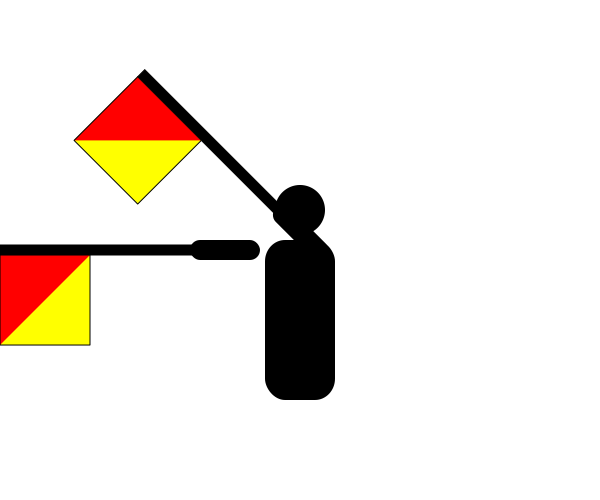
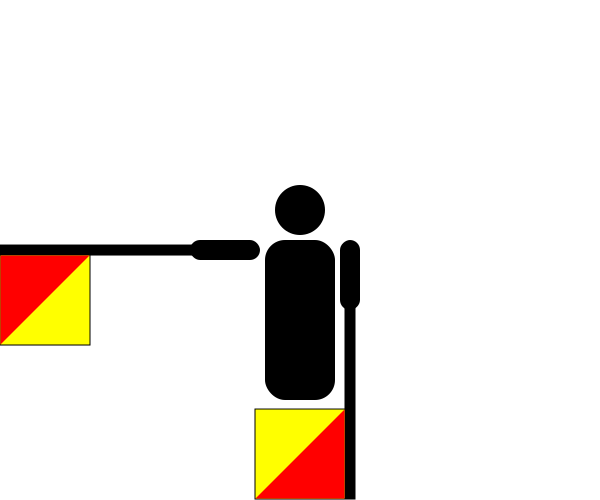
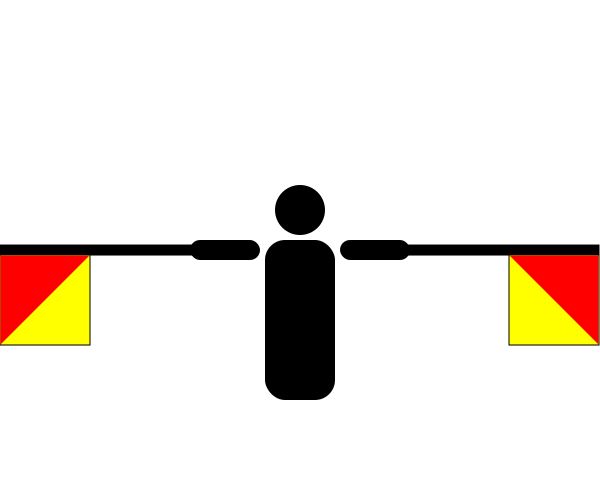
How to communicate the surname Lober in...
Braille
⠇⠕⠃⠑⠗
Morse
.-..----.....-.
Semaphore


Sorry, we don't have any statistics on this name. That's probably because it's very uncommon in Britain.