LITTLEFAIR
Recorded variant spellings include Little Fair
Littlefair is a surname of strictly English provenance, first emerging in documentary records during the late fourteenth century. It is not a toponymic name derived from a village or estate but rather a descriptive nickname that was subsequently inherited as a family appellation.
The earliest recorded spellings—Littlefair, Littelfair, and the dialectal Littefair—indicate its construction from Old English elements. The prefix lytel, meaning “little,” is a noun that later evolved into the adjective little in modern English. The second element is treated in source texts in two slightly different forms: fæger, meaning “fair” or “beautiful,” and feara, a term for a comrade or companion. When combined, these components would have produced a phrase roughly interpreted as “little fair one” or “little companion.” In the medieval period, such epithets were often applied affectionately to individuals of diminutive stature who were otherwise regarded as pleasing or well‑mannered. The name, therefore, would have described a person of small physical size and an attractive appearance or social role.
Historical evidence attests to the use of the name as early as 1381, when an Agnes Lutfair is recorded in the Subsidy Rolls of Staffordshire. This document, dated to the reign of King Richard I of Bordeaux, provides the earliest known instance of the surname in written form. Subsequent records, all contemporaneous with the name’s medieval emergence, include a Thomas Lytlefayr listed on the University of Oxford register in 1585, and a Robert Littlefayer who married Elizabeth Sympson in Caton, Lancashire, on 22 September 1627. Earlier family members are also noted in parish registers: Henricus and Elizabeth, children of Johis Litlefare, were christened at Wensley, Yorkshire, on 23 July 1582 and 3 September 1590 respectively. These citations demonstrate that the surname was adopted by multiple families across the English counties of Staffordshire, Yorkshire, Durham and Lancashire.
Despite these early attestations, Littlefair has remained exceptionally uncommon. The surname has not entered the realm of widespread or repeatedly cited English surnames in the centuries following its first appearance. Linguistic scholars attribute this rarity to its origin as a nickname rather than a placename or occupational title; as such, proliferation depended largely on the social prominence or demographic expansion of the original bearer. In the absence of a widespread lineage, the name persisted primarily among a handful of families whose lineages can be traced through the aforementioned parish and university records.
In contemporary usage, individuals bearing the surname Littlefair maintain a link to a distinctive element of English onomastic history. The name offers a window into the practices of surname formation in the Middle Ages, wherein personal traits—size, appearance, character and social function—often became hereditary identifiers. Its continued, though limited, presence in modern Britain and the diaspora attests to the endurance of such medieval naming traditions even as English society evolved dramatically over the past six centuries.
Typical given names associated with the Littlefair surname
Male
- Andrew
- Chris
- Christopher
- David
- Ian
- James
- John
- Mark
- Paul
- Robert
- Ronald
- Stephen
- Stuart
Female
- Diane
- Elizabeth
- Emma
- Helen
- Joanne
- Karen
- Mary
- Patricia
- Sarah
- Susan
- Wendy
Similar and related surnames
Related and similar names are generated algorithmically based on the spelling, and may not necessarily share an etymology.
How to communicate the surname Littlefair in...
Braille
⠇⠊⠞⠞⠇⠑⠋⠁⠊⠗
Morse
.-....--.-.....-..-...-.
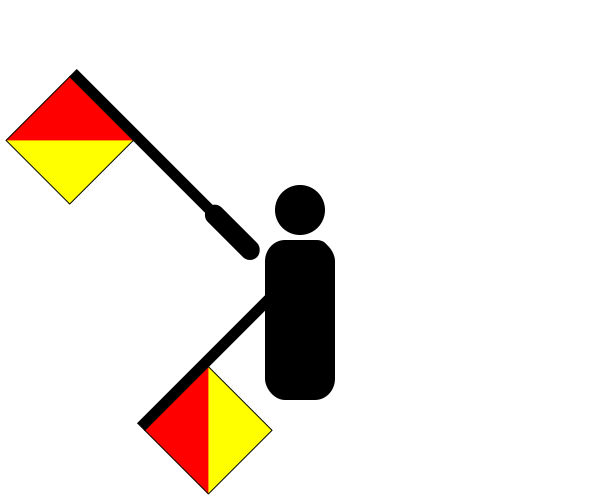
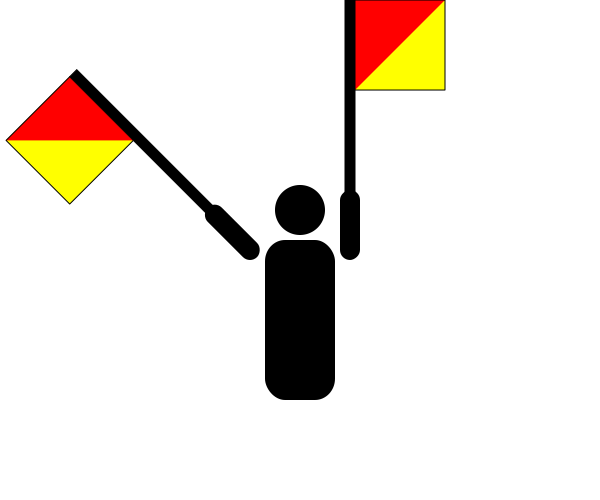
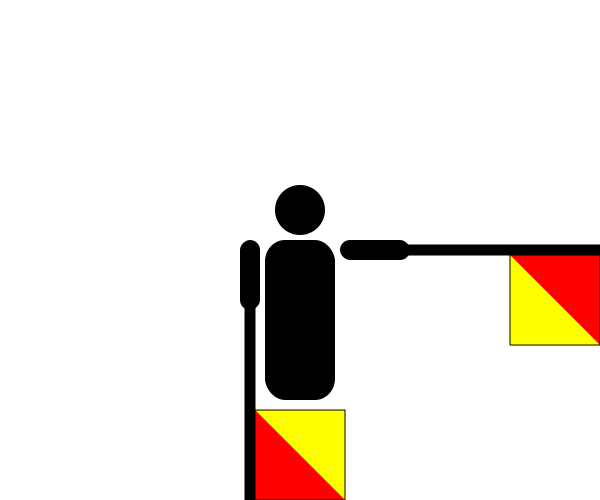
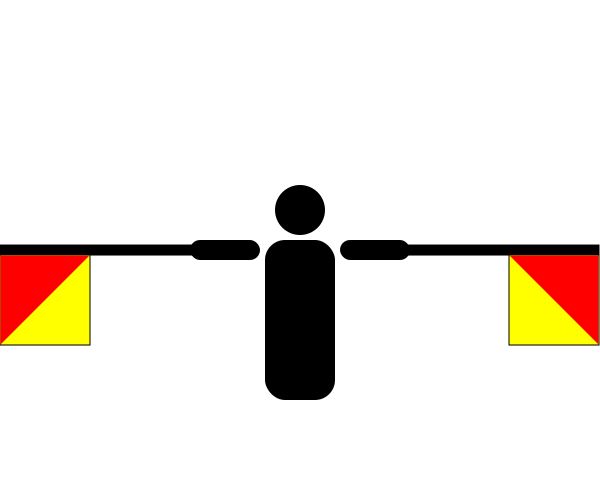
Semaphore



There are approximately 1,106 people named Littlefair in the UK. That makes it roughly the 6,821st most common surname in Britain. Around 17 in a million people in Britain are named Littlefair.
