LINNETT
Linnett is an English surname of medieval origin which has survived into the present day with a number of spelling variations.
The name is first recorded in the Hundred Rolls of Sussex in 1275 under the spelling Linet, where an individual named Robert Linet appears during the reign of King Edward I. This early use indicates that the surname had already become hereditary by the reign of the early thirteenth century.
One proposed derivation comes from the Middle English word linet, meaning a small songbird known as a linnet. As a nickname it may have been applied to a person with a pleasant singing voice or someone who dwelt among areas frequented by these birds. Another theory links the surname to pet‑forms of the feminine name Lina, itself a diminutive of names such as Adelina, Emelina or Lecelina, and also to the Middle English linet and Old French linot, both meaning linnet.
Alternative etymological explanations trace the surname to the Old English Leahtun, meaning “woodland clearing.” Under this interpretation the original bearer would have lived near or worked within a clearing of a forest. The Domesday Book of 1086 records occurrences of the name in the Nottinghamshire region, and later tax rolls such as the 1332 Subsidy Rolls of Cheshire mention individuals like Linnetta de Venables and her son Simon.
Throughout the Middle Ages the name appears in a variety of forms. Examples include Thomas Linet, who is recorded as a witness in the Assize Rolls of Kent in 1317; Thomas Linnit, christened at St. John, Hackney on 13 January 1558; and John, son of Dyonys Lynnett, who was christened at St. Giles, Cripplegate on 8 April 1592. In 1626 Elizabeth Linnett married Thomas Hill at St. Katherine by the Tower in London.
Common spelling variants have included Lynot, Lynnet, Linnet, Linnit, Linnitte and others. These variants reflect the lack of standardised spelling in medieval and early modern England.
In contemporary times the surname is predominantly found in the United Kingdom, where it is most common in the South East of England, particularly in London, Essex, Kent and Sussex. Outside the United Kingdom it appears in various countries, with the United States showing the highest concentrations in Texas, North Carolina, Ohio and Illinois, as well as in the Midwest and Great Lakes regions. In Australia the name is notable for William Edward Linnett, the first Australian recipient of the Victoria Cross for gallantry.
Derived surnames sometimes incorporate a patronymic element, with Linnett being understood as a diminutive of the personal name Lini plus the suffix -et. In a toponymic sense it has also been linked to places named Liney (from Old English linked, meaning a flax field), with spellings such as Leaney, Leanney and Leny.
Overall, the surname Linnett demonstrates a wide range of origins, spelling variants and geographic distribution. Although it does not rank among the most common British surnames, its documented history and occasional notable bearers give it a distinct place within the tapestry of English nomenclature.
Typical given names associated with the Linnett surname
Male
- Chris
- David
- James
- Mark
- Matthew
- Melvin
- Michael
- Paul
- Peter
- Richard
- Robert
- Scott
- Steven
- William
Female
- Claire
- Deborah
- Elizabeth
- Emma
- Helen
- Pamela
- Rebecca
- Sarah
- Susan
- Victoria
Similar and related surnames
Related and similar names are generated algorithmically based on the spelling, and may not necessarily share an etymology.
How to communicate the surname Linnett in...
Braille
⠇⠊⠝⠝⠑⠞⠞
Morse
.-....-.-..--
Semaphore

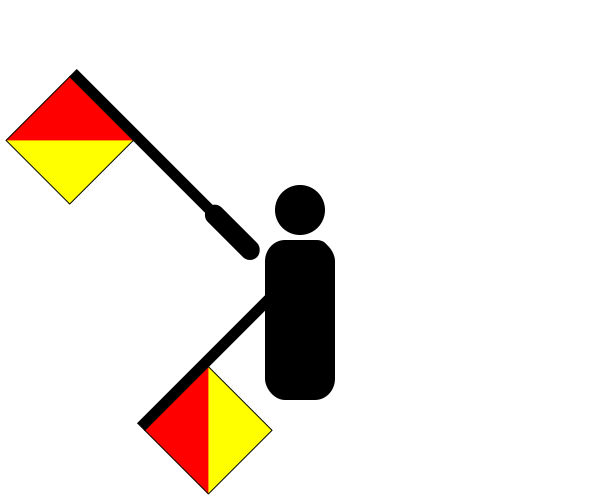
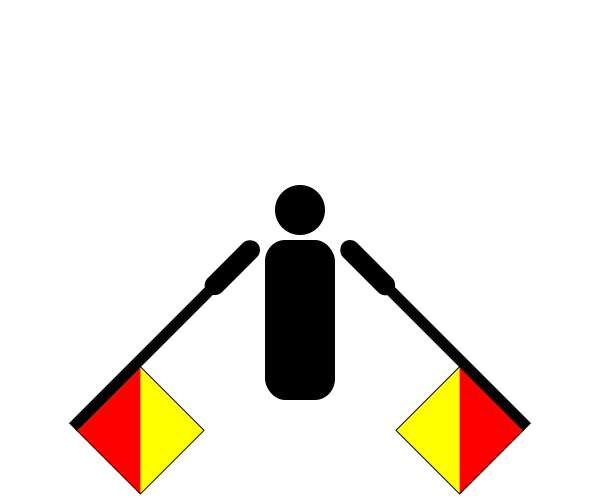

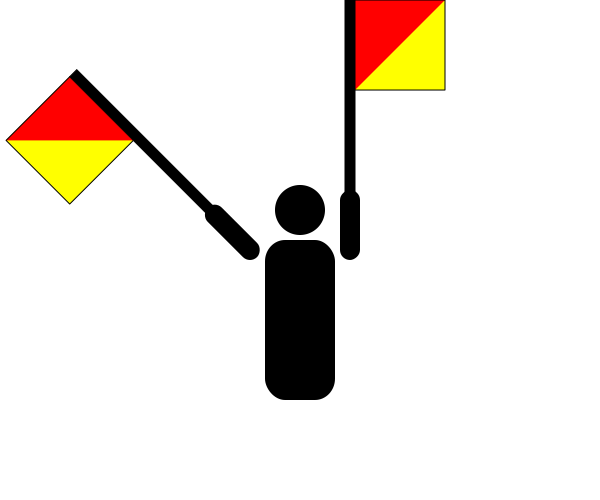
There are approximately 652 people named Linnett in the UK. That makes it one of Britain's least common surnames. Only around ten in a million people in Britain are named Linnett.

Famous people named Linnett
- Kirsty Linnett - Football player
- Jack Linnett - Chemist (1913 to 1975)
Names and descriptions courtesy of Wikipedia, and may contain errors. This is not intended to be an exhaustive list of every famous person with this name.