LINDHOLM
Lindholm is a surname of Swedish provenance, derived from the combination of two Swedish lexical elements: lind, meaning “lime tree” or “linden tree”, and holm, meaning “island” or “small island”. The composite therefore signifies “lime‑tree island” or “island with lime trees”. As a result, the name is traditionally regarded as a locational surname, indicating that the bearer formerly lived near or upon an island that was characterised by lime trees.
The surname is a comparatively common last name in Sweden and can also be found in other Scandinavian countries such as Finland, Denmark and Norway. In English‑speaking countries the name is usually associated with descendants of Swedish emigrants. Its prevalence in Sweden is reflected in the fact that it appears amongst a large percentage of Swedish families and can be encountered in records of emigration to the United Kingdom, the United States and other destinations.
Historical evidence shows that the name has evolved through more than forty spelling variants. These include Lind, Linde, Linden, Line, Lynd, Lyne, Lingner, Verlinden, Van Lint, Terlinden and Lindman. The earliest documentary reference is often cited as a 1254 city register entry of a person named Hainrich Linde in Konstanz. Earlier English records, for instance the 1181 Pipe Rolls of Oxfordshire, mention a person named Lina without an attached surname, which is considered an antecedent of the name. In Germany the name appears in the early thirteenth century, notably in a charter of 1305 naming Cunrad Linde of Beuren.
The name also appears in legal documents from the sixteenth century, such as the 1549 marriage of John Line and Joan Withy in St. Lawrence Jewry, London, and in twentieth‑century migration records. During the colonial era, a man named Christopher Line is recorded as owning approximately 272 acres of land in Barbados in 1679, illustrating the geographic spread of bearers of the surname beyond Europe.
Because the root elements lind and holm are common in the Germanic linguistic heritage, the surname is sometimes linked, by coincidence, to other family names that contain the same components. Variations such as Linderholm, Lyndholm and, less commonly, Lendholm are occasionally seen. However, such correlation does not imply a genealogical connection between families who bear different forms of the name; the meanings can vary according to local dialects and historical contexts.
In contemporary settings, the surname remains most frequently encountered in Sweden but retains a global presence due to historical migrations. Irish, English and American bearers of the name may trace their lineage to Scandinavian ancestors who carried the name from across the Baltic Sea to new lands. The distribution of the name within particular local areas often mirrors historical migration patterns and settlement clusters, a phenomenon common to many surnames with locational origins.
Similar and related surnames
Related and similar names are generated algorithmically based on the spelling, and may not necessarily share an etymology.
How to communicate the surname Lindholm in...
Braille
⠇⠊⠝⠙⠓⠕⠇⠍
Morse
.-....-.-......---.-..--
Semaphore

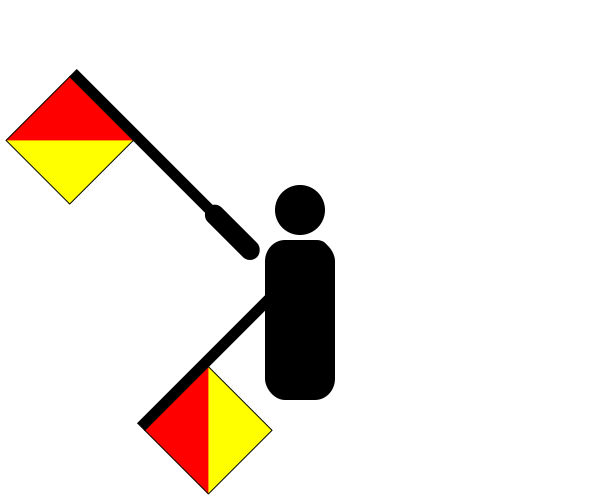
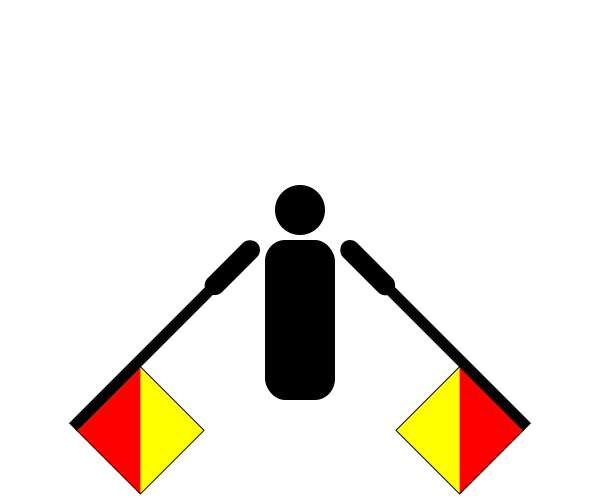


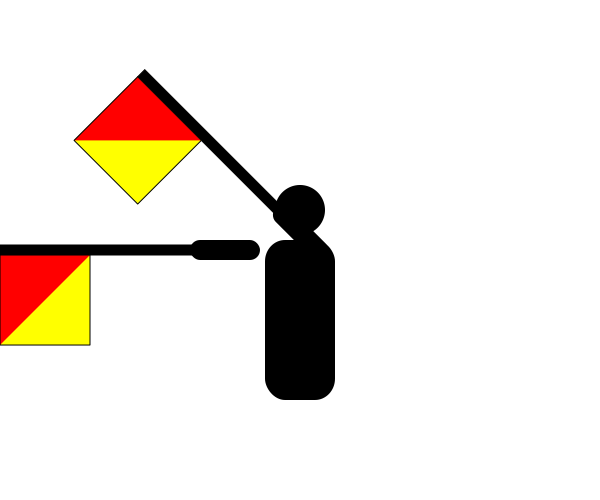

There are approximately 55 people named Lindholm in the UK. That makes it one of Britain's least common surnames. Only around one in a million people in Britain are named Lindholm.
Origin: Scandinavian
Region of origin: Europe
Country of origin: Sweden
Religion of origin: Christian
Language of origin: Swedish
