LINDENBERG
The surname Lindenberg is of German origin, formed from the elements linden – the lime or basswood tree – and berg, meaning mountain or hill. Consequently the literal interpretation of the name is “lime tree mountain” or “hill of lime trees.”
It is generally understood to be a topographical name. In medieval societies natural and man‑made features were the easiest means of distinguishing individuals within small communities, and a person who lived near a hill populated with lime trees would naturally acquire the identifying appellation Lindenberg.
The earliest documentary references to the surname appear in a range of forms, including Lind, Linde, Linden, Line, Lyne, Lingner, Verlinden, Van Lint, Terlinden and Lindman. The first recorded instance in England appears in the 1181 Pipe Rolls of Oxfordshire, where a Lina is noted; this form is linked to the medieval female given name Line, an aphetic variant of Catherine and related to names such as Emmeline and Adeline.
In Germany the name is dated to the 13th century. A 1254 city register of Konstanz records a Hainrich Linde; a 1305 charter from Beuren mentions Cunrad Linde. These early attestations confirm that the surname had already become associated with specific families by the mid‑14th century.
During the Early Modern period further instances appear. A 1549 marriage record in St. Lawrence Jewry, London, notes the union of John Line and Joan Withy. By the late 17th century, a Colonel Christopher Line is recorded as owning 272 acres in Barbados on 23 December 1679, illustrating the migration of bearers of the surname to the New World.
Following German emigration in the 19th and early 20th centuries the surname spread beyond its country of origin. Today it is found, though not extremely common, in Germany, the United States, Canada, and other parts of Europe where German diaspora communities have settled. The name became more widely recognised in modern times, partially due to the prominence of the German rock musician Udo Lindenberg.
Variants of the surname that have appeared in historical records include Lindenburgh, Lindenberger, Lindenburg, Lindenbergh, Linderberg, Lintenberg and Lintenburgh. These variations arise from regional dialects and phonetic spellings recorded by clerks and immigration officers, and sometimes from simple errors in transcription. The suffix berg is occasionally replaced by the cognate hügel, resulting in forms such as Lindenhügel that convey the same topographical meaning.
Similar and related surnames
Related and similar names are generated algorithmically based on the spelling, and may not necessarily share an etymology.
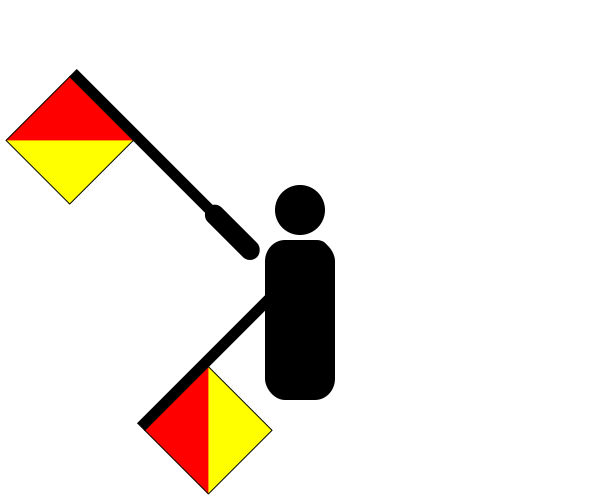
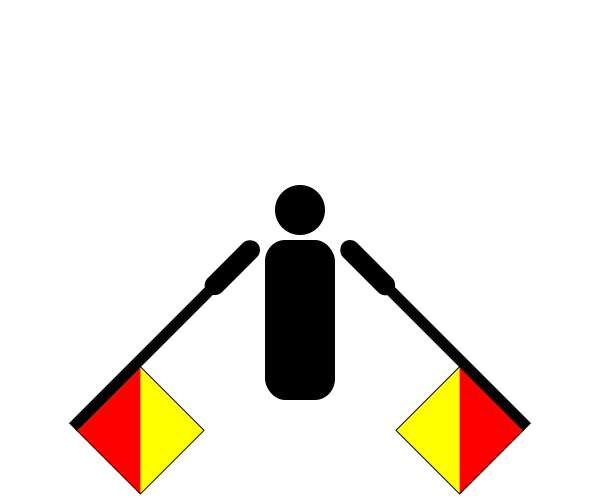
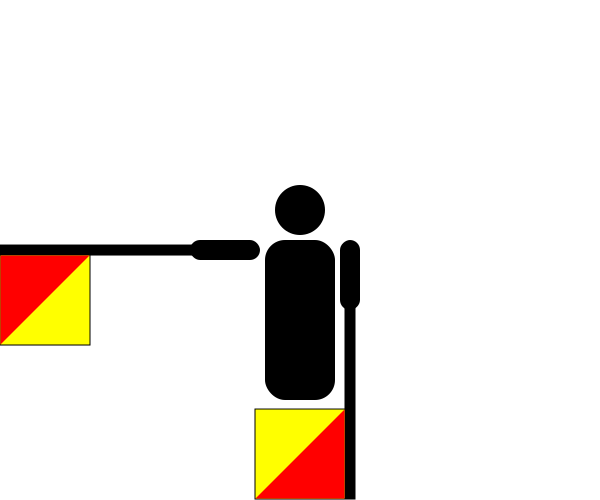
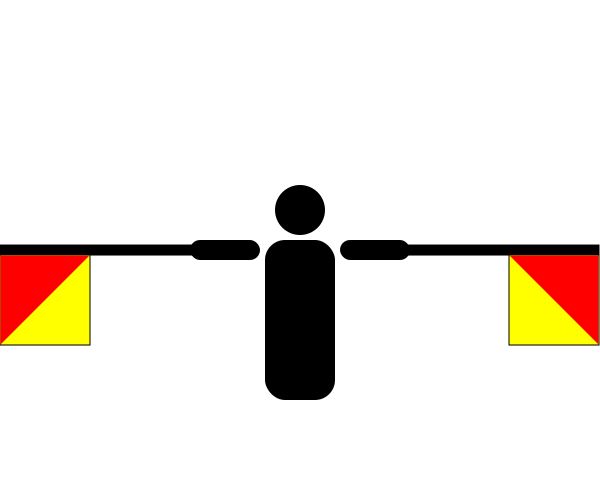
How to communicate the surname Lindenberg in...
Braille
⠇⠊⠝⠙⠑⠝⠃⠑⠗⠛
Morse
.-....-.-...-.-.....-.--.
Semaphore




There are approximately 111 people named Lindenberg in the UK. That makes it one of Britain's least common surnames. Only around two in a million people in Britain are named Lindenberg.