LIES
Lies is a surname of German origin that exhibits both occupational and toponymic roots. Its earliest attestations, recorded between the twelfth and thirteenth centuries, show the name in a range of spellings that reflect the linguistic diversity of early medieval Europe.
The occupational derivation of Lies comes from the Middle High German word liese, meaning flax. It was commonly applied as a nickname to those engaged in the cultivation, processing, or trade of flax or linen, such as growers, spinners or linen merchants.
Other etymological strands suggest a connection to the natural landscape. In German, the term lee was a nickname for a meadow, while the *Old High German* word lasi and its variants laz and Liesen described the cutting of hay or the existence of a meadow or pasture. Bearers of the name in early medieval Germany were therefore sometimes identified as dwelling in meadows or as people associated with meadowland.
Through the process of linguistic borrowing, Lies also acquired an English toponymic dimension. The name, recorded as de la Lea or de la Lee, derives from the pre‑7th century element leah, meaning a clear opening within a wooded area or a low‑lying meadow. It was adopted by individuals who resided near places named Lee, Leigh or Leas across counties such as Buckinghamshire, Hampshire, Essex, Lakeshire, and Shropshire, as well as in the Dublin and Cornwall regions. Early legal documents mention Turqod de la Lea in the Pipe Rolls of Warwickshire in 1193 and Richard de la Lee in the Hundred Rolls of Wiltshire in 1273.
In addition to the occupational and geographic origins, a number of patronymic and diminutive forms exist. Variants include Lay, Lie, Lye, Lays, Lias, Lis, Lys, Lyes, and longer forms such as Lebesmann, which in Dutch connotes a beloved man. In England, spellings Lees, Lyes and occasionally Lehrs appear in church registers, while in the United States the name is most commonly rendered simply as Lies.
The surname has been borne by several notable individuals. Benjamin Lay (1677‑1759), a Quaker cleric from Philadelphia, is remembered for his vigorous opposition to slavery in the West Indies. In Germany, figures such as Johann Christian Lies, who served as mayor of Weersburg in 1752, and Heinrich Liessen, a knight‑saddle commander in the Dutch army, demonstrate the surname's historical presence across Europe.
A heraldic device traditionally associated with the family features a red field, a silver chevron charged with three round, red discs, and a crest comprising a gold escallop with a red saltire.
Contemporary demographic data indicate that Lies remains most common in Germany and Austria, but is also found in other European countries including France, the Netherlands, Belgium, Switzerland, and Poland. Significant concentrations exist within the United States, particularly in Wisconsin, Minnesota, Illinois, Indiana and New Jersey, where descendants of German and Austrian emigrants have settled.
In sum, the surname Lies exemplifies the intricate interplay of occupation, landscape, and linguistic evolution that characterises many European family names. Its varied spellings and widespread geographic distribution reflect the migratory patterns and cultural interactions that have shaped the name since its earliest records in the medieval period.
Similar and related surnames
Related and similar names are generated algorithmically based on the spelling, and may not necessarily share an etymology.
How to communicate the surname Lies in...
Braille
⠇⠊⠑⠎
Morse
.-........
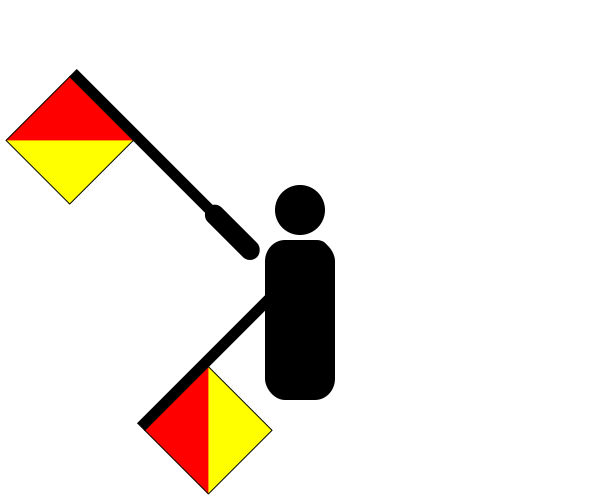
Semaphore



Sorry, we don't have any statistics on this name. That's probably because it's very uncommon in Britain.
