LIEBER
The surname Lieber is of German origin, deriving from the Middle High German word lieber, which signifies “dear” or “beloved.” It is traditionally regarded as a nickname, assigned to an individual who was regarded as warm, affectionate or pleasant by their contemporaries.
Historical records show the name appearing in a variety of spellings, including Lieb, Lieber, Leverman, Liberman, Liebmann, Liepmann, Lipman, Lippman and Lipmanovicz. This range reflects the common practice of the early modern period for surnames to be recorded with orthographic variation, especially where local dialects differed widely.
One of the earliest documented uses of the name, in the character of Conrad Liepmann, appears in the town charters of Vaihengen, Germany, in 1394. Subsequent records include Anna Justina Lipman of Dresden (baptised 19 November 1661), Anna Elizabeth Liebmann of Leipzig (8 August 1700) and Carl Gottfrid Lippmen of Dresden (22 November 1801). These entries illustrate the surname's persistence across several centuries in central Europe.
In addition to its German usage, Lieber is found across a range of Central and Eastern European countries, such as Poland, Austria, Hungary and Romania. The surname also appears in Jewish Ashkenazic communities, a fact reflected in its prevalence among North American populations that settled during the 19th and early 20th centuries.
In the United States, the 2010 Census records approximately 29 000 individuals with the surname Lieber, one of the most common German‑American surnames among Jewish families in cities such as New York. Many of these families emigrated from Germany during the 1700s and 1800s in response to religious persecution, bringing the name across the Atlantic and shaping its modern demographic profile.
While the surname is primarily associated with its German roots, it is also found in several English‑speaking countries, particularly Canada, the United Kingdom, Australia and South Africa. In these regions, spelling variants such as Liberman, Leiber, Lebmann and Lyberman often coexist with the original form. The consonance of these variants is attributable to the migration of Jews and non‑Jews alike during the 19th and 20th centuries.
In contemporary usage, the surname Lieber retains the sense of affection and pleasantness that characterised its origin. The word lieber continues to appear in German compounds such as liebkind (“dear child”), liebenswert (“lovable”) and lieblich (“lovely”), demonstrating the lasting influence of the root on the language.
Worldwide, estimates suggest that around 100 000 people currently bear the surname Lieber or one of its recognised variants. This figure includes individuals in Europe, the United States, Israel, Canada, Australia and South Africa, highlighting the surname's global dispersion while preserving its distinctly German heritage.
Similar and related surnames
Related and similar names are generated algorithmically based on the spelling, and may not necessarily share an etymology.
How to communicate the surname Lieber in...
Braille
⠇⠊⠑⠃⠑⠗
Morse
.-.....-.....-.
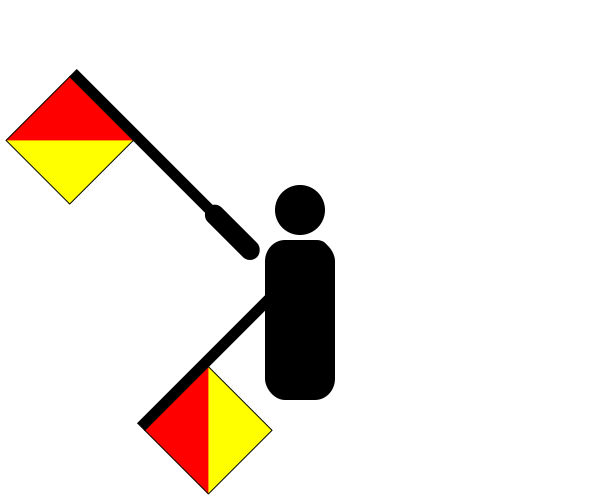
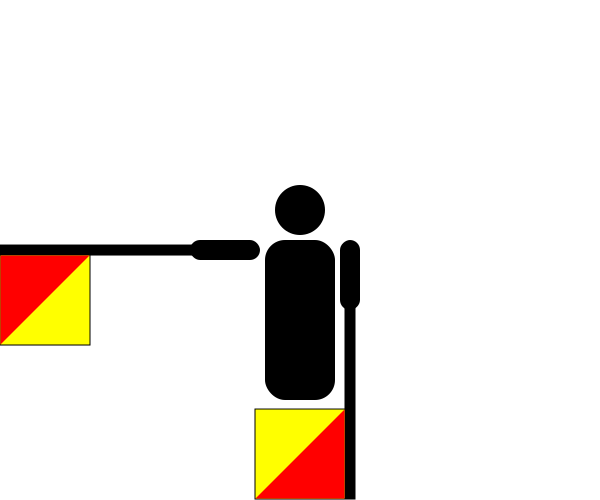
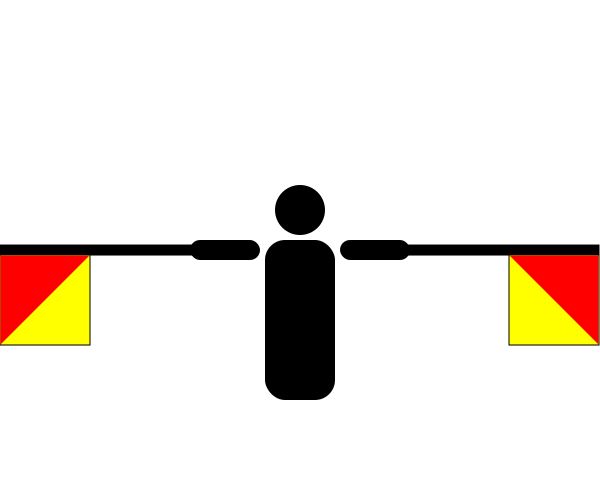
Semaphore


There are approximately 74 people named Lieber in the UK. That makes it one of Britain's least common surnames. Only around one in a million people in Britain are named Lieber.
