LIEB
Lieb is a surname of German origin. It derives from the Middle High German word liep, meaning “dear” or “beloved”, and it was originally used as a nickname for a person who was cherished within their community.
The spelling of the name has varied widely over the centuries. Recorded forms include Lieb, Lieber, Leverman, Liberman, Liebmann, Liepmann, Lipman, Lipmann, Lippman and Lipmanovicz. These variants reflect regional pronunciation differences and the influence of other languages such as Polish and Hebrew on the surname’s evolution.
One of the earliest documented instances is that of Conrad Liepmann, mentioned in the charters of the town of Vaihengen, Germany, in 1394. Other early records include Anna Justina Lipman, the daughter of Michael Lipman, baptised at Dresden on 19 November 1661; Anna Elizabeth Liebmann, recorded at Leipzig on 8 August 1700; and Carl Gottfrid Lippmen, also of Dresden, dated 22 November 1801. These entries illustrate the surname’s presence in German civic and ecclesiastical documents from the late Middle Ages onward.
In the 13th century, surnames began to be officially recorded in most European countries. The consistency of record‑keeping varied considerably; in England, parish registers were relatively thorough, whereas in Poland they were often sparse and inconsistent. This disparity contributed to the continual alteration of the surname’s spelling, even within the same family line.
In addition to its Germanic roots, the name Lieb is also associated with Jewish communities. In Hebrew, the word lieb is interpreted as “heart”, conveying similar connotations of love and belovedness. Consequently, the surname has been adopted by German‑speaking Jews, particularly after Jews were required to adopt hereditary surnames in the 18th and 19th centuries.
Geographically, Lieb remains common throughout Germany, especially in the southern regions of Bavaria and Baden‑Württemberg. It is also found among descendants of German and Jewish emigrants in the United Kingdom, the United States, Israel, and other parts of Eastern Europe. In England, the surname appears in historic records largely as a result of migration from continental Europe during the 19th and early 20th centuries.
Although variants such as Lieben and Liebmann share a similar etymological stem, they are distinct surnames with separate origins and should not be conflated with Lieb. The presence of related surnames—Liebowitz meaning “son of Lieb”, Löb and Loeb reflecting regional orthographic differences, and others—underscores the diversity of surnames that arise from a common linguistic root.
Typical given names associated with the Lieb surname
Male
- Iain
- Jonathan
- Martin
- Peter
- Wolfgang
Female
- Karin
- Loraine
Similar and related surnames
Related and similar names are generated algorithmically based on the spelling, and may not necessarily share an etymology.
How to communicate the surname Lieb in...
Braille
⠇⠊⠑⠃
Morse
.-.....-...
Semaphore

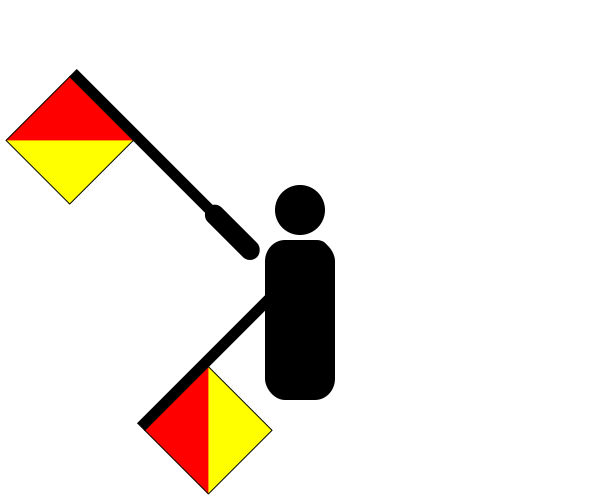

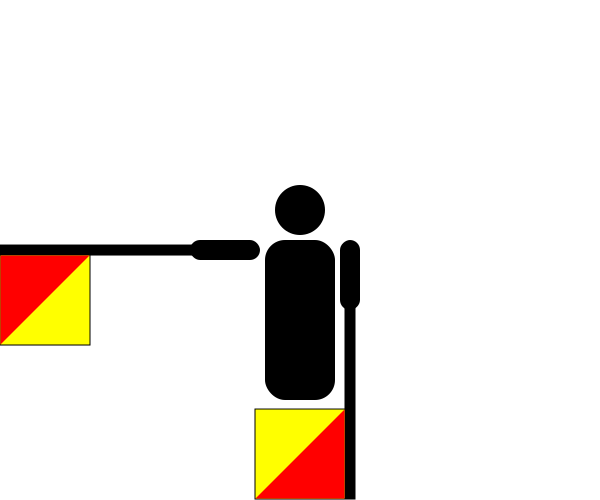
There are approximately 46 people named Lieb in the UK. That makes it one of Britain's least common surnames. Only around one in a million people in Britain are named Lieb.
Origin: English
Region of origin: British Isles
Country of origin: England
Religion of origin: Christian
Language of origin: English
