LEYLAND
The Leyland surname is firmly rooted in English tradition, originating from a specific geographic locality within the British Isles. This locational name identifies an ancestor who was associated with the town of Leyland in Lancashire, in the North West of England.
The toponym Leyland itself is derived from two Old English elements: leah, meaning a woodland clearing or glade, and land, denoting a tract of ground. Consequently, the name has been interpreted as “land within or beside a forest” or simply “lands in a clearing,” reflecting the character of the landscape surrounding the town. Some early scholars have also described the place name as signifying “fallow land,” based on the Old English root laege meaning untillred or uncultivated.
Documentation of the place name dates back to the Domesday Book of 1086, where it appears as Lailand. Subsequent records from the Lancashire Pipe Rolls (c. 1160) record the form Leilandia, and the Lancashire Assize Rolls of 1246 note the variant Leylond. In the early 13th century, the first recorded spelling of the family name is that of Aldulf de Leilande, dated 1203 in the Feet of Fines of Kent, within the reign of King John.
Over the following centuries, a range of orthographic variants appeared, including Lailand, Leilandia, Layland, Leylond, Leylande, Leylland, and Leland. Such variation reflects both regional pronunciation differences and the limited literacy of the period, which allowed for flexible spelling of surnames. The root forms of the name have remained predominantly Leyland in contemporary usage.
Among notable bearers of the surname is Joseph Bentley Leyland (1811 – 1851), an English sculptor whose works include the bronze statue of Dr. Beckwith of York, the relief of the York Minister, and the group of African Bloodhounds. His artistic legacy demonstrates the surname’s presence in the cultural life of 19th‑century England.
In modern times the Leyland surname is most strongly concentrated in the Lancashire area, a pattern confirmed by recent studies of surname geography in the United Kingdom. The name is considerably less common than many other English surnames, yet it persists as a marker of local heritage. Diaspora movements from Britain have carried the surname to countries such as Australia, Canada, the United States, New Zealand, and South Africa, though it remains relatively rare in those contexts as well.
Thus, the Leyland surname provides a clear illustration of how English place names have been adopted as family names, preserving linguistic elements of the early medieval period while continuing to identify individuals in contemporary societies across the globe.
Typical given names associated with the Leyland surname
Male
- Andrew
- Christopher
- David
- James
- John
- Mark
- Michael
- Paul
- Peter
- Robert
- Stephen
Female
- Catherine
- Christine
- Emma
- Helen
- Julie
- Lesley
- Margaret
- Mary
- Patricia
- Rebecca
- Sarah
- Susan
- Victoria
Similar and related surnames
Related and similar names are generated algorithmically based on the spelling, and may not necessarily share an etymology.
How to communicate the surname Leyland in...
Braille
⠇⠑⠽⠇⠁⠝⠙
Morse
.-...-.--.-...--.-..
Semaphore


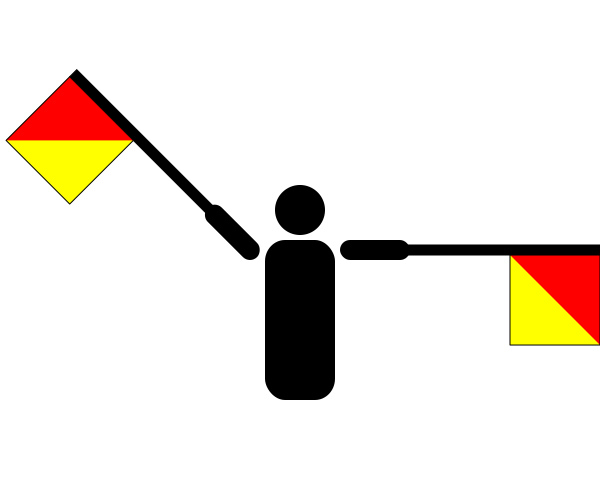

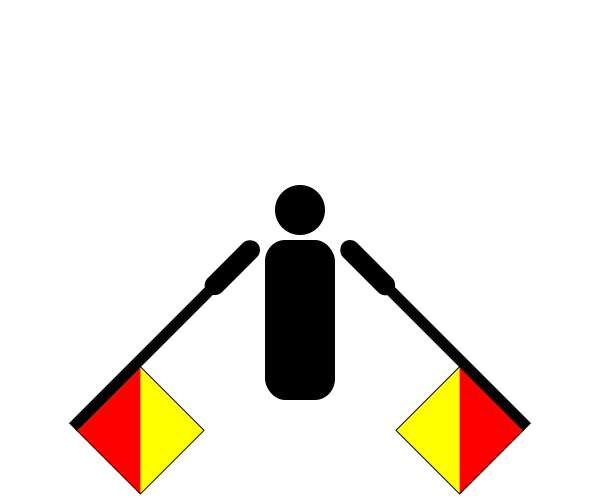

There are approximately 4,257 people named Leyland in the UK. That makes it roughly the 2,196th most common surname in Britain. Around 65 in a million people in Britain are named Leyland.
Surname type: Location or geographical feature
Origin: English
Region of origin: British Isles
Country of origin: England
Religion of origin: Christian
Language of origin: English

Famous people named Leyland
- Maurice Leyland - Cricket player of England. (1900 to 1967)
Names and descriptions courtesy of Wikipedia, and may contain errors. This is not intended to be an exhaustive list of every famous person with this name.