LENIHAN
Lenihan is an ancient surname rooted in the Gaelic tradition of the British Isles, and it is most strongly associated with Ireland. The name is historically linked to the noble families of the western and mid‑western counties, where it remains most common today.
The surname originates from the Gaelic patronymic form Ó Leannacháin, which means “descendant of Leannachán.” The base personal name Leannachán is a diminutive of leannán, a word that translates as “lover” or “paramour.” In early Irish usage the phrase carried a poetic connotation of romantic affection; it was also sometimes extended metaphorically to denote a passionate, ardent character.
Other investigations of the name have produced alternative but more uncertain meanings. Some sources note that variant spellings such as Mac Leanachain could be interpreted as “long ship,” a sobriquet potentially associated with seafarers or those influenced by Norse activity during the ninth century. A second proposed reading, describing “a possessor of mantles,” would reference the cloaks worn by persons of noble standing, implying a hereditary or ceremonial role. These variations are not conclusively proven, and the prevailing scholarly consensus remains the romantic derivation.
Evidence of the surname’s antiquity can be traced to the mid‑13th century. The earliest recorded spelling appears in the Annals of Loch Ce as that of Maelciaran O’Lenechan, who served as a priest in 1249. The period was marked by the influence of Norman authority in Ireland, particularly through figures such as Hubert de Burgh, chief justice of the realm. After the Norman presence receded, families bearing the name were often recorded in the civil and church registers that survived the ensuing centuries.
Geographically, the name remains highly concentrated in Ireland, particularly within the counties of Cork, Limerick, Clare, Mayo, Armagh, Roscommon, and Tyrone. Outside of Ireland, the manor of occupations that carried the name spread to the United Kingdom, where it is found most densely in Birmingham, Leeds, Exeter, Devon, and the northern region of Belfast. Across the Atlantic, the name has established a presence in Canada—particularly in the provinces of Ontario, Quebec, British Columbia, and Alberta—in Australia with significant populations in Sydney, Melbourne, and Perth, and in the United States, especially within the states of Pennsylvania and New York. These diaspora patterns parallel broader migratory trends from the 18th century onward.
Aside from spelling variants such as Lenaghan, McLenahan, McClenaghan, Lenehan, and Leanaghan, the surname remains most commonly rendered as Lenihan in contemporary records. Its persistence in modern registries reflects its deep cultural resonance and the continued pride of those who bear it.
Typical given names associated with the Lenihan surname
Male
- Anthony
- Brian
- David
- Denis
- Dennis
- James
- John
- Mark
- Michael
- Patrick
- Paul
- Thomas
Female
- Barbara
- Catherine
- Christine
- Claire
- Denise
- Elaine
- Emma
- Kathleen
- Margaret
- Mary
- Patricia
- Sarah
- Susan
Similar and related surnames
Related and similar names are generated algorithmically based on the spelling, and may not necessarily share an etymology.
How to communicate the surname Lenihan in...
Braille
⠇⠑⠝⠊⠓⠁⠝
Morse
.-...-........--.
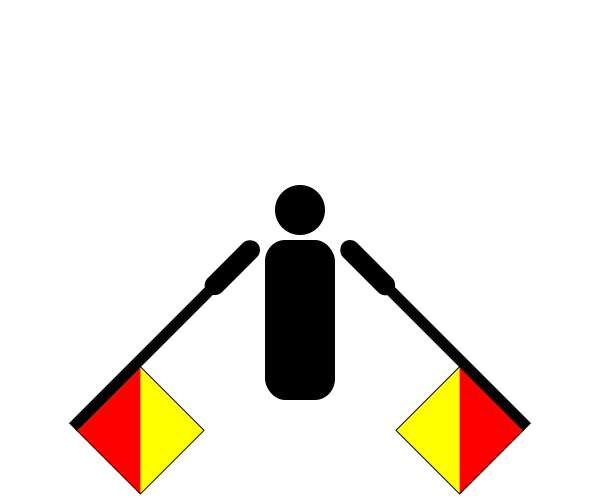
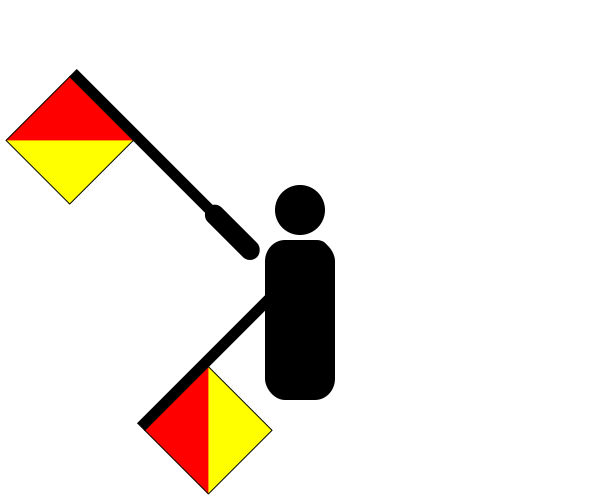
Semaphore




Did you know?
According to a survey carried out by Democracy Club, politicians and candidates with the surname Lenihan are most likely to say that their favourite biscuit is a Chocolate Digestive.
There are approximately 1,165 people named Lenihan in the UK. That makes it roughly the 6,562nd most common surname in Britain. Around 18 in a million people in Britain are named Lenihan.
Origin: Celtic
Region of origin: British Isles
Country of origin: Ireland
Religion of origin: Christian
Language of origin: Gaelic