LEGGETT
Leggett is an English surname of medieval origin, borne by individuals who historically served as representatives or envoys. The name is classified as a status name, indicating a person entrusted with significant responsibilities within both ecclesiastical and civil contexts.
The etymology of Leggett can be traced to the Middle English term legat or legget, itself borrowed from the Old French legat and ultimately from the Latin legatus, meaning “ambassador” or “legate.” The Latin verb legare means “to appoint” or “to ordain,” and is derived from lex, the word for law, underscoring the official nature of the office associated with the surname.
Early documentation records the surname in the year 1199, within the Pipe Rolls of Cornwall, where a Peter Legat is mentioned during the reign of King Richard I. This is the earliest known spelling of the family name in surviving records. The surname was also applied to individuals elected to represent their villages at manor courts, further reflecting its occupational connotations.
Variations of the surname have appeared over the centuries, including Legat, Leggatt, Legget and Leggitt. These alterations arose from regional dialects, clerical transcription practices, and personal preference, thereby producing a diversity of orthographies within the same lineage.
A heraldic grant was awarded to the Legat or Leggett families of Essex, Kent and Norfolk. The arms consist of an ermine shield charged with a red lion rampant, and the crest is composed of two red lion’s gambs erect, supporting a gold mitre. The family motto, “Jesus hominum Salvator,” reflects the Christian heritage that accompanies the name.
The surname notably appeared in a 1585 marriage record when Richard Colfe and Elisabeth Leggett were united at St. Dionis Backchurch, London. Following the Norman Conquest of 1066, the name spread from France to England and subsequently to Scotland and Ireland. In more recent times, migration has carried the surname to the United States, Australia and other English‑speaking regions, with particular concentration in the southern United States.
In keeping with its occupational roots, the name Leggett continues to signify a link to the historical practice of appointing individuals to act on behalf of others, be they civic, religious or administrative authorities. Its enduring presence across centuries and continents attests to the lasting influence of Norman culture on English nomenclature.
Typical given names associated with the Leggett surname
Male
- Andrew
- David
- James
- John
- Mark
- Michael
- Paul
- Peter
- Robert
- Stephen
Female
- Anne
- Elizabeth
- Joanne
- Julia
- Julie
- Karen
- Linda
- Margaret
- Mary
- Patricia
- Sarah
- Susan
- Victoria
Similar and related surnames
Related and similar names are generated algorithmically based on the spelling, and may not necessarily share an etymology.
How to communicate the surname Leggett in...
Braille
⠇⠑⠛⠛⠑⠞⠞
Morse
.-...--.--..--
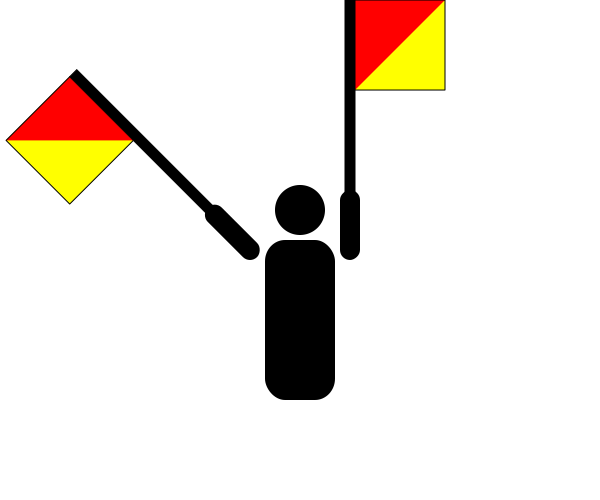
Semaphore


Did you know?
According to a survey carried out by Democracy Club, politicians and candidates with the surname Leggett are most likely to say that their favourite biscuit is a Treacle Crunch Cream.
There are approximately 5,269 people named Leggett in the UK. That makes it roughly the 1,797th most common surname in Britain. Around 81 in a million people in Britain are named Leggett.
Surname type: Status name
Origin: English
Region of origin: British Isles
Country of origin: England
Religion of origin: Christian
Language of origin: English

Famous people named Leggett
- Anthony James Leggett - Physicist
- Charles Leggett - Musician (1874 to 1934)
- Peter Leggett - Football player (1943 to 2016)
Names and descriptions courtesy of Wikipedia, and may contain errors. This is not intended to be an exhaustive list of every famous person with this name.