LEDBETTER
Ledbetter is an English surname that derives from two separate Old English roots. The first, leod betera, translates as “better people” and is believed to have been a nickname assigned to an individual regarded as superior or noteworthy within a community. The second root combines the word lead, meaning the metal, with beater, meaning one who beats or strikes. As a result the surname can also be interpreted as “lead‑beater”, an occupational designation for a person who worked in the processing of lead or who lived near a lead mine.
The name is first recorded in the early part of the thirteenth century, with the earliest documented spelling being that of Ingald Ledbater in 1221, a witness in the Assize Court Rolls of Warwickshire during the reign of King Henry I. Other early entries include Walter Ledbeter, noted in the Assize Court Rolls of Northumberland in 1256, and several church registries in London, for example Jane Leadbetter, who married Anthony Arkinson on 27 June 1592 at St. Margaret's, Westminster; Laurence Leadbetter, who married Mary Crannam on 1 September 1603 at St. Dunstan's, Stepney; and Michaell Leadbetter, who married Dorothie Clarke on 25 May 1618 at St. Martin Vintry.
The occupational meaning of the surname is strongly linked to the lead‑mining industry that flourished in parts of England such as Derbyshire and Yorkshire. In these areas, a Ledbetter would have been a worker who, by beating or processing ore, extracted lead, or a resident of a locality where lead was obtained. The surname also has a locational element, suggesting that some bearers were associated with a place where the mass of lead was produced, and it has been traced back to Bedfordshire, where a family seated from ancient times held a family seat.
Over the centuries the spelling of the surname has varied widely, including but not limited to: Leadbeter, Ledbeter, Leadeater, Leadeatter, Lidbetter, Lidebetter, Leidbetter, Leadbeter, Leetbetter, Deadbetter, Ladbeater, Letbetter, Lidbeatter, and other misspellings that reflect dialectal differences and the evolution of the English language.
Among the most prominent individuals bearing the surname was Charles Leadbetter, an astronomer who flourished in 1728. He was the author of treatises on astronomy and mathematics, and he was among the earliest commentators on Isaac Newton’s work. The family is also associated with a coat of arms described as a red shield, a silver chevron between three silver plates, three black crosses pattee, and a crest consisting of a demi‑unicorn erminois with a red muzzle, arms, and mane, seated upon a red mural coronet.
In contemporary times the Ledbetter surname is found chiefly in the United States, particularly in the southern states of Texas, Georgia, Alabama, Arkansas and the broader southeastern region. It is also present in England, with the highest concentrations in the East Midlands. Small populations bearing the name can also be found in Canada and Australia.
Typical given names associated with the Ledbetter surname
Male
- Andrew
- Brian
- David
- Nicholas
- Stephen
Female
- Anne
- Catherine
- Claire
Similar and related surnames
Related and similar names are generated algorithmically based on the spelling, and may not necessarily share an etymology.
How to communicate the surname Ledbetter in...
Braille
⠇⠑⠙⠃⠑⠞⠞⠑⠗
Morse
.-...-..-....--..-.
Semaphore


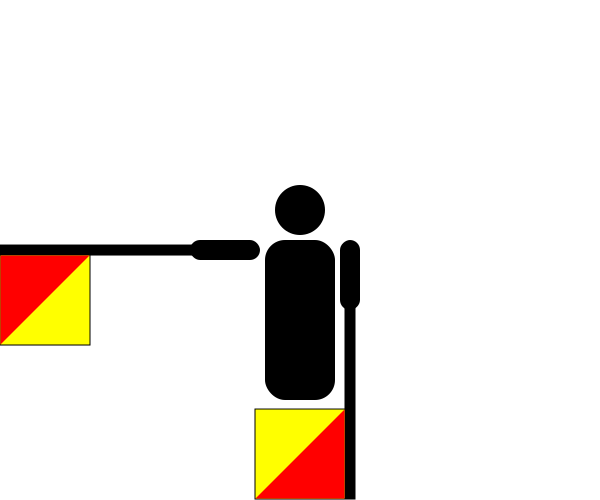
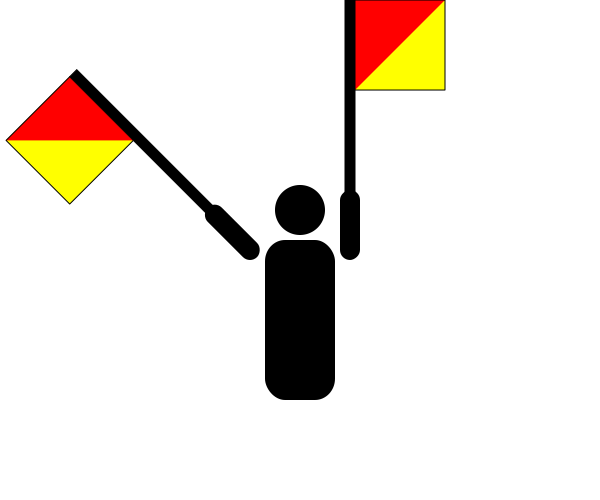
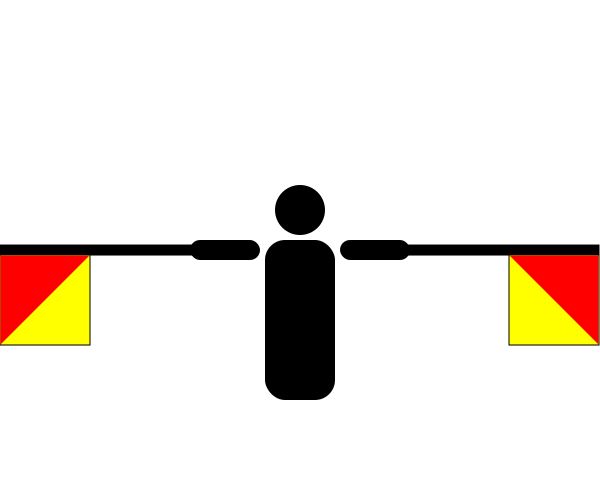
There are approximately 119 people named Ledbetter in the UK. That makes it one of Britain's least common surnames. Only around two in a million people in Britain are named Ledbetter.
Origin: English
Region of origin: British Isles
Country of origin: England
Religion of origin: Christian
Language of origin: English
