LAZAR
Lazar is a surname of Hebrew origin, derived from the personal name Eleazar, which means “God has helped”. The name appears in the Old Testament as the designation of a high priest, and in the New Testament it is borne by Lazarus, the figure whom Jesus resurrected, thereby associating the name with divine aid and renewal.
The surname is primarily a patronymic, signalling descent from an ancestor named Lazar or Eleazar. It is therefore most commonly found within Jewish communities, both Ashkenazi and Sephardic. In contemporary usage it remains a distinct surname among these groups.
In Europe the name was introduced by returning crusaders and pilgrims of the 11th and 12th centuries. These warriors, who had adopted baptismal names such as Matthew, Mark, Luke and Lazar, returned home and bestowed the names upon their children. Over time the baptismal names were inherited as family surnames, becoming entrenched in the local naming systems. The surname Lazar is one of many that originated as Christianised Hebrew names but which were later assimilated into the cultural fabric of Western Europe.
Hungary possesses a long history of the surname, where it is traditionally spelled Lázár. In the country it is centuries‑old and is borne by a substantial proportion of the population. The name is similarly common across other Eastern European lands such as Romania, Serbia, Russia, Ukraine and the wider Balkans, where it is often seen in local variants such as Lazăr, Lazare, Lazarov and Lazarenko.
In Slavic countries the name has evolved from a given name to a family name by the customary practice of forming patronymics. For example, Lazarin and Lazarenko literally mean “son of Lazar”. In French, Italian, Spanish and Greek linguistic traditions comparable forms are Lazare, Lazaro and Lazaros, respectively.
The spelling variations seen across different regions reflect both linguistic adaptation and historical pronunciation. In some contexts the suffix -s functions as a pet form, giving surnames such as Lazars, while in Russian the form Lazarev has become customary. The Arabic translation of the surname similarly conveys the sense of divine assistance, though it is a distinct cultural adaptation.
Modern bearers of the surname can be found globally, including in North America where immigration from Europe and the Jewish diaspora has introduced the name into the United States and Canada. Nevertheless, outside Europe and Israel the surname remains comparatively uncommon.
The name remains significant due to its enduring connotations of divine help and resurrection. Its spread across diverse linguistic and cultural boundaries demonstrates the adaptability of biblical names into the surnames of many societies.
Typical given names associated with the Lazar surname
Male
- Adrian
- Alan
- Bernard
- Bogdan
- Ciprian
- Daniel
- David
- Florin
- Ionut
- Marius
- Mihai
- Robert
- Vasile
Female
- Alexandra
- Ana
- Claudine
- Cristina
- Daniela
- Elena
- Ioana
- Lauren
- Maria
- Mihaela
- Monica
- Nicoleta
- Nina
- Roxana
Similar and related surnames
- Laisure
- Laesser
- Lasar
- Laza
- Lazara
- Lazare
- Lazari
- Lazaro
- Lacer
- Laiser
- Lasarow
- Lasarus
- Lascar
- Laser
- Lasore
- Lasri
- Lasser
- Lasserre
- Lassiere
- Lauezzari
- Lauser
- Lauzier
- Lawcer
- Lazaar
- Lazard
- Lazareck
- Lazareff
- Lazarek
- Lazarel
- Lazares
- Lazarev
- Lazaris
- Lazaroo
- Lazaros
- Lazarou
- Lazarous
- Lazarov
- Lazarow
- Lazarra
- Lazars
- Lazarte
- Lazaruk
- Lazarus
- Lazarz
- Lazea
- Lazer
- Lazeris
- Lazers
- Lazerus
- Lazor
- Lazur
- Lazuras
- Lazurus
- Lazzara
- Lazzari
- Lazzaris
- Lazzaro
- Lazzeri
- Leaser
- Leasor
- Leasure
- Leazr
- Leeser
- Leiser
- Leisser
- Leisure
- Leizer
- Lesar
- Leser
- Lesieur
- Lesire
- Lessar
- Lesser
- Lessor
- Lessore
- Lesuer
- Lesur
- Lesure
- Leyser
- Lezar
- Lezard
- Lezer
- Lieser
- Liser
- Lissauer
- Lisser
- Lizar
- Lizer
- Lizier
- Lizura
- Loeser
- Looser
- Loosir
- Loser
- Lozer
- Lucero
- Lucier
- Lusser
- Lussier
- Luzar
- Lyser
- Lysser
Related and similar names are generated algorithmically based on the spelling, and may not necessarily share an etymology.
How to communicate the surname Lazar in...
Braille
⠇⠁⠵⠁⠗
Morse
.-...---...-.-.
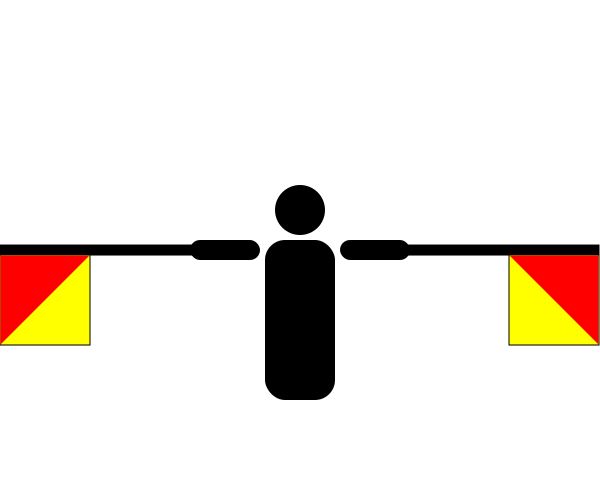
Semaphore


There are approximately 479 people named Lazar in the UK. That makes it one of Britain's least common surnames. Only around seven in a million people in Britain are named Lazar.
Region of origin: Europe
Country of origin: Hungary
Language of origin: Hungarian

Famous people named Lazar
- Bob Lazar - American UFO conspiracy theorist
- John Lazar - Mayor of Adelaide (1801 to 1879)
Names and descriptions courtesy of Wikipedia, and may contain errors. This is not intended to be an exhaustive list of every famous person with this name.