LATTIMER
The surname Lattimer originates from England and is associated with the British Isles. It first appeared in the Domesday Book of 1086 as Ralph Latimarus, a name recorded during the reign of King William I. The spelling of the name evolved over the centuries, reflected in later documents such as the marriage of John Lattimer and Anne Cole in 1564 at St. Olave, Hart Street, London, and the union of Frauncis Lattimer and Thomas Oulton in 1614 at St. Stephan's, Coleman Street, London.
Scholars attribute the origin of the name to two distinct roots. One hypothesis identifies it as a patronymic derived from the Old English personal name Leofhelm, meaning “dear helmet.” According to this view, the surname was originally used to denote the descendants of a man given that personal name.
A second theory recognises the name as an occupational designation linked to the Latin language. The appellation Latimer and its variants in Anglo‑Norman‑French, such as Latiner or Latimmier, translate to “interpreter.” The name appeared in medieval records as Latonere, described in a 1327 prompt as “he who uses Latin speech.” As Latin was the lingua franca of official documentation during the Middle Ages, the designation for clerks or keepers of records became increasingly common.
Other toponymic theories associate the surname with several places in England, or with the Scottish locality near the Solway Firth. It is suggested that the name may derive from Old English leget, meaning a hovel or hut, or from a term referring to two small rivers or streams, rendered in older forms as laddre and myre. The name has, in many instances, been linked to a person who lived near such natural features.
In the United States and Canada the surname is most common in central and western Pennsylvania, Virginia, and West Virginia, reflecting migration patterns of families who arrived from northern England and Scotland in the seventeenth and eighteenth centuries. Individuals bearing the name participated in the American Revolutionary War, and later expanded westward into the Midwest and the South.
Contemporary bearers of the surname may find it in several orthographic forms, including Latimer, Lattimore, Lattermore, Lattermoor, and Ladermore. The affectionate Latin motto attesting to the character of the family, “Fortiter, Fideliter, Feliciter” – translating to “With Strength, With Loyalty, With Happiness” – appears on the ancient coat‑of‑arms, which features three seated foxes as a symbol of courage and cunning.
Thus, the surname Lattimer encapsulates a lineage characterised by linguistic versatility, clerical service, toponymic ties, and a resilient presence across the British Isles, North America and beyond.
Typical given names associated with the Lattimer surname
Male
- David
- Edward
- George
- Iain
- James
- John
- Joseph
- Mark
- Michael
- Peter
- Richard
- Scott
- William
Female
- Andrea
- Angela
- Carol
- Catherine
- Eileen
- Lindsay
- Margaret
- Rebecca
- Sarah
- Susan
- Valerie
- Victoria
- Wendy
Similar and related surnames
Related and similar names are generated algorithmically based on the spelling, and may not necessarily share an etymology.
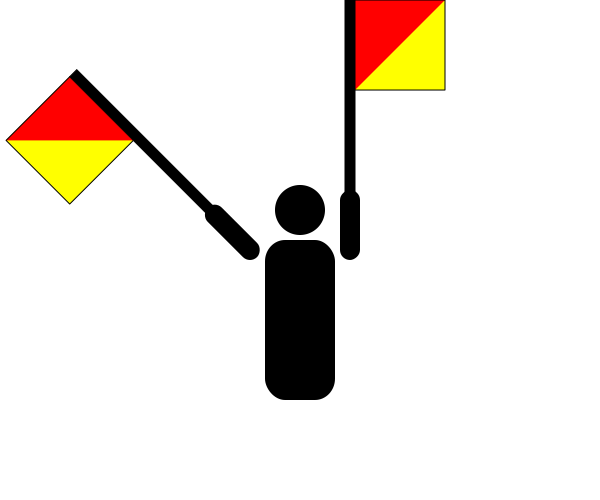
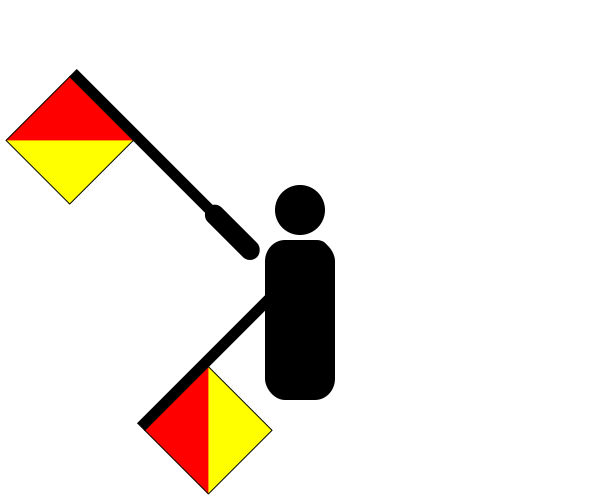
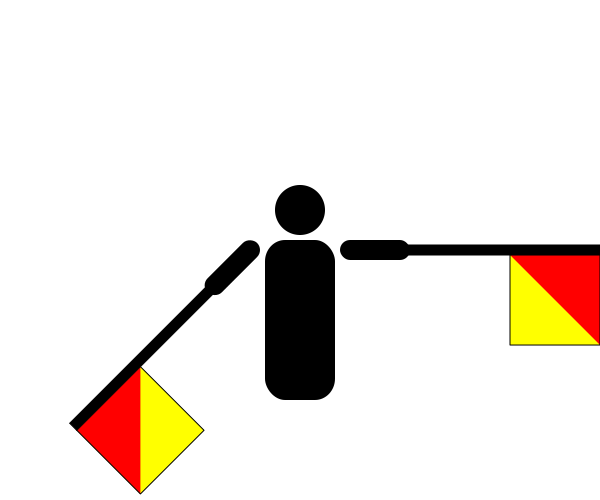
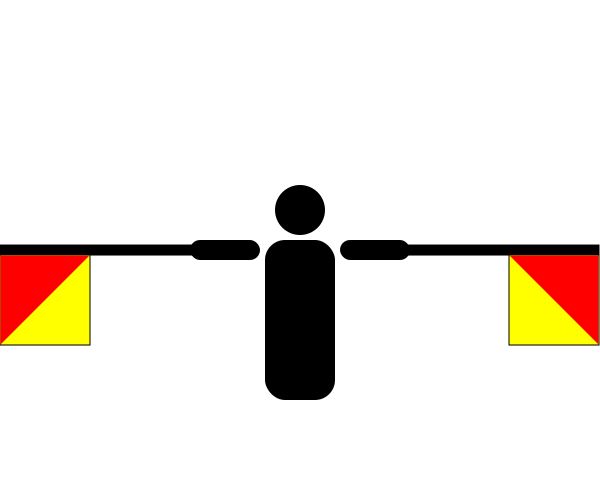
How to communicate the surname Lattimer in...
Braille
⠇⠁⠞⠞⠊⠍⠑⠗
Morse
.-...---..--..-.
Semaphore



There are approximately 508 people named Lattimer in the UK. That makes it one of Britain's least common surnames. Only around eight in a million people in Britain are named Lattimer.
Surname type: Occupational name
Origin: English
Region of origin: British Isles
Country of origin: England
Religion of origin: Christian
Language of origin: English
