LATTA
The surname Latta originates primarily from the Scottish islands of the British Isles, where its early use can be traced to the Gaelic linguistic tradition. The name is historically linked to the Gaelic word lathach, meaning a barn or cowshed. As a locational surname, it likely identified individuals who lived near or worked in such structures, thereby denoting a particular occupation or place of residence within the agrarian society of medieval Scotland.
Early documentary evidence places the name in the lands of Laithis, in the region of Ayreshire. The first known record is that of Thomas Laithis, who granted these lands to the Fullertons in the year c.1350. Subsequent spellings—Lathis in 1476, Layse in 1509, and Lawte at Coldingham in 1525—illustrate both the fluidity of orthography in the medieval period and the surname’s persistent geographic association with this part of Ayrshire.
The transformation to the modern form Latta is first recorded in 1709 at Lochwinnoch, with later manifestations noted in Dumbarton and Aberdeen around the mid nineteenth century. A significant entry appears in 1677, when a James Lattay is accorded in the parish records of Lochwinnoch during the reign of King Charles the First, a monarch historically nicknamed “The Merry Monarch.” This particular spelling underscores the presence of variant endings such as -ay in the name’s genealogical registers.
Beyond the Scottish lowland sources, the surname demonstrates an additional etymological layer derived from Old Norse influences. The name is connected to the Old Norse personal designation Hlǫða, a habitational marker for a locale named similarly in Ponteland, Northumberland. This Norse connection attests to the Scandinavian presence and linguistic blending that characterised the Viking Age across northern Britain, indicating that the name Latta may also denote a person originating from the Northumberland area or the wider region of the Lothians—a historical belt in southern Scotland whose identity persists in modern place names such as Glasgow and Lanarkshire.
The surname’s Gaelic counterpart is sometimes presented as Fhlat, interpretable as “expansive place.” First documented in Ayrshire, this definition implied a setting of broad agrarian activity, further reinforcing the locational nature of the surname. Throughout the Middle Ages, families bearing the name held estates in Ayrshire and played a recognised role within the regional power structures of the time.
Variations in spelling and pronunciation have yielded a spectrum of related forms. Documented variants include Lattie, Latty, Lattey, Latto, and Letta, among others. Other names with comparable phonetic traits—such as Latt, Lattau, or Latter—appear in parish registers and land deeds, reflecting the influence of regional dialects and the modest literacy rates of earlier centuries. In addition, some bearable analogues, anglicised from Gaelic patronymics like O Lachtnain and Mac Lachtnain, have evolved into surnames such as Loughnane and Loughnan, which are closely related in sound and by extension may share a common origin for certain lineages.
By the nineteenth century the surname had migrated beyond Scottish borders, appearing in substantial numbers across the United States—particularly in the southern states—and in other Commonwealth countries, including Canada, Australia, and to a lesser degree New Zealand and England. Nevertheless, its core concentration remains within Scotland, reflecting both the historical roots of the name and the enduring presence of families who trace their ancestry back to the ancient Ayrshire and Lothian territories.
In contemporary demographic statistics, the surname Latta retains a modest but noticeable frequency across the UK, especially in Glasgow, Lanarkshire, and the surrounding lowland environs. It continues to be catalogued by genealogical societies, heraldic registries, and legal archives. As with many surnames, its evolution over time has been shaped by migration, intermarriage, and the natural variations in spelling that arise when names are recorded by different clerks and in varying orthographic conventions.
Overall, the surname Latta exemplifies a composite heritage, merging Gaelic locational reference, Norse habitational roots, and an evolving array of spellings that have been preserved through meticulous parish and civil records. Its historical footprint, anchored in the Scottish landscape and extended across the wider Anglophone world, remains a testament to the linguistic and migratory history of the British Isles.
Typical given names associated with the Latta surname
Male
- Brian
- Craig
- David
- Ian
- James
- John
- Peter
- Robert
- Thomas
- William
Female
- Agnes
- Alison
- Carol
- Denice
- Elizabeth
- Julie
- Lesley
- Margaret
- Mary
- Sandra
- Susan
- Suzanne
- Vivien
Similar and related surnames
- Lad
- Ladd
- Lade
- Lait
- Laitak
- Laite
- Laitt
- Larter
- Lat
- Lata
- Latacz
- Latam
- Latan
- Latas
- Late
- Lateo
- Latt
- Lattan
- Lattari
- Lattaway
- Latte
- Latter
- Lattes
- Latti
- Lattie
- Lattle
- Latto
- Lattor
- Latts
- Lattu
- Latty
- Latuta
- Laud
- Layt
- Layte
- Leat
- Leatt
- Leeta
- Leete
- Leett
- Leita
- Leitao
- Leta
- Letai
- Letea
- Lett
- Lettan
- Lettau
- Lette
- Lloyd
- Lote
- Loud
- Loyd
Related and similar names are generated algorithmically based on the spelling, and may not necessarily share an etymology.
How to communicate the surname Latta in...
Braille
⠇⠁⠞⠞⠁
Morse
.-...---.-
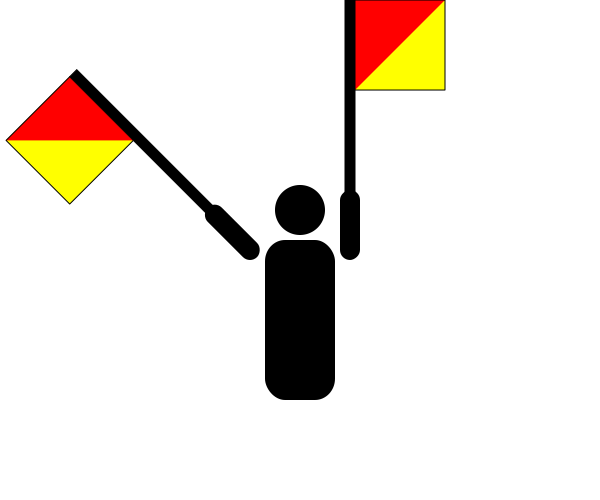
Semaphore


There are approximately 753 people named Latta in the UK. That makes it roughly the 9,185th most common surname in Britain. Around 12 in a million people in Britain are named Latta.
Origin: Celtic
Region of origin: British Isles
Country of origin: Scotland
Religion of origin: Christian
Language of origin: Gaelic

Famous people named Latta
- Alex Latta - Scottish football player (1867 to 1928)
- Eddie Latta - Songwriter (1902 to 1)
- James Latta - Flying ace (1897 to 1)
- Sir John Latta, 1st Baronet - Businessman and noble (1867 to 1946)
Names and descriptions courtesy of Wikipedia, and may contain errors. This is not intended to be an exhaustive list of every famous person with this name.