LASSETER
The surname Lasseter bears a remarkable history that reflects several distinct etymological strands. In its earliest known form it appears within Scandinavian contexts, where it is derived from the Old Norse personal name Ljótr, literally meaning ugly or unattractive. This designation would have originally served as a nickname for a person whose appearance, or a particular physical trait, was considered unfavourable by contemporary norms. The evolution of the personal name into a hereditary surname in Scotland is documented by the migration of the form into varied regional spellings such as Lasister and Laiester, indicating a long‑standing Scottish linguistic influence.
Another well‑attested origin of the name is locational, arising from the Anglo‑Saxon town of Leicester – known in the “Anglo‑Saxon Chronicles” of 942 as Ligora Ceaster and recorded in the Domesday Book of 1086 as Ledecestre. The placename itself derives from the Old English tribal designation Ligore (“dwellers on the river Legra”) combined with Ceaster, a term for a Roman fort taken from Latin castra (“legionary camp”). Over the centuries, the surname developed through a progression of early references – such as Nicholas de Leycester (1286, Cheshire), William Leycetter (1480, Yorkshire), Henry Lasisture (1503, Sussex) and Richard Lasseter (1550, Sussex). The modern spelling Lasseter thus reflects a direct lineage from this locational source.
In addition to the above, there is evidence that the surname also entered use within French‑speaking contexts. Here it is formed from the phrase laissez‑terre, meaning “leave the land”, and was first recorded in the sixteenth century when landowners granted parcels to tenants whose labour and produce were shared. French Huguenot settlers, and later colonial administrators, carried the name to the Americas and to former French colonies in Africa and the Caribbean, where it remains a comparatively rare surname. In the United Kingdom, the name is documented in Scotland as early as the seventeenth century, and it also appears in Irish records of the same period. Contemporary censuses show that the surname is most heavily concentrated in the southern United States – notably in Georgia and Texas – although isolated pockets exist throughout Canada, Nigeria, Germany and the United Kingdom. Common variants include Lassiter, Lasiter, Lassitre, Lassetter, Lasster, Laister, Laster and Lasater, which have arisen from linguistic adaptations of the original French L'Astre and German L'Aster or through transcriptional changes in English‑speaking regions.
Typical given names associated with the Lasseter surname
Male
- Ian
- Mark
- Robert
- Ronald
- Simon
Female
- Diane
- Janet
- Julie
- Katharine
- Margaret
Similar and related surnames
Related and similar names are generated algorithmically based on the spelling, and may not necessarily share an etymology.
How to communicate the surname Lasseter in...
Braille
⠇⠁⠎⠎⠑⠞⠑⠗
Morse
.-...-.......-..-.
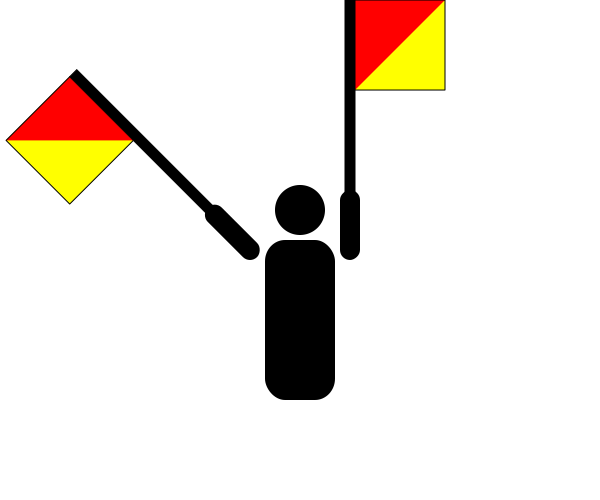
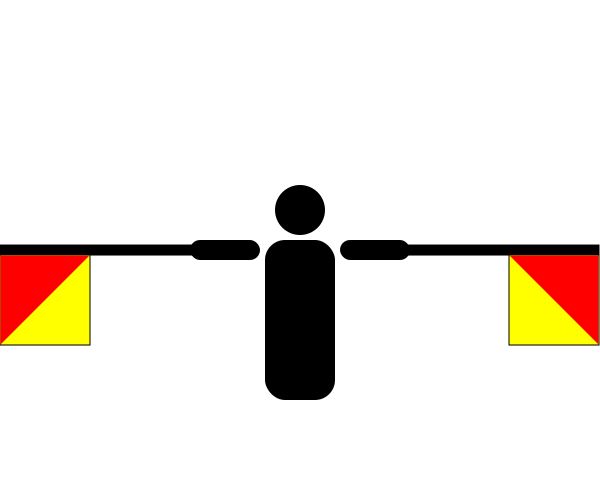
Semaphore


There are approximately 84 people named Lasseter in the UK. That makes it one of Britain's least common surnames. Only around one in a million people in Britain are named Lasseter.
