LASHBROOK
Lashbrook is a surname of English origin. It is a topographic or locational name, meaning that the original bearers of the name were likely associated with a particular physical feature in the landscape.
The etymology drawn from Old English indicates that leas means “pasture” and broc means “stream.” Consequently, the surname can be interpreted as “dweller by the stream in the pasture.” The scholarly record also notes an alternative composition using the Ancient British word laec, which could denote a small lake or water, coupled with broc, suggesting a person living by a body of water within a grove or woodland. These linguistic elements show that the name attaches directly to a natural setting.
Several localities in England bear the name Lashbrook. Three of them are situated in the historic county of Devonshire, and these are most often cited as the original source of the surname. None of the villages in which the name first appeared survive today; they are now known only as localities, a circumstance that is common among surnames that stem from lost medieval villages. Over three thousand surnames in the British Isles are believed to derive from such vanished settlements, and the surname is one of those that still preserves the memory of its lost origins.
Early written records of the surname appear in Devonshire church registers. One example is Walter Lashbrooke of Hatherleigh, recorded on 31 August 1565. A later instance is Typhanie Laishbrooke, noted at Belstone near Okehampton on 10 August 1619. The variation in spelling of these early entries illustrates the fluid orthography of the period while maintaining the essential phonetic structure of the name.
Some scholars propose a further layer of origin linking Lashbrook to the Norman French word L’eschebrec or the Old French eschebrec, meaning a kind of alder tree. In this view the surname is viewed as an anglicised version of a Norman name that had been adapted to English phonology. Multiple spelling variants across countries—such as Leschbrooke, Lescherbrick, Leshbrook, Lasebrook, and others—support the notion that the name evolved as settlers moved and language contact occurred.
In contemporary distribution, Lashbrook is not a highly common surname. Within the United Kingdom, the densest concentrations are found in Nottinghamshire, London and Derbyshire, with notable clusters also in Yorkshire, Hampshire and the West Midlands. In the United States, census data indicate that the surname is most heavily represented in California and North Carolina, and that a number of bearers reside in Texas, Georgia, Arizona and Louisiana. The census identifies only 0.04 % of the population as bearing the name. Australian records locate Lashbrooks mainly in New South Wales, Victoria and Western Australia, though the surname remains relatively sparse there as well.
Despite its modest frequency, the surname Lashbrook continues to serve as a tangible connection to England’s distant past. Individuals who carry the name may regard it as a link to a specific landscape feature and to the generations who once inhabited that environment. The preservation of the name in historical documents, parish records and modern registration systems underscores its enduring relevance.
Typical given names associated with the Lashbrook surname
Male
- Adam
- Christopher
- Daren
- David
- John
- Mark
- Michael
- Nigel
- Paul
- Peter
- Richard
- Steven
Female
- Anne
- Christine
- Deborah
- Emma
- Florence
- Helen
- Jacqueline
- Jean
- Lynn
- Margaret
- Marie
- Nicola
- Sandra
- Susan
- Tracy
Similar and related surnames
Related and similar names are generated algorithmically based on the spelling, and may not necessarily share an etymology.
How to communicate the surname Lashbrook in...
Braille
⠇⠁⠎⠓⠃⠗⠕⠕⠅
Morse
.-...-.......-....-.-------.-
Semaphore



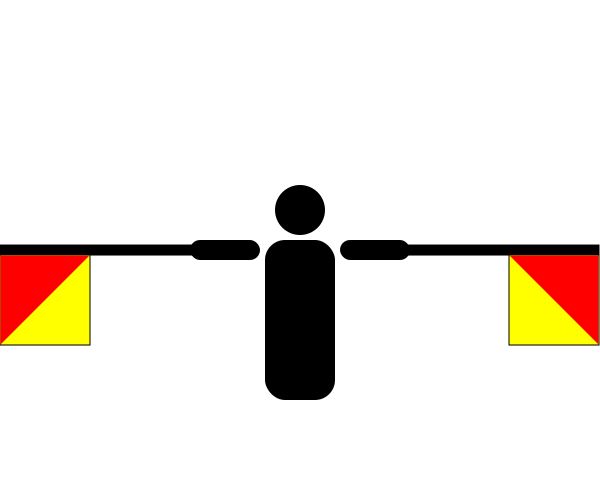
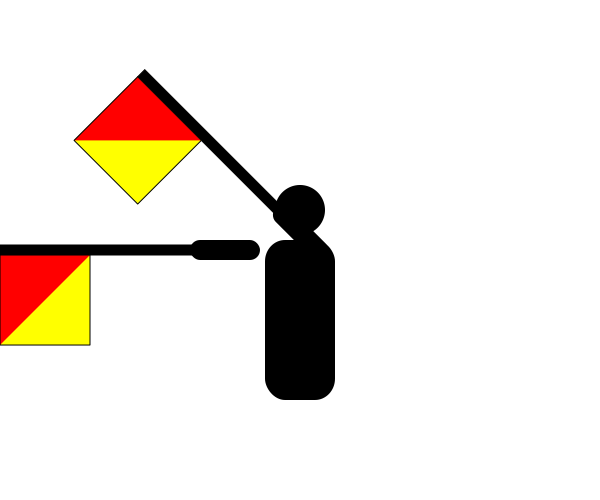
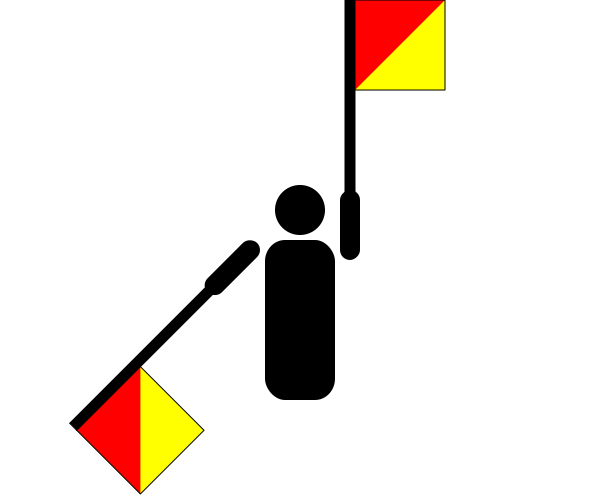
There are approximately 422 people named Lashbrook in the UK. That makes it one of Britain's least common surnames. Only around six in a million people in Britain are named Lashbrook.
Surname type: Location or geographical feature
Origin: English
Region of origin: British Isles
Country of origin: England
Religion of origin: Christian
Language of origin: English
