LARIMER
Larimer is a surname of dual linguistic heritage, deriving from both French and Scottish origins. Its etymology reflects an occupational surname first used in the medieval period to denote craftsmen skilled in the making or repairing of protective gear or metal fittings.
The earliest form seen in written records is the French term l’armer, meaning an armourer. Over time the name evolved through several spellings—including l’arimeur, meaning rim‑maker, and l’arimier, meaning harness‑maker—and was adopted into English usage after the Norman Conquest of 1066. The occupational nature of the name is evident in the early documentary evidence that records the craft of metal working for both armour and harnesses.
Early English documents cite several individuals who bore the name in its various forms. In 1239 the bailiff of Norwich is recorded as Gervase Lorimarius, also known as Gervase Sadler, and in 1273 Adam le Lorimer is listed as a landowner in Shropshire. Tommasus Loremare appears in the 1379 Poll Tax Rolls of Yorkshire. These entries confirm that the surname had already become established in England by the early thirteenth century.
Over the following centuries a number of orthographic variants came into use, including Larimer, Lorrimer, Lorymer, Lorimer, Lorriman, Lorryman, and Lurriman. The addition of a suffix such as -man—meaning friend or servant of Lori‑mer—suggests a further development of the name, as seen in the 1662 Preston Guild register entry for James Lurryman and the 1687 Lancashire record of Richard Lorriman.
From the English and Scottish contexts the name migrated to North America during the eighteenth and nineteenth centuries. The bulk of modern bearers of the surname are found in the United States, particularly in Pennsylvania and Colorado, states that received large numbers of Scottish immigrants. It is also recorded in Ohio, Indiana and other regions where settlers of Irish and Scottish descent were common.
Some sources propose an additional Irish connection, tracing the name back to the Gaelic O’Laoghaire, associated with St. Laoire. Variation in spelling—such as Larimore, Larrimer, and Larimar—may be attributed to phonetic misspellings during the Anglicisation process. Although this line of origin is less documented than the French and Scottish traditions, it is still referenced in a number of genealogical accounts.
In contemporary usage the surname Larimer survives primarily as a family name in the United States, with scattered bearers in the United Kingdom and other English‑speaking regions. Despite its medieval beginnings, it remains a living testament to the occupational identities that shaped medieval societies.
Similar and related surnames
Related and similar names are generated algorithmically based on the spelling, and may not necessarily share an etymology.
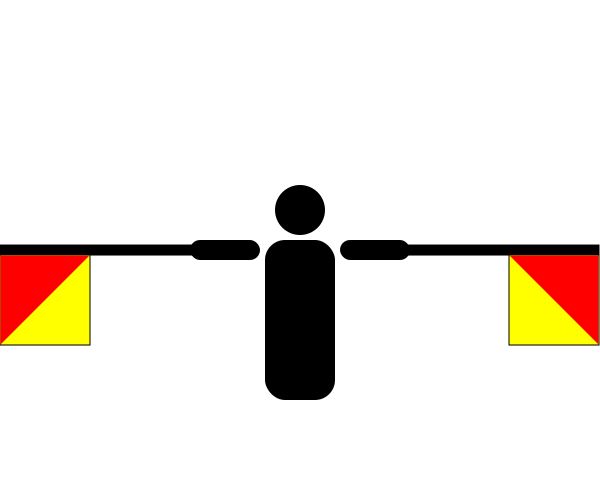
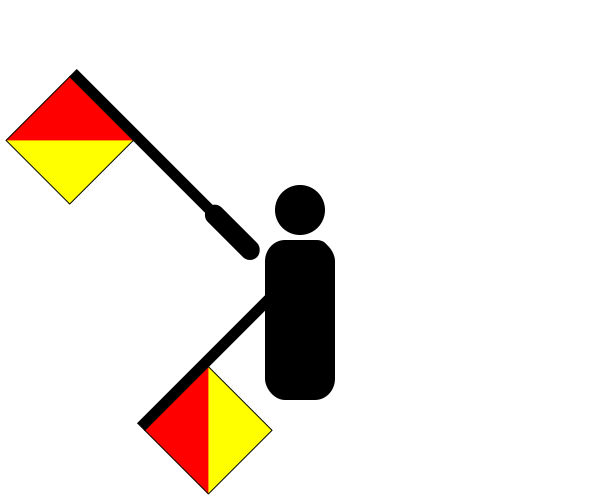
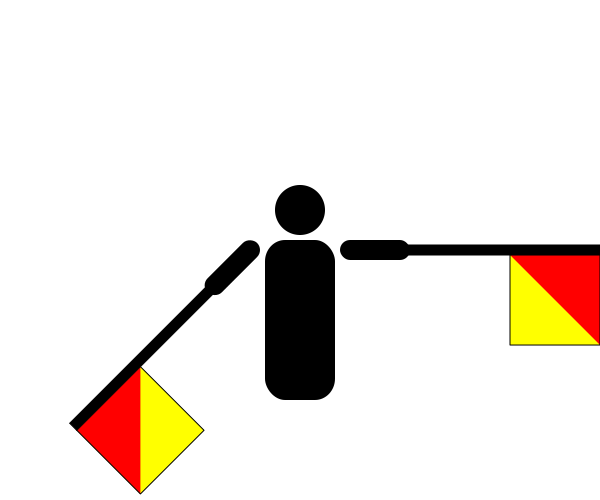
How to communicate the surname Larimer in...
Braille
⠇⠁⠗⠊⠍⠑⠗
Morse
.-...-.-...--..-.
Semaphore



Sorry, we don't have any statistics on this name. That's probably because it's very uncommon in Britain.
