LANGSTAFF
Langstaff is a surname of English origin, derived from the Old English elements lang, meaning “long”, and staef, meaning “staff” or “stick”. The composite expression traditionally signified a long, slender pole and, by extension, a person bearing such a pole or characterised by a tall, lean stature.
The name is believed to have arisen in the early medieval period as a nickname. It was afforded to an individual who was unusually tall, thin, or who carried a long staff while travelling, whether as a pilgrim, a shepherd, or a peddler. In some contexts it also functioned as an occupational label for a court official known as a tipstaff or a minor church officer called a beadle; both types of official usually carried a long staff as a badge of office.
The earliest documented instance of the surname dates to the early thirteenth century. In 1210, the Pipe Rolls of Westmorland record a person named Richard Langstaf, and in 1218 a Hugo Longstaf appears in the Register of the Freemen of the City of Leicester. A further example is William Longstaff, whose name occurs in a Norfolk record of 1347.
Throughout history the surname has manifested several orthographic variants. Common forms include Longstaff, Longstaffe, Langstaffe, and earlier spellings such as Longstaf and Langstaf. These differences reflect the fluid spelling conventions of the period and the influence of regional dialects.
Geographically, the name became concentrated in the North East of England, particularly within Yorkshire and Northumberland. Ecclesiastical records from the late sixteenth and early seventeenth centuries document marriages involving the name, for example, Agnes Langstaff's union with William Jeffrayson at Romaldkirke, York, in 1580, and a later marriage to James Walker in Bradford in 1625.
While the surname is relatively uncommon today, it has spread beyond Britain in accordance with waves of emigration to the United States, Canada, Australia, and New Zealand. In these countries, individuals of English descent commonly bear the name, maintaining a connection to its Anglo‑Saxon roots.
In modern usage, Langstaff persists as a testament to the evolution of surnames, illustrating how a descriptive feature of a person’s appearance or occupation could become a hereditary identity. Its endurance across centuries and continents underscores the historical significance of the name within the broader tapestry of English nomenclature.
Typical given names associated with the Langstaff surname
Male
- Anthony
- Christopher
- David
- James
- John
- Michael
- Nicholas
- Paul
- Philip
- Richard
- Stephen
Female
- Amanda
- Anne
- Carol
- Elizabeth
- Emma
- Gillian
- Jane
- Jean
- Julie
- Julienne
- Margaret
- Mary
- Nicole
- Sarah
- Susan
Similar and related surnames
Related and similar names are generated algorithmically based on the spelling, and may not necessarily share an etymology.
How to communicate the surname Langstaff in...
Braille
⠇⠁⠝⠛⠎⠞⠁⠋⠋
Morse
.-...--.--....-.-..-...-.
Semaphore


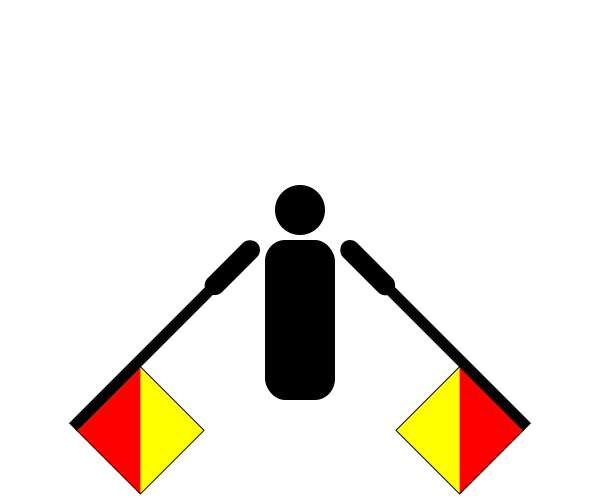


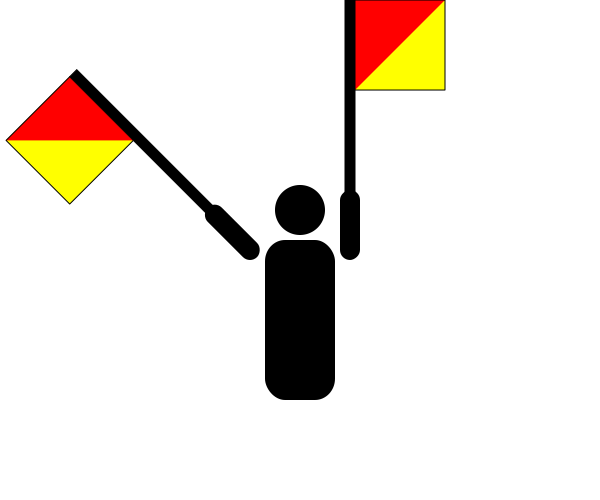
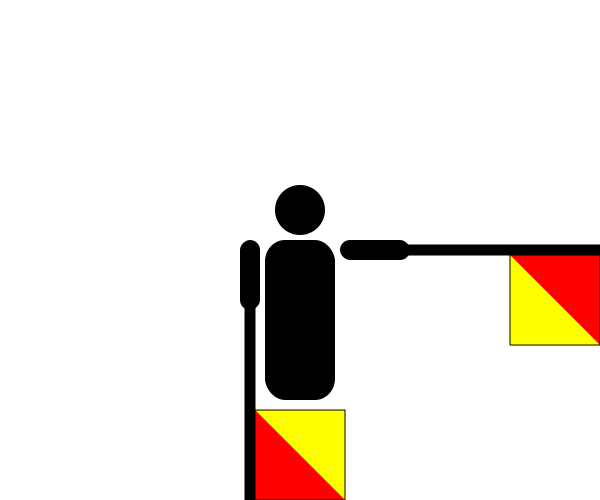
There are approximately 710 people named Langstaff in the UK. That makes it roughly the 9,599th most common surname in Britain. Around 11 in a million people in Britain are named Langstaff.
Origin: English
Region of origin: British Isles
Country of origin: England
Religion of origin: Christian
Language of origin: English

Famous people named Langstaff
- James Langstaff - Bishop of Rochester; Bishop of Lynn
Names and descriptions courtesy of Wikipedia, and may contain errors. This is not intended to be an exhaustive list of every famous person with this name.