LANGHORN
Langhorn is an English surname that originates from the British Isles, specifically England. It derives from the Old English words lang, meaning long, and horn, meaning horn or ridge. The composition of the name suggests that it was originally a descriptive or locational marker, applied to a person either because of a physical attribute or because they lived near a prominent landmark resembling a horn.
Scholars caution that surnames constructed from two recognised topographical elements should be examined carefully. In the case of Langhorn, the Old English phrase lang horna referred to a long straight spur of land. Some commentators have linked the name with a now lost medieval village in Cumberland, but certainty remains elusive.
Historical records illustrate the name through a range of spellings. The earliest extant instance is the christening of Kathryn Langthorne in 1567 at Attleborough, Norfolk. Subsequent references include William Langhorne of Cumberland noted in the 1582 Oxford University register, John Longhorne of St Mary Whitechapel in London in 1629, Wylly Longthorn of Norwich in 1632, and George Longhorn christened at St Sepulchre Church, London, in 1667. Richard Longthorne, also recorded as Langhorne, suffered execution in 1679 in connection with the Popish Plot, although contemporary opinion holds that he was likely innocent.
In 1610 a coat of arms was granted to the family at Bedford. The blazon describes a black field charged with a silver cross, and on a silver chief three bugle‑horns of the field, stringed red. This heraldic device reflects, in a symbolic manner, the martial or signalling connotations that the “horn” element of the name might have carried in medieval society.
The surname is recorded with a number of variants, including Langhorne, Longhorn, Longthorn, Langerhorn, Langhearne, and Langern. The wide spectrum of spellings largely reflects the fact that scribes and clerks historically noted names as they heard them, giving rise to the accepted standard spelling only after subsequent generations.
In contemporary times Langhorn remains relatively uncommon. Census records in the United States indicate a modest cluster of households bearing the name, with the greatest concentration in Iowa and notable populations in Illinois, Pennsylvania, Ohio, Texas, and Indiana. While the name has a clear English origin, its dispersion across the Atlantic is thought to result from 17th‑ and 18th‑century migration, including the movement of United Empire Loyalists following the American Revolution.
Despite its scarcity, the name Langhorn retains cultural significance. It is sometimes associated with heritage societies that trace lineage to early English or Scottish clans, and the crest appears in the heraldic collections of such organisations. The enduring nature of the surname serves as a testament to the historical narratives and regional identities embedded within English onomastics.
Typical given names associated with the Langhorn surname
Male
- David
- George
- John
- Mark
- Michael
- Paul
- Peter
- Philip
- Robert
- Stuart
- Toby
Female
- Audrey
- Brigid
- Hanne
- Helen
- Joanne
- Karen
- Kathryn
- Linda
- Lisa
- Louise
- Margaret
- Rebecca
- Sarah
- Stephanie
Similar and related surnames
Related and similar names are generated algorithmically based on the spelling, and may not necessarily share an etymology.
How to communicate the surname Langhorn in...
Braille
⠇⠁⠝⠛⠓⠕⠗⠝
Morse
.-...--.--.....---.-.-.
Semaphore


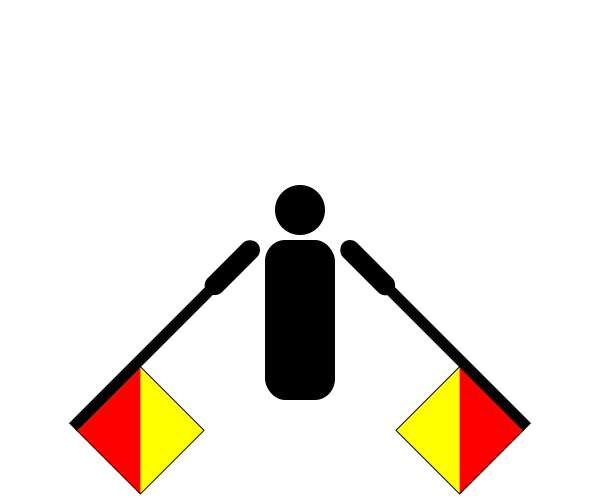


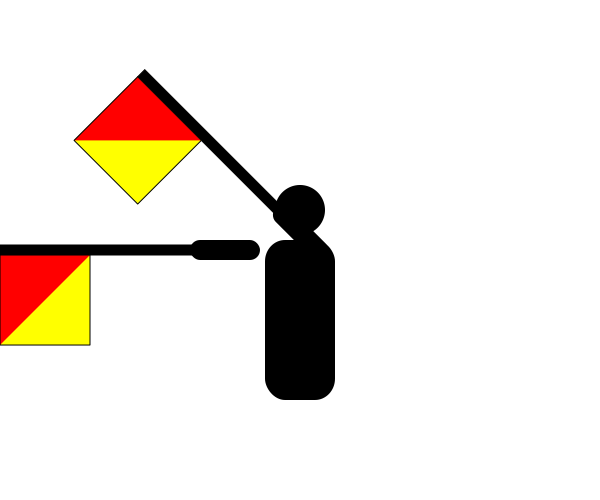
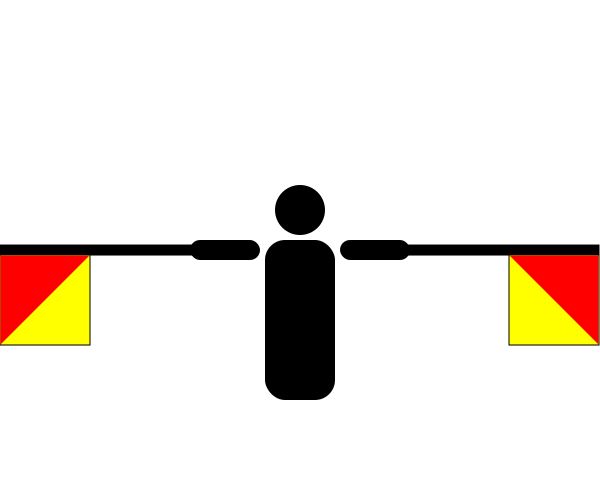
There are approximately 502 people named Langhorn in the UK. That makes it one of Britain's least common surnames. Only around eight in a million people in Britain are named Langhorn.
Surname type: Location or geographical feature
Origin: English
Region of origin: British Isles
Country of origin: England
Religion of origin: Christian
Language of origin: English
