LANDRETH
Landreth is a surname of English and Scottish provenance, first attested in the late 17th century within the district of Berwickshire, Scotland.
The etymology is centred on the Old English personal name Landræd, composed of the elements land – meaning “open, clear land” – and ræd – signifying “counsel” or “advice”. Consequently the name conveys the notion of a man who was a wise counsellor in land, and it evolved into a patronymic surname that identified the descendants of an individual bearing that given name.
In addition to its patronymic roots, the surname has topographical associations. The elements lande, a French medieval term for a glade or pasture of Gallic origin, and rithe, the Anglo‑Saxon word for running water derived from Old English rith, are believed to describe a dwelling by a stream within a glade. The place name Lanreath in Cornwall, recorded as Landreyth in 1377, is considered a possible precursor to the family name.
Early documentary references include the death of James Landreth, “Wiver”, in Hume, Berwickshire, in 1717 and a marriage in 1733 in St. Mary the Great, Cambridge. Mr. James Landreth served as minister at Simprin, Berwickshire, in 1756, and a Calvins in St. Botolph without Algate, London, in 1768 bears the surname as a testament to its continued use.
Records from 1690 in Coldstream, Berwickshire, list George Landreth, son of Patrick Landreth, as the first clearly documented bearer of the spelling that persists to the present day.
Although the name is now found worldwide, it remains most frequent in the British Isles, particularly in England, Scotland, and to a lesser extent Ireland. In Scotland it is especially common in the historical regions of Stonehaven and Aberdeen, where local registries record significant concentrations of the surname from the early 1400s onwards.
The surname’s distribution in the United States is extensive, with substantial populations in the east and mid‑west states such as North and South Carolina, Alabama, Tennessee, Virginia and Texas. It is likewise widespread in Canada, notably in Quebec and Ontario, and in Australia, especially across the Midlands and South West regions.
There exist a number of orthographic variants that reflect regional pronunciation and spelling practices, including Landreith, Landers, Landerd, Lander, Landrighe, Landridge, Landreyth, Landrieth, Landret, Landretz, Lantrec, Landrethi, Landerty, Lanterty, Landren, Landerdough, Landerdis, Landermont, Landraught, Landaub, Landreg, Landrare, Landriet, Lantrith and Landree.
Despite these variations, each retains the core elements that signify the surname’s medieval origins as a marker of both personal authority over land and geographical association with cleared fields or woodland clearings, as denoted by Old English leah and Gaelic landrei.
Thus, the surname Landreth remains a proud reminder of its ancient roots and the historical landscape that shaped its bearers’ identities across the centuries.
Typical given names associated with the Landreth surname
Male
- Alan
- Ben
- David
- Derek
- Dominic
- John
- Mark
- Michael
- Paul
- Philip
- Robert
- Scott
- Stephen
- William
Female
- Ailsa
- Alison
- Amanda
- Charlotte
- Chloe
- Cindy
- Hanna
- Jacqueline
- Jane
- Julie
- Marjorie
- Mary
- Michelle
- Sarah
- Wendy
Similar and related surnames
Related and similar names are generated algorithmically based on the spelling, and may not necessarily share an etymology.
How to communicate the surname Landreth in...
Braille
⠇⠁⠝⠙⠗⠑⠞⠓
Morse
.-...--.-...-..-....
Semaphore


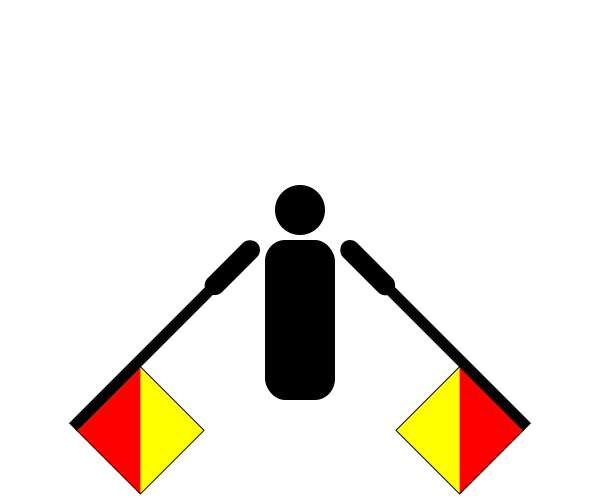

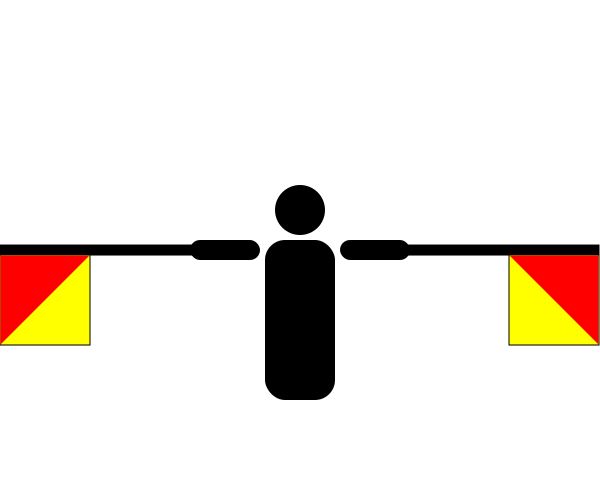

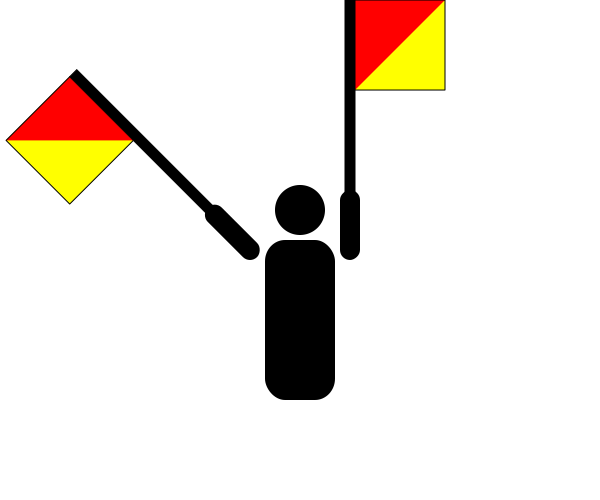

There are approximately 227 people named Landreth in the UK. That makes it one of Britain's least common surnames. Only around three in a million people in Britain are named Landreth.
Origin: Celtic
Region of origin: British Isles
Country of origin: Scotland
Religion of origin: Christian
Language of origin: Gaelic
